From Ashur to Nimrud and Nineveh, Assyrian rulers built an expanding empire. Dated monuments, inscriptions and museum collections reveal how conquest, administration and royal imagery worked together.
Ashur and the changing scale of power
Assyria developed around Ashur on the Tigris in northern Mesopotamia. The city supported a trading network in the early second millennium BCE, long before the great conquests of the first millennium. After a period of dependence on Mitanni, Ashur-uballit I, who ruled approximately 1365–1330 BCE, renewed Assyrian expansion. Historians distinguish this Middle Assyrian phase from the later Neo-Assyrian empire: their territories and political circumstances changed considerably. [1] These distinctions help place the monuments in time rather than treating every Assyrian object as evidence for one unchanging state.
Nimrud, Khorsabad and Nineveh
Ashurnasirpal II moved the royal capital to Nimrud, ancient Kalhu, in 879 BCE. Sargon II later built a new capital at Khorsabad, or Dur-Sharrukin. His successor Sennacherib developed Nineveh as his capital. [4] Ashur retained religious significance while these other royal centres expanded. [1] The sequence matters when identifying a palace relief: a monument from Ashurnasirpal’s Nimrud belongs to a different reign and building project from a campaign panel commissioned by Sennacherib at Nineveh. A single label such as “Assyrian palace” can obscure those differences.
Conquest and provincial government
Assyrian armies brought booty and tribute from conquered territories. Governors installed in defeated capitals helped extend royal authority, while mass deportations forcibly uprooted populations. These were coercive instruments of empire, not simply voluntary migration. Under Sargon II, the use of alphabetic Aramaic on leather or papyrus spread alongside changing sealing practices. [4] Military campaigns, provincial rule, forced movement and written administration therefore belong in the same account. The prominence of kings in surviving palace imagery should not hide the people whose labour, property and homes were affected by expansion.
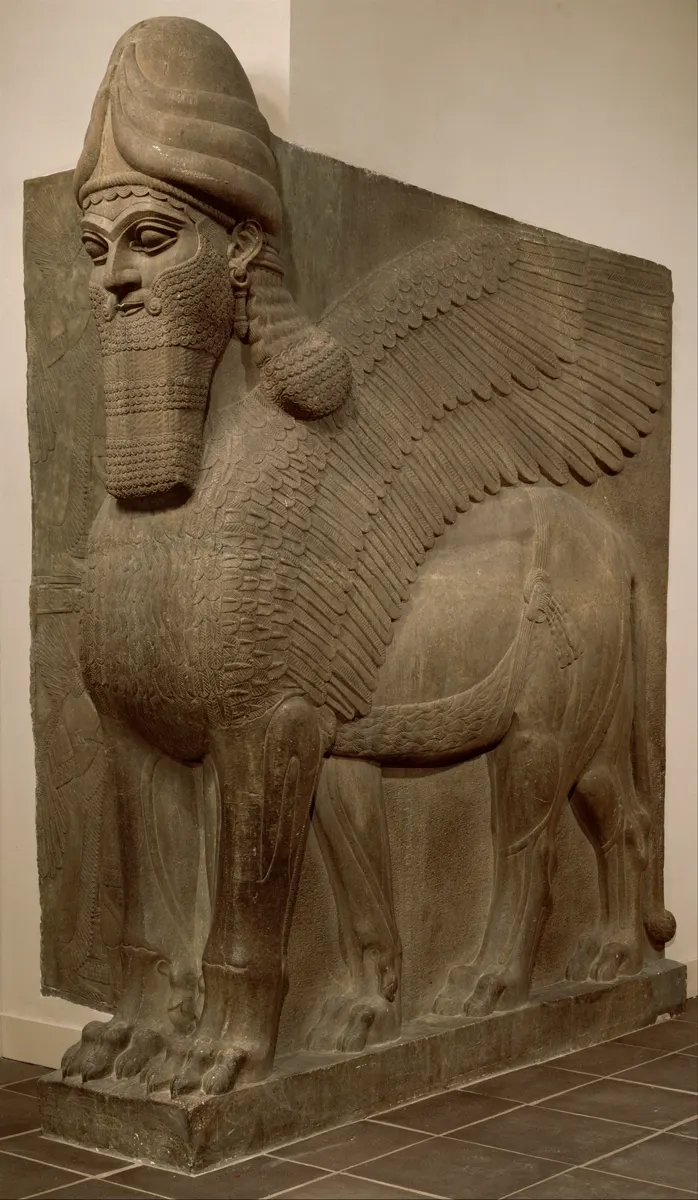
Reading the lamassu in the photograph
The Met dates this human-headed winged lion to the reign of Ashurnasirpal II and identifies its material as gypsum alabaster. Such guardians occupied important palace doorways. Its horned cap marks a divine being; its belt signifies power. Five legs solve a visual problem: from the front it appears planted firmly, while from the side it seems to advance. [2] This is architectural sculpture designed for approaching viewers, rather than a representation of a real animal. Looking at the doorway function explains the unusual anatomy more clearly than treating it as an artistic mistake.
A relief can preserve both ritual and royal claims
A separate gypsum relief in Princeton University Art Museum, object y207, comes from Ashurnasirpal II’s palace at Kalhu. It shows a winged male figure, an apkallu or sage, and once belonged to a larger throne-room frieze. The museum reconstructs a pairing around a king or sacred tree. A cuneiform text crosses the figure and recounts royal titles, campaigns and palace construction. [3] The carved body and written text make different contributions to the same setting. The inscription records how a ruler presented his achievements; it is not an independent verdict on every royal claim.
Expansion and the end of imperial rule
Later rulers campaigned far beyond the northern Mesopotamian heartland. Esarhaddon captured Memphis in Egypt in 671 BCE, and Ashurbanipal fought in Egypt, Babylonia and Elam. At the end of the seventh century, Babylonian and Median attacks brought down the empire; Nineveh fell in 612 BCE. [1] Surviving monuments allow us to study the court’s religious and political language alongside conquest. Distinguishing an ancient royal government, its subjects and its official self-image also prevents a history of that government from becoming a judgement about present-day communities.
Sources and further reading
- Department of Ancient Near Eastern Art, Metropolitan Museum of Art, “Assyria, 1365–609 B.C.” (2004; revised 2010): chronology and expansion.
- Metropolitan Museum of Art, “Human-headed winged lion (lamassu)”, ca. 883–859 BCE, 32.143.2: object record and public-domain image.
- Princeton University Art Museum, “Relief of a winged genie (apkallu), from the palace of Ashurnasirpal II”, ca. 883–859 BCE, y207.
- Metropolitan Museum of Art, “Mesopotamia, 1000 B.C.–1 A.D.” (2000): capitals, deportation, tribute and Aramaic writing.