Mirza Mohammad Reza Kalhor connected Persian calligraphy with lithographic publishing. His printed commissions, teaching and surviving siyah-mashq sheets show how inherited forms could be adapted.

A Kurdish artist within Persian calligraphic culture
Mirza Mohammad Reza Kalhor, generally dated 1829–1892, was a calligrapher from the Kalhor community of the Kermanshah region. His career belongs to the artistic and publishing history of Qajar Iran. [1] [2] His Kurdish background and his work in Persian calligraphy describe different aspects of the same life. Named teachers, earlier models, commissions and surviving pages give a more useful account of how he developed his practice.
Training meant studying earlier work closely
Kalhor studied with Mirza Mohammad Khvansari and subsequently worked from the calligraphy of Mir Emad. Ekhtiar describes repeated copying of inscriptions associated with Mir Emad, including the inscription at Mir Fendereski’s tomb in Isfahan. [1] The distinction matters: an artist who died in 1615 could be a model, not a living teacher of a nineteenth-century calligrapher. Training through exemplars connects generations without requiring personal contact. Reed’s anthology also situates his practice within both nastaʿliq and shekasteh traditions. [2]
Why lithography could preserve the written hand
Olimpiada Shcheglova’s history explains why lithography prospered in Iran: comparatively simple equipment, an existing body of trained copyists and a strong calligraphic culture. Lithographed books retained much of the handwritten codex’s appearance while costing less than manuscripts. By the late 1840s several Tehran presses were producing books regularly. [3] This was a setting in which writing could become a reproducible publishing resource. It avoids the misleading assumption that print necessarily replaced the calligrapher. The printed book still involved choices about lettering, layout, borders, correction and the organisation of a page.
The changes were specific to the letter and line
Ekhtiar identifies compacting and stacking words, smaller letters and dots, and thicker shafts and curves as features of Kalhor’s adaptation to lithography. [1] These are concrete decisions about proportion and page density, not simply a claim that he made writing modern. When comparing a specimen, readers can look at the spacing between words, the relationship of small marks to broad strokes, and the balance between the written area and its frame. Such observation is more informative than assuming every bold piece of nastaʿliq must be his work.
Royal work without a permanent bureau appointment
Ekhtiar distinguishes Kalhor’s private practice and occasional work for the publications bureau from a permanent appointment he declined. In 1883 he transcribed twelve issues of Ordu-ye homayun during the royal journey to Khorasan. [1] A journal commission is not the same as authorship of everything the journal contains. Likewise, the date of a modern facsimile does not date the nineteenth-century writing. His work connects calligraphic labour to the practical demands of serial publication as well as to the more familiar individual album sheet.
Look at a surviving siyah-mashq sheet
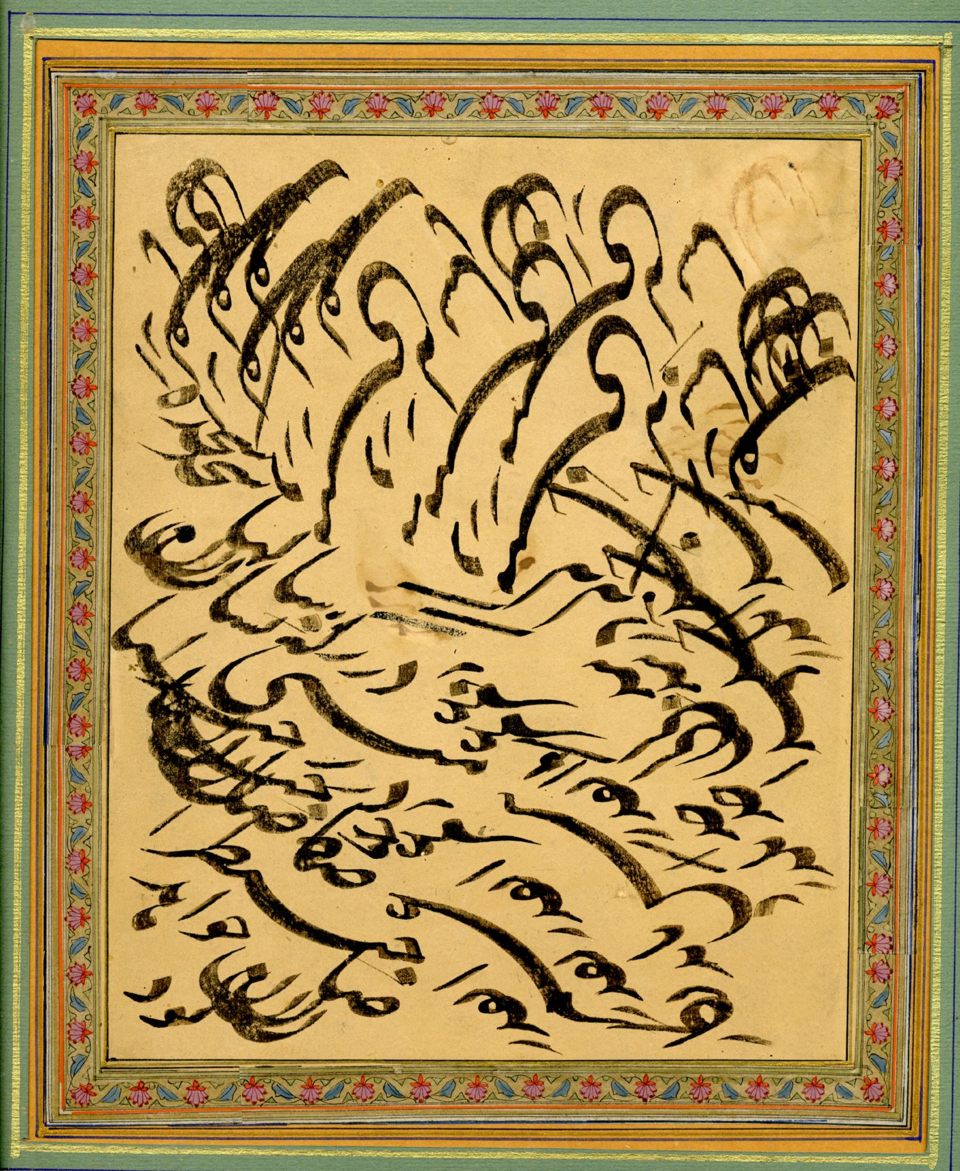
The illustrated sheet has black forms moving diagonally over cream paper, enclosed by thin coloured rules and a floral border. [5] Reed identifies it as siyah mashq from the Archive of Iran’s Association of Calligraphers. Its glossary describes repeated letters and words, first a hand exercise and later an independent artistic form. [4] The image makes repetition and the contrast of thick and thin strokes visible. It should not be treated as a conventional paragraph, an authenticated complete poem, or proof of the order in which every stroke was made. The catalogue does not supply a precise creation date for this sheet.
Teaching extended the practice beyond one career
Reed names pupils including Zayn-al-Abedin Sharif Qazvini, Morteza Najmabadi and Morteza Borghani, and records Kalhor’s death in Tehran in 1892. [2] That identifies a route through which a style could continue: students, exemplars and published writing. It is different from proving that a particular modern font directly reproduces his hand. Readers comparing works should ask who wrote the text, who composed its words, when it was copied or printed, and which institution identifies the surviving object. Those questions keep artistic achievement connected to evidence.
Sources and further reading
- Maryam Ekhtiar, Kalhor, Mirza Mohammad-Reza, Encyclopaedia Iranica, published 2010, updated 2018; biography, lithographic adaptations and royal commissions.
- Reed College, Anthology of Iranian Masters of Calligraphy, Mohammad Reza Kalhor; biography, practice, pupils and death.
- Olimpiada P. Shcheglova, Lithography i. In Persia, Encyclopaedia Iranica, 2009, updated 2021; selected printing-history discussion.
- Reed College, Kalhor siyah-mashq sheet, Archive of Iran’s Association of Calligraphers; object identification and glossary.
- Mirza Mohammad Reza Kalhor, Siyah Mashq; Archive of Iran’s Association of Calligraphers via Reed College and Wikimedia Commons. Faithful reproduction of public-domain art.