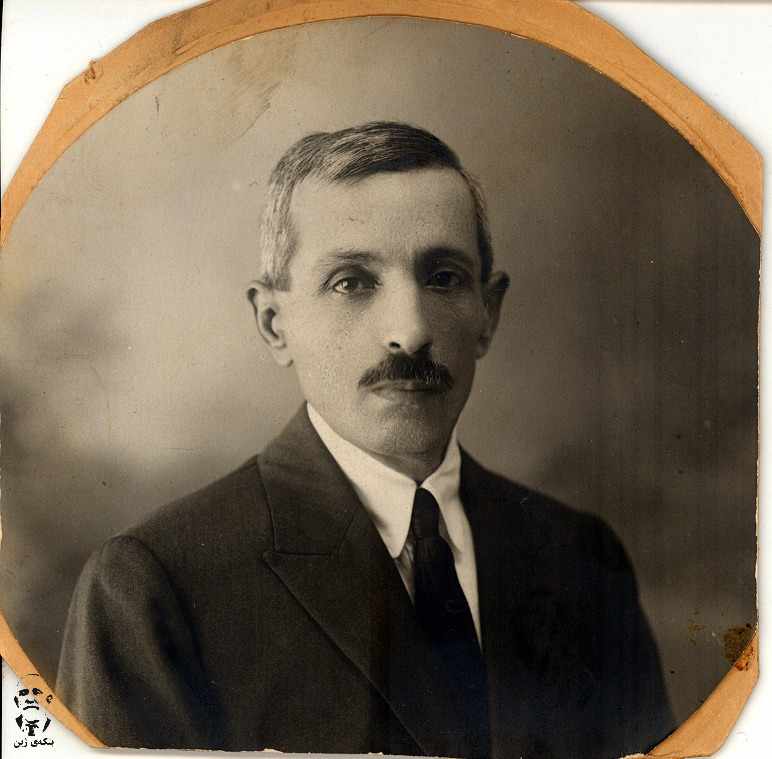
Muhammad Amin Zaki combined military and ministerial service with writing Kurdish history. His books, the surviving administrative record and later scholarly readings reveal both his research methods and his political outlook.

Education and military service
Muhammad Amin Zaki, also known as Mehmed Emin Zekî Bey, was born in Sulaymaniyah in 1880. Ahmet Özel’s scholarly biography traces his education from a Persian-language madrasa through military schools in Sulaymaniyah and Baghdad to Istanbul’s military academy, from which he graduated in 1902. His Ottoman career included mapping and boundary work, followed by wartime service in Iraq and Palestine and work in the military-history department after the war. [1]
Minister and senator in Iraq
The British Foreign Office’s 1947 “Leading Personalities in Iraq” records Zaki’s appointment as minister for communications and works in November 1926 and subsequent education and defence portfolios. It also lists later economics and communications appointments, resignations because of ill health in 1940 and 1942, and his appointment as senator in December 1943. The same page identifies Muhammad Hassan Kubba as the president of the Chamber of Deputies from December 1944. [2] These entries distinguish Zaki’s career from an office sometimes mistakenly assigned to him. The record’s judgments of his political influence are British officials’ assessments.
The fire and the return to research
Özel’s account, drawing on Zaki’s introduction, describes research in Istanbul and European libraries before the First World War. A fire in 1919 destroyed his documents and about two hundred pages already written. He initially abandoned the project. After returning to Baghdad, reading Vladimir Minorsky’s encyclopaedia article on the Kurds in 1929 encouraged him to begin again, re-examining available references and other books. [1] The reconstruction involved renewed reading and source collection; reducing it to a work composed entirely from memory obscures that process.
The history and its circulation
His major Kurdish work, commonly rendered A Brief History of the Kurds and Kurdistan, appeared in Baghdad in two volumes in 1931 and 1937. Rafiq Salih, director of publications at the Zheen Center, distinguishes the general history from the second volume on Kurdish states and principalities. He also lists Zaki’s history of Sulaymaniyah, biographical writings and Ottoman military histories. [3] Translation extended the readership: Arabic Collections Online identifies Muhammad Ali Awni as translator of its digitized Arabic edition, held by the American University in Cairo and catalogued as a 1936 printing. [4]
How Zaki understood historical writing
Abbas Vali examines Zaki’s own explanation for writing history: the replacement of Ottoman identification by Turkish nationalism prompted questions about Kurdish origins and the absence of Kurdish history from his education. Vali reads the resulting work as an attempt to bridge an Ottoman past and an Iraqi Kurdish present. He also discusses Zaki’s criticism of rivalries among traditional leaders and his emphasis on knowledge and economic resources as conditions for successful political independence. [5] This interpretation places Zaki’s scholarship within debates about modernization and political leadership, while preserving the difference between the historian’s argument and a later scholar’s analysis.
Rights advocacy and a wider written legacy
Salih dates Two Futile Attempts to Baghdad in 1935 and reports its censorship over criticism of government policy toward the Kurds. His bibliography also records a 1929 report on the Iraqi army. [3] These works connect Zaki’s historical research with parliamentary accountability, administration and Kurdish rights. He died in 1948. [1] His legacy can be approached through these different kinds of writing, each with its own audience and purpose.
Sources and further reading
- Ahmet Özel, “Mehmed Emin Zekî Bey,” TDV İslâm Ansiklopedisi (2019): biography and account of the history’s preparation.
- British Foreign Office, “Leading Personalities in Iraq, 1947,” entries 77–78, printed p. 19; British Library IOR/R/15/6/392, f. 30r, Qatar Digital Library.
- Rafiq Salih, “Pioneers of Kurdish Legacy: Muhammad Amin Zaki,” Kurdistan Chronicle, 29 September 2024; author identified as Director General of Zheen Center Publication.
- Arabic Collections Online, American University in Cairo copy of Khulāṣat tārīkh al-Kurd wa-Kurdistān, translated by Muhammad Ali Awni, Maṭbaʿat al-Saʿādah; catalogue dates the printing to 1936.
- Abbas Vali, “Genealogies of the Kurds: Constructions of Nation and National Identity in Kurdish Historical Writing,” especially pp. 77–81: analysis and translated passages from Zaki.