Nalî’s nineteenth-century Central Kurdish poetry rewards close reading: a defence of writing in Kurdish, a night of separation and a verse message carried by the wind. His texts and edited collections give firmer ground than imagined childhood scenes or a single political meaning imposed on every poem.
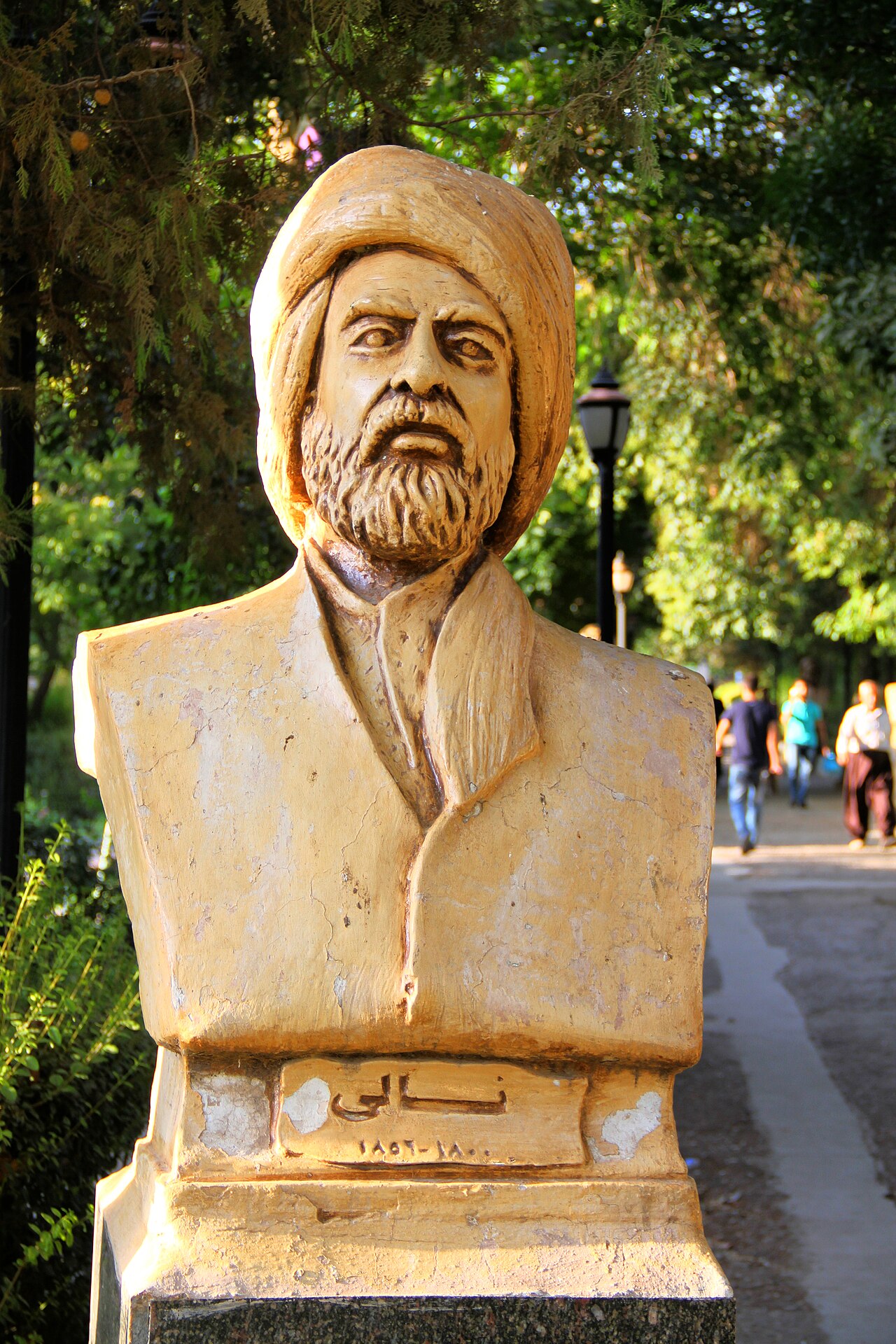

A nineteenth-century life with disputed dates
The Manchester–Slemani anthology identifies Nalî as Khidr Ahmed Shawaisi Mikayali, raised in Khak w Khol on the Sharazur plain. It gives alternative birth years of 1797 or 1800 and death years of 1855 or 1856. [1] VejinBooks instead uses 1800–1877. [2] The disagreement should remain visible. A precise lifespan cannot responsibly be inferred simply by choosing the most repeated date.
The Baban setting changed in stages
Sulaymaniyah’s Baban political setting did not disappear in one uncomplicated event in 1850. Wolfgang Behn’s account distinguishes the end of Baban autonomy in 1847 from the removal of its last district administrator in 1851. [3] This provides a dated setting for reading poems about the city and separation. It does not make every image a direct record of an Ottoman policy or establish that one event caused each journey in Nalî’s life.
A poem makes its own case for Kurdish
In Vejin’s text 19, the speaker treats composing in Kurdish as a deliberate test of poetic ability. He resists dismissing the work because of its language and asks readers to attend to meaning. Images of a skilled rider and valuable manuscript drafts turn poetic mastery into a competitive performance. [4] It defends Kurdish expression. It does not establish that Nalî standardised grammar or translated scientific works.
Yalda and the language of separation
Text 687 opens with the darkness of Yalda and the speaker’s distance from the beloved. Its comparisons include a dismissed governor, rulers whose power loses importance beside the beloved, and Mansur’s gallows. [5] Political and religious references intensify longing within a ghazal. They should be read as parts of the poem’s figurative argument, rather than automatic proof that the beloved always means a nation. Vejin identifies this poem’s metre as hazaj; its separate classification of text 19 as ramal also shows why one metre cannot describe the whole collection. [4]
The wind carries questions about a city
In text 702, the wind is asked to visit familiar waters, neighbourhoods, a lodge, a madrasa and the poet’s room. Sarchinar, Tanjaro and other named places make longing geographically precise. Repeated questions ask what remains flourishing and what has become desolate, before the speaker wonders whether to return. [6] The poem joins attachment to place with uncertainty about its condition. Its questions should not all be rewritten as eyewitness declarations that the feared damage had already occurred.
Editions and translation are part of the legacy
Vejin’s bibliography records an Urmia edition of 1985 and a fifth edition published in Sanandaj in 2001. Both name Mela Abdulkarim Mudarris and Fatih Abdulkarim for research and commentary, with review by Muhammad Mela Karim. [2] The 2021 anthology also provides the verse letter in English, translated by Tyler Fisher, Haidar Khezri, Alana Marie Levinson-LaBrosse and Shene Mohammed. [1] Edited texts, commentary and translation give readers ways to inspect the poetry, while the date of an edition remains distinct from a poem’s composition.
Sources and further reading
- Manchester and Slemani Cities of Literature, My Body Is Not Yours (2021), pp. 7, 34–39 and 340; Nalî, translation credits and biographical note.
- VejinBooks, Diwan of Nalî; Central Kurdish collection, dates and bibliography of the 1985 Urmia and 2001 Sanandaj editions.
- Wolfgang Behn, Bābān Dynasty, Encyclopaedia Iranica III/3 (1988), p. 307; the 1847 and 1851 transitions.
- Nalî, VejinBooks text 19; deliberate Kurdish composition, poetic self-defence and ramal metre. Original Central Kurdish consulted; analysis is paraphrase, not a verse translation.
- Nalî, VejinBooks text 687; Yalda, separation and figurative language; hazaj metre. Original Central Kurdish consulted.
- Nalî, VejinBooks text 702; verse address to the wind, Sulaymaniyah’s places and questions about return. Original Central Kurdish consulted.
- Diyar Muhammed, Nalî memorial bust in Sulaymaniyah’s public garden, 22 August 2015; Wikimedia Commons, CC BY-SA 4.0.