Kurdish clothing varies by region, generation and occasion. Documented Iranian examples, an Erbil museum display and contemporary makers show how garments combine local names, materials and changing practice.
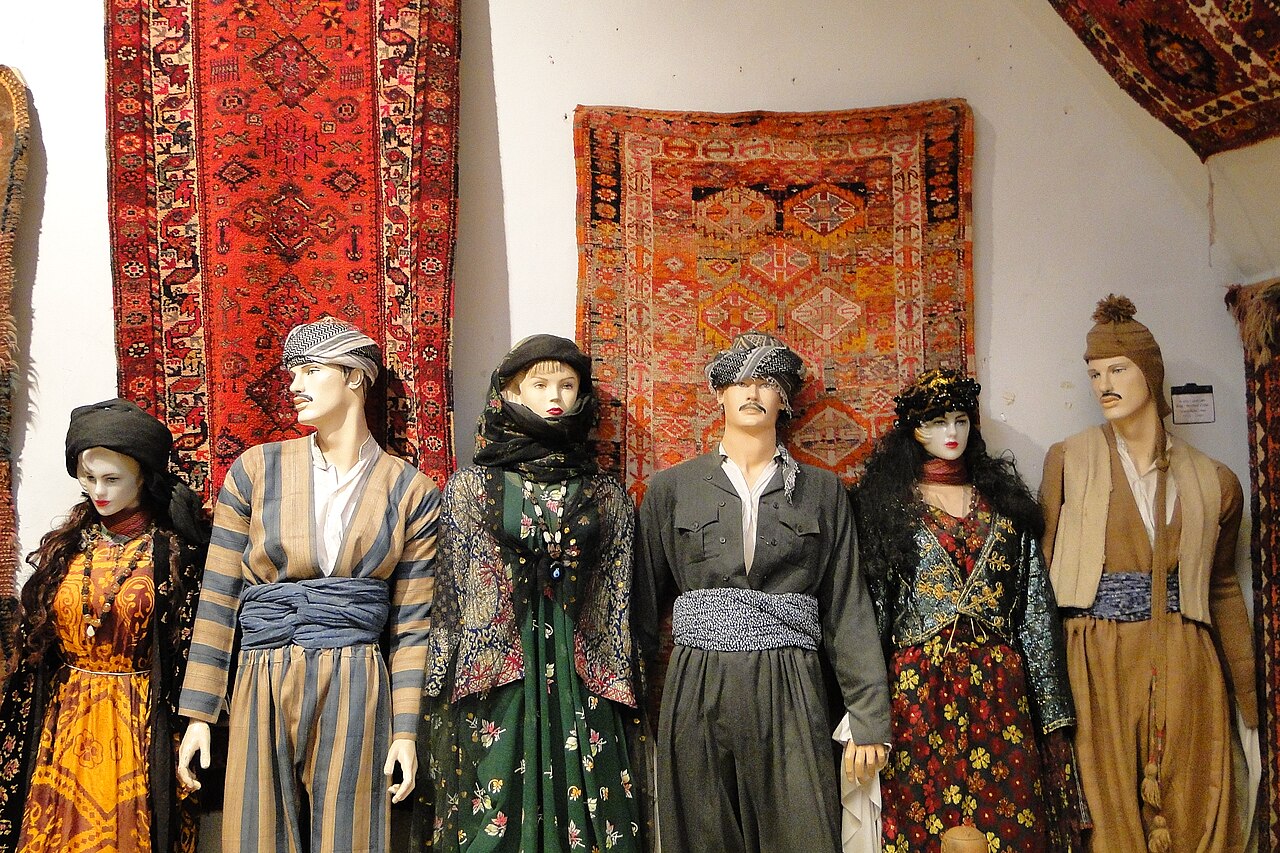

Regional examples, not one uniform
Andrews and Mohseni’s 1992 study distinguishes dress around Mahabad, Sanandaj, Kermanshah and Quchan. It records differences in cut, layers and headwear, as well as age, occasion and fabric weight. [1] Such dated regional descriptions are more useful than treating today’s state borders as four uniform costume traditions.
Garments and local names
In their account, Mahabad and Sanandaj women’s ensembles include dresses over trousers, jackets and distinctive headwear. Sanandaj examples add an open mantle; Kermanshah dresses lack the long sleeve extensions. Men’s examples combine a shirt, vest or jacket, trousers, sash and cap or turban. [1] The glossary summarizes selected terms from this account; spellings and usage vary.
| Term | Meaning |
|---|---|
| Kerās | Shirt or dress |
| Pāntol | Trousers |
| Sorāni | Long sleeve extension |
Materials, means and historical change
Andrews’s separate study of Azarbaijan describes Mîlan dress between Maku and Khoy using cotton print, silk brocade and velvet. It records coin-decorated waistcoats and explains that the number, quality and condition of garments could reflect a wearer’s means. The account notes distinct dress in the mid-1970s. [2] These observations provide a dated comparison of textiles and layers, without making any one colour a universal code for Kurdish status or identity.
Footwear and the people who make it
Klash belongs in this account alongside cloth garments. SEED’s 2022 For Every Woman exhibition profiles Jwan Yaseen Mohammad, who makes shoe uppers by hand and with knitting machines. Her account emphasizes income, customer trust and plans to expand her business. [3] Naming the maker and the part she produces makes the work visible, rather than presenting every traditional item as anonymous or unchanged.
Adaptation is also part of the story
The same exhibition describes Jwana Abubakir’s Nwe Conic project, which reworks donated clothing and incorporates everyday materials into new designs. [3] This is a documented example of creative reuse, not evidence that every contemporary design reproduces an ancient garment. The museum photograph likewise shows varied ensembles in one display. [4] Recording a garment’s place, date, maker, fabric and use preserves more information than colour alone and allows future comparisons between everyday wear, special occasions and museum collections.
Sources and further reading
- Peter Alford Andrews and Shirin Mohseni, “Clothing xvi. Kurdish clothing in Persia,” Encyclopaedia Iranica V/8 (1992), pp. 822–825; regional dress and terminology.
- Peter Alford Andrews, “Clothing xxi. Turkic and Kurdish clothing of Azarbaijan,” Encyclopaedia Iranica V/8 (1992), pp. 836–840; Kurdish costume, especially the Mîlan.
- SEED Foundation, For Every Woman, exhibition held in Erbil, 25 November–10 December 2022; profiles of Jwan Yaseen Mohammad and Jwana Abubakir.
- Adam Jones, Kurdish Costumes on Display — Kurdish Textile Museum — Erbil — Iraq, 16 April 2011; own photograph, Wikimedia Commons, CC BY-SA 3.0.