Feqiyê Teyran’s poetry makes water speak and turns familiar stories towards questions of love, knowledge and existence. Studies of named poems show how his Kurmanji writing connects Sufi thought with narrative and everyday imagery.
Water becomes a partner in thought
In Ey Av û Av, water is addressed as an interlocutor. Halil Akgül’s study examines the poem’s question-and-answer structure: the poet gives water human qualities and uses their dialogue to consider existence and divine wisdom. [1] Sami Çeliktaş’s close reading follows questions about restless movement, waves and the reason for water’s activity. The answers develop through the poem, turning a familiar natural phenomenon into a means of philosophical inquiry. [5] The dialogue gives readers a sequence of questions to follow.
Creation, the elements and contemplation
Akgül places the poem’s reasoning within a Sufi and Qur’anic framework. His interpretation discusses God as necessary being, the creation of water, earth, wind and fire, and the pursuit of spiritual knowledge through contemplation. [1] These four elements belong to the poem’s inherited philosophical vocabulary. Their role is to connect the visible world with reflection on its origin and meaning. Water’s movements become part of that reflection rather than remaining a decorative description of landscape.
Şêxê Sen’anî: a story transformed
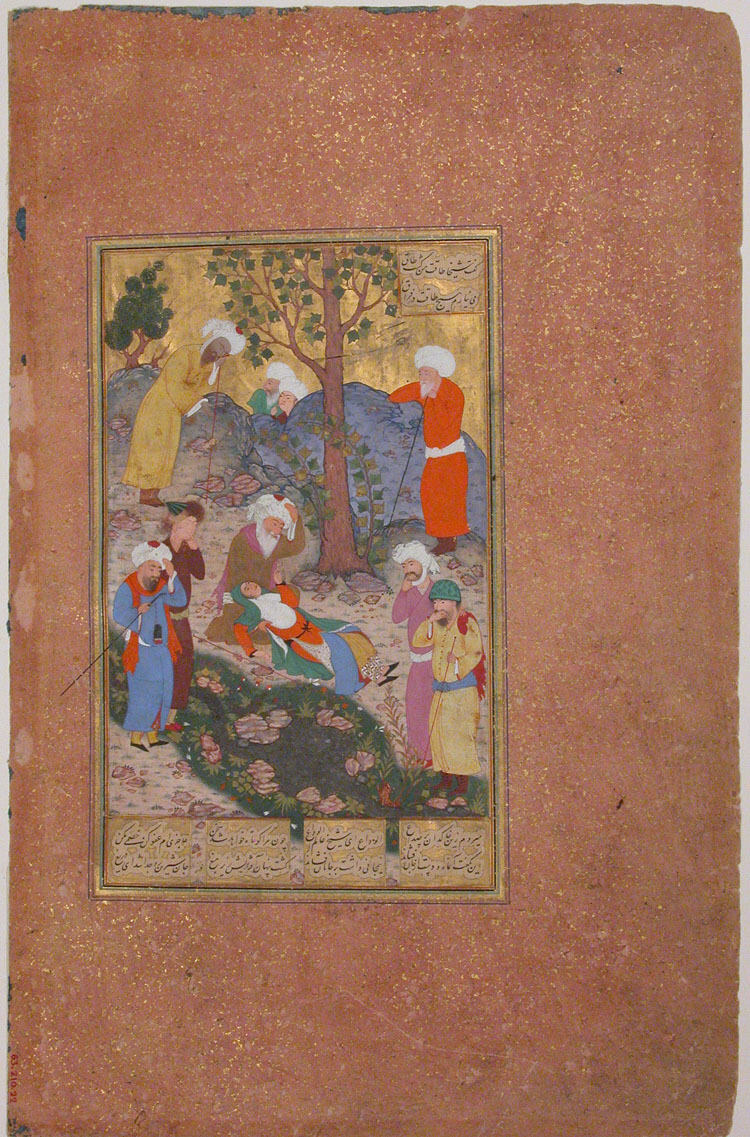
The story of the shaikh who loves a Christian woman circulated through Attar’s poetry and later adaptations. Mehmet Nur Yavuzer’s study examines Feqiyê Teyran’s Kurdish treatment as a transformation of tragic narrative. He reads the conflict between faith and love, and the lovers’ deaths, through a Sufi journey towards reunion and spiritual fulfilment. [3] This interpretation explains how plot and religious meaning work together. The manuscript illustration reproduced here belongs to Attar’s wider narrative tradition and provides a visual point of comparison. [6]
The poet’s intellectual materials
Önder Beyter organizes his study of Feqiyê Teyran’s intellectual sources around religion, society, humanity and nature. He identifies Islamic and Sufi thought alongside regional mythology, Iranian historical traditions and Kurdish history. [2] This range helps explain why the poems combine a river’s movement, familiar story characters and theological questions. Their materials come from several overlapping fields of knowledge and storytelling. Reading those connections gives more substance to the idea that the poet brought learning into accessible literary forms.
Influence as a literary argument
Ayhan Yıldız argues for a distinct place for Feqiyê Teyran in Kurmanji Sufi folk literature. His study links the poet’s vernacular style and religious approach with later writers, naming Bekir Begê Erizî, Feqî Reşîdê Hekarî and others. [4] This is a specific scholarly argument about literary history. It directs attention to shared forms, language and ideas when assessing influence, while encouraging readers to examine the later works themselves.
Reading across poetic traditions
Çeliktaş compares Ey Av û Av with Henry Vaughan’s The Waterfall. He examines how both poets address moving water and use it to reflect on creation, spiritual life and return to the divine. [5] The comparison offers a further route into Feqiyê Teyran’s work: begin with the concrete image, follow the speaking voice and questions, and then consider the religious meanings the poem develops.
Sources and further reading
- Halil Akgül, Tema û Hêmanên Felsefî di Ey Av û Av’a Feqiyê Teyran de, The Journal of Mesopotamian Studies, special issue, 2023.
- Önder Beyter, Çavkaniyên Hizrî yên Feqîyê Teyran, Nûbihar Akademî 22 (2024): intellectual sources.
- Mehmet Nur Yavuzer, A Sufi Poem from a Tragic Story: Example of Feqiyê Teyran’s Şêxê Sen’ani Poem, Anemon 13/3 (2025), pp. 1743–1766.
- Ayhan Yıldız, Şopa Feqîyê Teyran di Edebîyata Tesewufî de, Kurdiyat 8 (2023): Sufi folk literature and influence.
- Sami Çeliktaş, Water Metaphor in Henry Vaughan’s The Waterfall and Feqiyê Teyran’s Ey Av û Av Poems, Van Yüzüncü Yıl University social sciences journal, 2025, pp. 136–150.
- Metropolitan Museum of Art, Shaikh San’an and the Christian Maiden, folio 22v of Attar’s Mantiq al-Tayr, circa 1600, 63.210.22: collection record and public-domain image.