Saladin’s son al-Zahir Ghazi ruled Aleppo from 1186 to 1216. His history connects changing Ayyubid alliances, major defensive works, urban institutions and the limits of courtly protection for scholars.
An Aleppo emir, not governor of every allied city
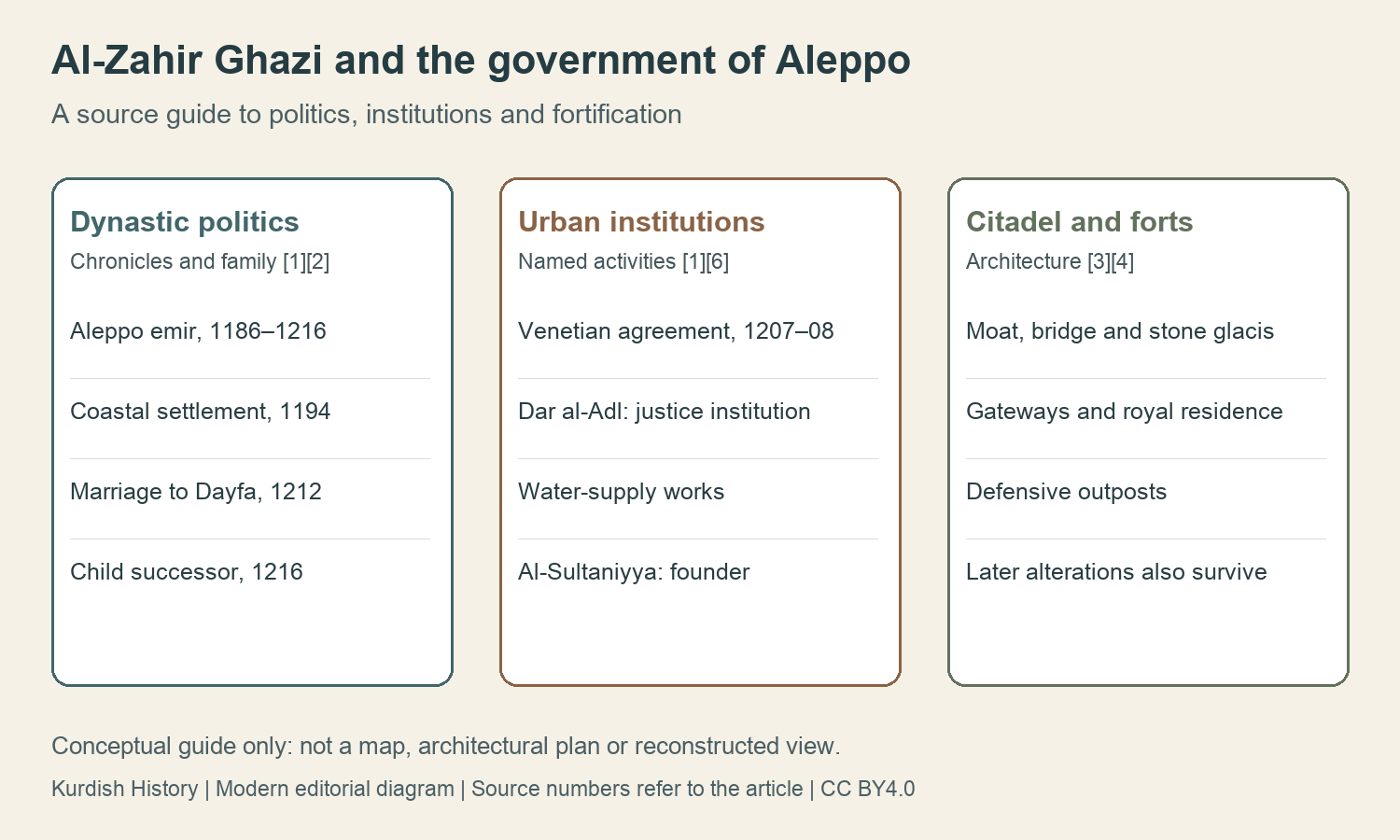
Al-Zahir Ghazi was Saladin’s son and ruler of the Ayyubid branch at Aleppo from 1186 to 1216. Abdülkerim Özaydın’s biography distinguishes his Syrian principality from the other rulers with whom he negotiated. It identifies Arslanshah as Mosul’s separate emir, involved in alliances with al-Zahir; that does not make Mosul part of al-Zahir’s own government. [1] The Ayyubid family distributed power among several centres. A shared dynasty did not erase territorial interests or make every local emir the deputy of a single unchanging central administration. This distinction is essential when following a campaign: an ally, superior, rival and subject are different political relationships.
Family diplomacy repeatedly changed direction
Özaydın records the 1194 settlement assigning Jabla and Latakia to al-Zahir, later cooperation with al-Afdal against al-Adil and eventual recognition of al-Adil’s superior position. [1] In 1212 al-Zahir married al-Adil’s daughter Dayfa Khatun. El-Azhari’s study places their son al-Aziz’s birth in 1213. [2] The marriage joined first cousins from competing branches; it was a political connection rather than proof that rivalry had disappeared. Presenting al-Adil simply as a consistently helpful uncle would flatten a changing relationship. The history is better followed through specific agreements, submissions and marriages than through assertions that al-Zahir always pursued one strategy.
The citadel: defence and royal residence
The Museum With No Frontiers catalogue attributes major changes to al-Zahir: the moat, bridge, stone-covered slope or glacis, towers, gateway and royal palace complex. It also distinguishes earlier work under Nur al-Din and later alterations under other rulers. [3] Yasser Tabbaa’s published chapter abstract describes a wider programme of rebuilt or new fortresses as protective outposts for the capital, with recurring features in their entrances and palaces. [4] The citadel should therefore be read as part of a defensive and administrative system, not as an entirely new building erected by one man. Surviving fabric records more than one period, and a general attribution does not date every visible stone.
Trade, water and named institutions
Özaydın records a Venetian agreement in 1207–08, water-supply works and a dar al-adl, an institution for hearing important legal matters. [1] The Getty’s catalogue identifies al-Zahir as founder and Tughril as patron of the al-Sultaniyya madrasa. [6] These are concrete activities and named responsibilities. They support a discussion of how commerce, government and religious patronage interacted. They do not supply an agricultural time series, a measured 30% production increase or a survey of universal public approval. Courts and madrasas also involved officials, teachers, builders and later patrons whose work should remain visible alongside the emir.
Suhrawardi shows the limits of patronage
The philosopher Shihab al-Din al-Suhrawardi gained access to al-Zahir’s court and his favour. Roxanne Marcotte’s Stanford Encyclopedia of Philosophy entry explains the subsequent combination of religious accusations and political concerns, and notes disagreement over the precise charges and sequence leading to his execution in 1191 or early 1192. [5] Özaydın describes the order coming from Saladin and its implementation by al-Zahir. [1] Patronage could therefore coexist with imprisonment and killing. Neither a wholly tolerant cultural haven nor a single uncontested explanation of the execution captures the evidence. An accusation made by opponents should be reported as an accusation, not adopted as a historical verdict on the philosopher’s beliefs.
A child successor and a continuing household
Al-Zahir died in 1216. His young son al-Aziz Muhammad succeeded, with the atabeg Tughril exercising the principal regency until 1231. Dayfa’s own regency came later, after al-Aziz died in 1236 and her grandson al-Nasir Yusuf inherited. [2] These were different transfers of authority. Al-Zahir’s buildings, officers and family connections continued into succeeding reigns, but that continuity does not make every later project his commission. His significance lies in the relationships between a local princely court, its fortified landscape, civic institutions and the wider Ayyubid family. Each can be investigated through named records rather than an invented record of uniform prosperity.
Sources and further reading
- Abdülkerim Özaydın, el-Melikü’z-Zâhir, Gāzî, TDV İslâm Ansiklopedisi(2004). Biography, alliances, Venetian agreement, civic works and Suhrawardi.
- Taef Kamal El-Azhari, Dayfa Khatun, Ayyubid Queen of Aleppo:634–640 AH/1236–1242 AD, Annals of Japan Association for Middle East Studies 15(2000), pp.27–55, especially 30–32. DOI 10.24498/ajames.15.0_27.
- Zena Takieddine, Samer Abd al-Ghafour and Abd al-Razzaq Moaz, Citadel of Aleppo, Discover Islamic Art, Museum With No Frontiers. Architectural phases and patronage; not a present-condition survey.
- Yasser Tabbaa, Defending Ayyubid Aleppo: The Fortifications of Al-Zahir Ghazi(1186–1216), in The Production of Meaning in Islamic Architecture and Ornament(2021), pp.94–104. Published abstract consulted, not the restricted full chapter.
- Roxanne Marcotte, Suhrawardi, Stanford Encyclopedia of Philosophy, section 1.1, Life, revised 2019. Court relationships and disputed circumstances of execution.
- Getty Cultural Objects Names Authority, Madrasa al-Sultaniyya, record 700078736. Founder al-Zahir Ghazi; patron Shihab al-Din Tughril.