Urartu was an Iron Age kingdom centred on Lake Van. Its fortresses, canals, inscriptions and metalwork illuminate highland history; they do not establish a direct, exclusive genealogy for a modern people.
A kingdom centred on Lake Van
Urartu was an Iron Age state whose capital, Tušpa, occupied the Rock of Van on Lake Van’s eastern shore. Its major surviving monuments belong to the ninth–seventh centuries BCE. [1] Its rulers extended their power into areas now within Armenia, northwestern Iran and Iraqi Kurdistan, as well as eastern Turkey. [2] Ancient power shifted over time: a map of royal campaigns is not a modern national boundary, and the places mentioned in an inscription were not necessarily all governed in the same way.
Read royal inscriptions as claims by rulers
The Sardursburg inscriptions at Van provide a concrete example. Six versions of Sarduri I’s text are written in Assyrian, celebrate his kingship and attribute construction with imported limestone blocks to him. The Urartian Monuments presentation identifies them as CTU A 1-1A–F and provides transliterations, translations and references. [3] They document royal building and self-presentation, rather than an impartial account of every inhabitant. Their survival also shows why language, script and state must be distinguished: an Urartian king could commission an Assyrian-language text.
Water, storage and the organisation of settlements
Fortified centres supported administration, agricultural storage and military control. The Met describes temples and large storerooms with vessels for grain and oil. [1] Menua’s canal south of Van offers another kind of evidence for government: a landscape-scale water project associated with a named ruler. Salvini describes its course and inscriptions and notes its continued use when writing his study. [2] Such evidence explains how the kingdom sustained settlement. It does not justify a single unsupported total for every ancient canal or a claim that all surviving masonry belongs to the same period.
Ḫaldi, Muṣaṣir and conflict with Assyria
Salvini discusses the Kelišin bilingual stele and the importance of Ḫaldi’s sanctuary at Muṣaṣir. His account also identifies the Meher Kapısı inscription’s ordered offerings to deities. [2] These connect religious institutions with royal power. The conflict with Assyria has dated anchors: Tiglath-pileser III’s victory against Sarduri II in 743 BCE and Sargon II’s sack of Muṣaṣir during his eighth campaign in 714 BCE. [2] A military reverse, a royal account of victory and the destruction of the entire kingdom are different events.
What an inscribed bronze object can reveal
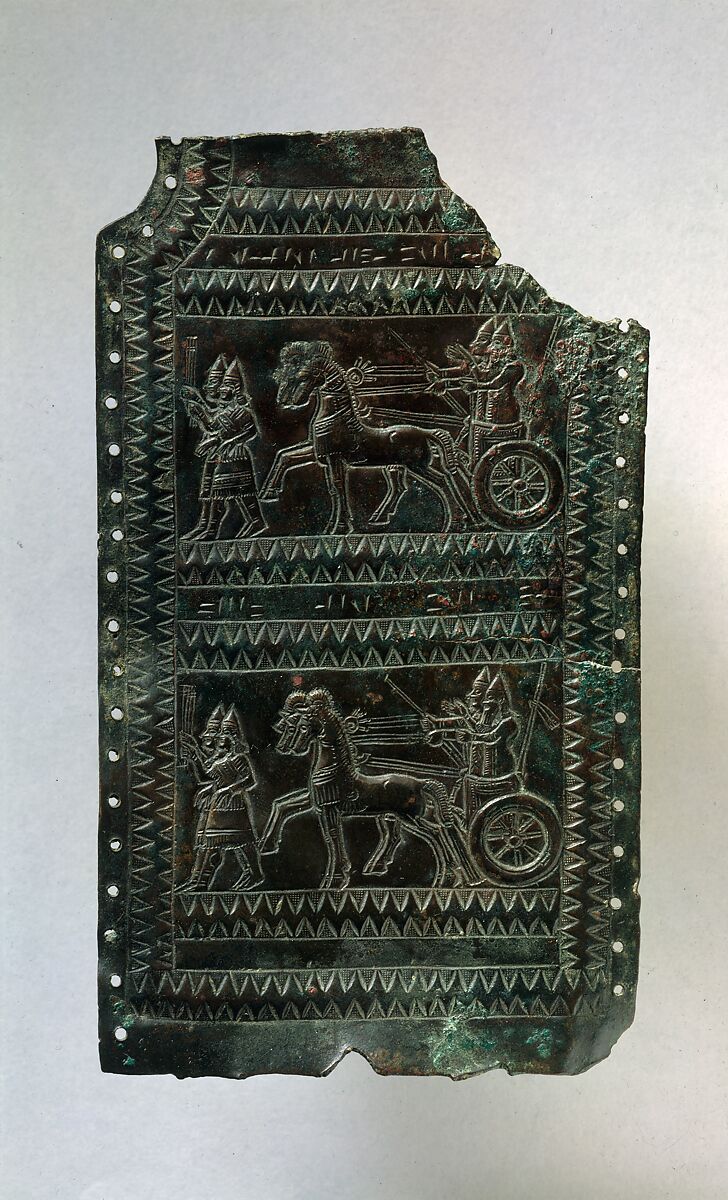
The illustrated plaque is a small, specific piece of evidence. The Met dates it to about 713–679 BCE, identifies two repeated processional scenes and reads its inscription as referring to Argishti’s arsenal. What the footmen carry is unknown. [4] A University of Hamburg project studies how Urartian metal inscriptions were physically made, comparing materials, tool marks and writing. Its 2026 description notes that many surviving inscribed metal objects lack secure archaeological provenance. [5] A museum label can identify an object without reconstructing its full original setting.
Why the kingdom’s end needs caution
The Met’s archaeological overview describes widespread destruction but treats its precise dating and the perpetrators as unresolved, discussing Scythians and Medes as possibilities. [1] That does not support a detailed narrative of Cyaxares capturing Tušpa in exactly 590 BCE, followed by a documented, peaceful merger of all elites. A destruction layer, a king’s last surviving inscription and the disappearance of a political system do not automatically supply the same date. An honest chronology identifies uncertainty instead of turning a proposed reconstruction into a witnessed event.
Regional heritage is not a direct ethnic pedigree
Salvini identifies Urartian’s relationship with Hurrian and cautions that the population composition of the state is not known. [2] Glottolog classifies Kurdish within Indo-European. [6] These are different language histories; geographic overlap does not establish that Urartian was an early form of Kurdish. Nor do shared symbols or broad population similarities, without a specific evidential argument, prove exclusive descent or the origin of a modern religion. Urartu matters to Kurdish regional history because its monuments and political networks formed part of the highlands’ past. Studying that past does not require denying its importance to Armenian history or to other communities that live with these sites.
Sources and further reading
- Department of Ancient Near Eastern Art, The Metropolitan Museum of Art, “Urartu,” October 2004; geography, settlements, writing and uncertain destruction chronology.
- Mirjo Salvini, “The Spread of the Cuneiform Culture to the Urartian North (IX–VII Century BCE),” Melammu (2014), chapter 14; selected historical and inscription discussions.
- Urartian Monuments, Van Kale inscriptions: Sardursburg CTU A 1-1A–F, transliterations, translation and references.
- The Metropolitan Museum of Art, plaque fragment with chariot scenes and royal name Argishti, object 1976.5; public-domain image.
- University of Hamburg, CSMC, “Urartian Inscribed Metalwork,” project description updated 22 April 2026.
- Glottolog 5.3, Kurdish language search record: Indo-European classification.