Uthman Siraj al-Din I was a nineteenth-century Naqshbandi-Khalidi teacher associated with Tawela and Biyara in Hawraman. His training and successors shaped a wider religious network.
A teacher in the Khalidi succession
Ferhad Shakely identifies Uthman Siraj al-Din I as a Tawela-born disciple of Mawlana Khalid and a leading figure in the Naqshbandi-Khalidi network of Hawraman. His account dates the birth to 1781. [1] This identifies a particular teacher and lineage, rather than an unspecified “Barzinja order.”
Education and authorisation to teach
Kavak traces his studies through local madrasas and Baghdad, near Abd al-Qadir al-Jilani’s shrine. He dates initiation by Mawlana Khalid to 1811 and authorisation to 1813. [2] Studying at a Qadiri-associated institution and receiving Naqshbandi authorisation describe different relationships; neither makes the two orders one family.
Biyara and Tawela as working institutions
Kavak describes Biyara as both madrasa and Sufi lodge, combining education and spiritual guidance. Uthman moved between Biyara and Tawela, settling at Tawela after 1856. He corresponded with Kake Sheikh Ahmad, a Qadiri of the Barzinji family. [2] That contact does not establish family membership. A shared region and correspondence cannot alone prove shared genealogy.
Connections across the Iranian border
Hamid Algar places the hereditary Khalidi line established at Biyara within the religious history of Iranian Kurdistan. Its lodge attracted followers from Mahabad, then called Savojbolagh, and Sanandaj, as well as Talesh in Gilan. Algar identifies Sheikh Ali of Anbaran as one of Uthman’s Taleshi deputies. [3] These named connections show how a local centre reached beyond a single settlement or present-day state boundary. They offer firmer evidence of influence than claims that the teacher controlled an entire region’s political life.
Writing, succession and namesakes
Shakely records letters, some poetry and advisory writings. An 1856 instruction appointed sons Muhammad Baha al-Din and Abd al-Rahman as successors; Baha al-Din succeeded him. He distinguishes Muhammad Uthman Siraj al-Din II (1896–1997), whose later travels and publications belong to a different life. [1]
A note on dates and evidence
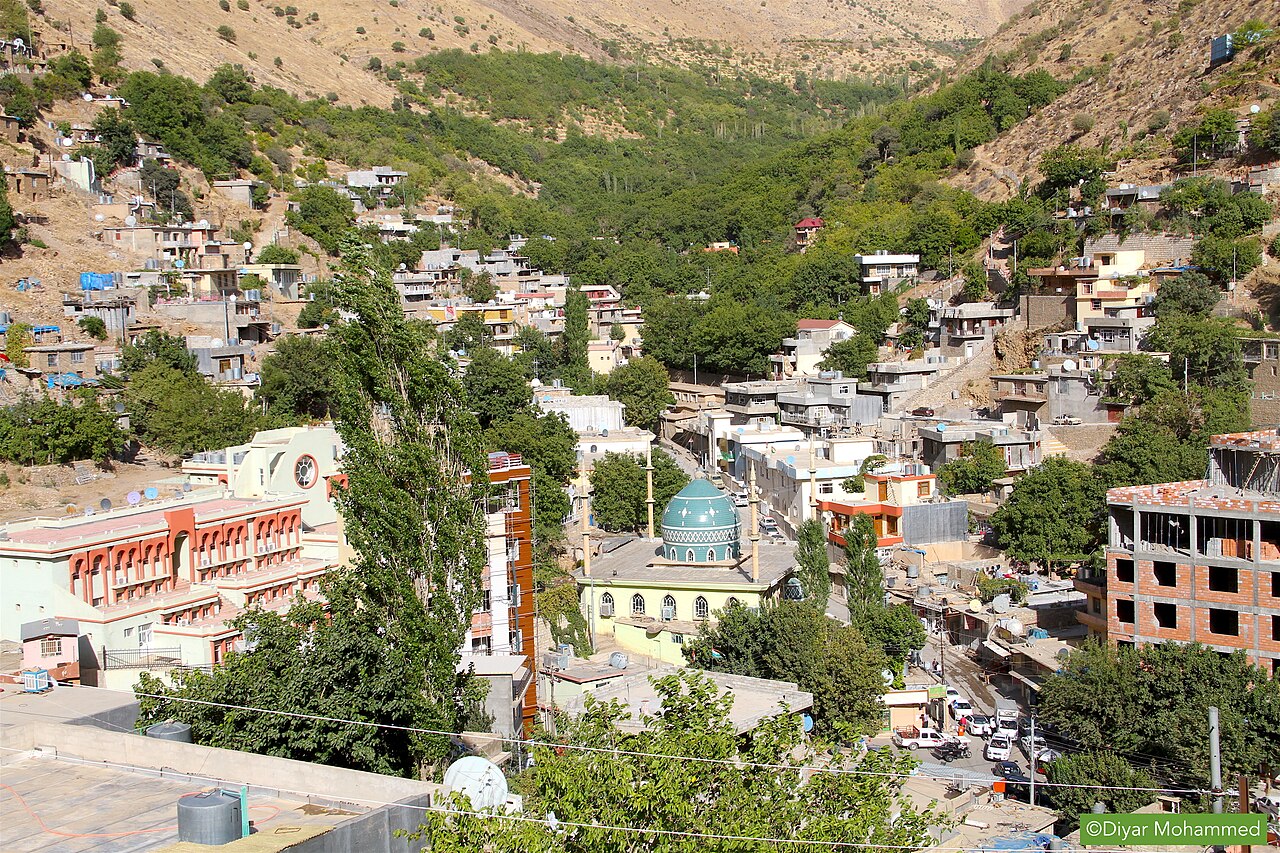
The studies agree on 1283 AH for Uthman I’s death, but render it differently: Shakely gives 1867, while Kavak gives 1866. [1] [2] The discrepancy is retained rather than silently resolved. Accounts of religious ancestry and saintly reputation should likewise be identified as traditions where appropriate. The photographed buildings date from a much later view of Tawela and cannot establish the appearance or age of each nineteenth-century institution. [4]
Sources and further reading
- Ferhad Shakely, The Naqshbandi Sheikhs of Hawraman and the Heritage of Khalidiyya-Mujaddidiyya in Kurdistan, in Elisabeth Özdalga, ed., Naqshbandis in Western and Central Asia (1999), especially pp. 92–94.
- Abdulcebbar Kavak, Mevlânâ Hâlid-i Bağdadî’nin Halifelerinden Şeyh Osman Siracüddin et-Tavîlî ve Biyâre Medresesi/Tekkesi, Atatürk Üniversitesi İlahiyat Fakültesi Dergisi 43 (2015), especially pp. 262–265.
- Hamid Algar, Iran ix (2.3): Shiʿism in Iran Since the Safavids, Encyclopaedia Iranica XIII/5 (2006), 456–474, updated 1 April 2016; Khalidi networks at Biyara.
- Diyar Mohammed Photography, Tawela village in Hawraman, 14 September 2016, Wikimedia Commons, CC BY-SA 4.0.