Harir is a town and plain in Erbil Province in the Kurdistan Region of Iraq. Archaeological fieldwork documents its settlements and monuments, while the nearby Batas-Herir relief preserves a royal image whose identity and date remain subjects of scholarly interpretation.

The town and its wider plain
Harir gives its name to a settlement area south of the Harir mountain range. Arthur Stefanski’s fieldwork account distinguishes the town from neighboring villages and the wider plain surveyed in 2016. [1] This distinction is useful: evidence found across several villages is not automatically the history of one continuous town. The monuments, scattered settlements and routes belong to a landscape with several centres of activity.
What the 2016 survey recorded
Stefanski reports intensive survey over about 42 square kilometres in the Harir valley. The season registered ninety-one sites, including twenty architectural features such as castles, mills and cemeteries, and six caves. Evidence extended from the Hassuna period through later medieval and modern times. Four transects he led near Darbandok, Barazan, Mamdi and neighboring villages produced thirteen sites with material from the third millennium BCE and later periods. [1] These are reported survey results. They do not supply a founding date for modern Harir or demonstrate that every period was represented at every location.
Roads through the foothills
Claudia Beuger and colleagues place the neighboring Khalifan landscape on the route from Erbil toward the Urmia region. Their 2015 field report notes the road’s improvement under A. M. Hamilton between 1928 and 1932, commissioned by the British authorities, and describes its setting between the Spilik pass and the Rawanduz river gorge. The report also connects the corridor with seasonal movement of pastoral communities. [2] The pass and gorge show how movement between the plain and the highlands depends on routes through sharply changing terrain.
Looking at the Batas-Herir relief
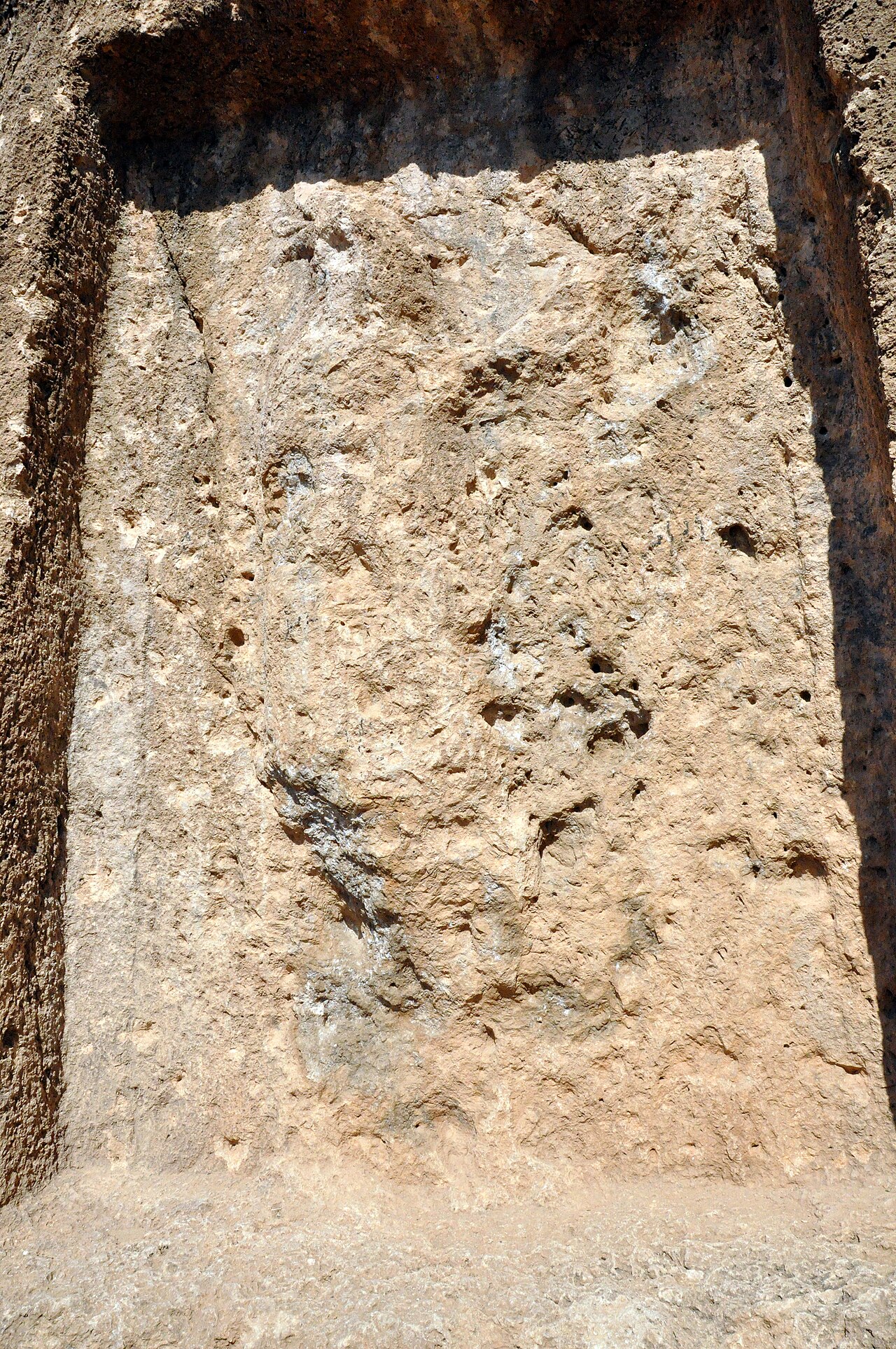
The relief near Batas shows a single standing figure within a rectangular frame cut into the cliff. Maciej Grabowski describes it as probably an Adiabenean ruler and gives the figure’s height as about 2.4 metres. His study considers posture, clothing, headdress and comparisons with other sculptures and coins. [3] In the accompanying 2014 photograph, the worn surface makes some details difficult to distinguish. A clear drawing can assist analysis, but it should not be mistaken for the present condition of the stone. [6]
Which ruler does it represent?
Grabowski challenges the older identification with Izates II and proposes Abdissares, using comparisons with the king’s coin portraits and headgear. His reconstruction is explicitly an argument from iconography and historical context. [3] Michał Marciak and Robert S. Wójcikowski’s 2016 study supports identification with Abdissar and places that ruler’s coinage in the first half of the second century BCE. They compare the conical tiara, broad diadem, raised flaps, short hair and beard. [4] This dating differs substantially from a first-century CE identification with Izates. A responsible caption should preserve the debate rather than assign one certain name and year to an uninscribed image.
A monument in its landscape
Zainab Bahrani’s Mapping Mesopotamian Monuments project includes Batas Harir among the rock-relief sites it documents. The project emphasizes on-site study: the cliff, approach, surrounding views and relationship with the terrain matter alongside the carved figure. Its work combines field documentation with digital recording and condition assessment. [5] Together with the settlement survey, this approach makes Harir more than a scenic gateway to the mountains. It is a place where different kinds of evidence—surface finds, buildings, roads and a carved royal image—answer different historical questions.
Sources and further reading
- Arthur Stefanski, Archaeological Survey in the Harir Plain, Erbil Province, Iraqi Kurdistan, conference abstract (March 2017), author-uploaded text reporting the 2016 field season.
- Claudia Beuger, Tobias Helms, Abdulwahhab Suleiman, Mustafa Abdulmuttleb Dlshad and Hidayet Hussein, Archäologische Forschungen im nordwestlichen Zagros: Vorläufige Ergebnisse aus den Feldbegehungen in Khalifan, MDOG 147 (2015), especially pp. 131–132.
- Maciej Grabowski, Abdissares of Adiabene and the Batas-Herir Relief, Światowit IX (L)/A (2011), pp. 117–140; competing identification and iconographic analysis.
- Michał Marciak and Robert S. Wójcikowski, Images of Kings of Adiabene: Numismatic and Sculptural Evidence, Iraq 78 (2016), pp. 79–101; DOI 10.1017/irq.2016.8.
- Zainab Bahrani, Rock Reliefs, Mapping Mesopotamian Monuments, Columbia University; on-site documentation and landscape context, including Batas Harir.
- Osama Shukir Muhammed Amin, Batas-Herir relief photograph, 26 September 2014, Wikimedia Commons; CC BY-SA 4.0. The file title’s identification is not treated as settled historical evidence.