A guide to Kurdish language rights, regional institutions, oil provisions and disputed territories, with dated UN records and legal sources.
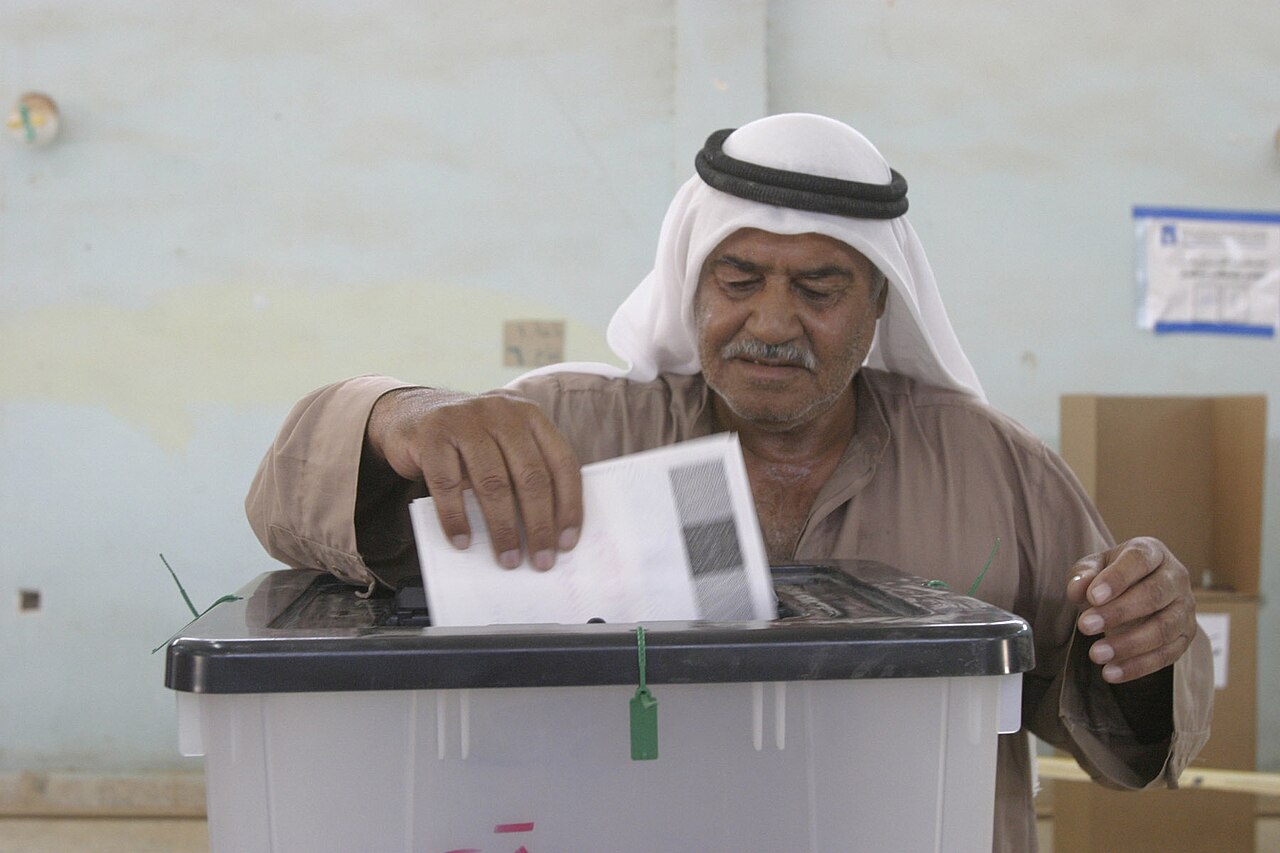

The 2005 referendum and its context
Iraq’s permanent constitution was approved in the national referendum of 15 October 2005. The Security Council recorded that approval in Resolution 1637 the following month. [1] Its preparation was contentious. In September, UN representative Ashraf Qazi identified federalism, the formation of additional regions, Islam’s role and the distribution of natural-resource powers as major negotiating issues. He also described severe time pressure and problems of inclusive participation following the January elections. The document emerged from that disputed transition, rather than from an agreement resolving every political question. [2]
Language and regional institutions
Article 4 makes Arabic and Kurdish official languages. Article 117 recognizes Kurdistan and its existing authorities as a federal region. Article 121 provides regional executive, legislative and judicial powers outside exclusive federal competences, and responsibility for internal security forces, including regional guards. Article 110 reserves foreign policy and national defence to federal authorities; regional self-government is not unrestricted sovereignty. Article 141 preserves regional legislation since 1992 and decisions, subject to constitutional compatibility. These provisions recognize existing institutions rather than creating Kurdish self-government from nothing in 2005. [3]
Article 140 and disputed territories
Article 140 continues the Transitional Administrative Law’s Article 58 process: normalization, a census and a referendum in Kirkuk and other disputed territories, with a deadline of 31 December 2007. [3] In a 2024 legal study, Sanh Sh. Qader discusses Decision 71/2019 as confirming that the provision remained applicable despite the missed deadline. The study also records government and parliamentary committees and continuing implementation obstacles. A missed deadline is therefore different from the legal disappearance of the provision; describing the entire process as having involved no action obscures those efforts. Qader’s analysis does not establish that the final referendum was completed. [4]
Oil: ownership, management and a court dispute
Article 111 assigns oil and gas to all Iraqis. Article 112 provides joint management of present fields and fair revenue distribution, regulated by law. [3] On 15 February 2022, the Federal Supreme Court ruled the Kurdistan Region’s oil and gas law unconstitutional in the joined cases 59/Federal/2012 and 110/Federal/2019. The court published notice of that decision. [5] The Kurdistan Region’s Judicial Council publicly disputed both the ruling’s constitutional authority and its interpretation of regional resource powers on 4 June 2022. That is the council’s stated position, not a neutral finding that the court ceased to exist. The disagreement concerns competing readings of the federal settlement. [6]
Why recognition required further implementation
In her Security Council briefing of 26 August 2020, UN representative Jeanine Hennis-Plasschaert described the constitution as establishing broad principles while leaving implementation to supporting legislation. She identified longstanding gaps over federal arrangements, resource distribution and disputed territories, while also noting a recent agreement concerning public salaries. This dated assessment helps explain why recognition did not automatically settle budgets, resource administration or territorial questions. It should not be converted into a claim that no agreements have ever existed or that all later arrangements are covered by a 2020 statement. [7]
Federal recognition and the secession question
Federal recognition also needs to be distinguished from a constitutional right to independence. On 7 November 2017, UNAMI reported the Federal Supreme Court’s interpretation of Article 1: the constitution guaranteed Iraq’s unity and contained no permission for its components to secede. UNAMI simultaneously called for negotiations respecting the Kurdistan Region’s constitutional rights. This record shows why the legal debate involved both regional guarantees and the boundaries of federal union. Neither part can be understood by treating the constitution solely as a promise of independence or solely as an instrument abolishing regional authority. [8]
Sources and further reading
- UN Security Council, Resolution 1637 (2005), adopted 8 November 2005; records approval of the constitution on 15 October.
- United Nations, Security Council briefing by Ashraf Jehangir Qazi, 21 September 2005, SC/8505; drafting timetable, participation and contested issues.
- Constitution of Iraq (2005), English text via Constitute; Articles 4, 110–112, 117, 121 and 140–141.
- Sanh Sh. Qader, From Domestic Mandates to International Responsibilities: Legal Strategies for Iraq’s Disputed Territories, KUJHSS 7/2 (2024), pp. 517–529, especially 520–522; DOI 10.14500/kujhss.v7n2y2024.pp517-529.
- Iraqi Federal Supreme Court, Notice about the decision that the Oil and Gas Law of Kurdistan Region is unconstitutional, 17 February 2022; decision of 15 February 2022.
- Judicial Council of the Kurdistan Region, statement of 4 June 2022, published by the KRG; the council’s position on oil powers and the Federal Supreme Court.
- Jeanine Hennis-Plasschaert, briefing to the Security Council, 26 August 2020; constitutional implementation and Baghdad–Erbil negotiations.
- UNAMI, statement of 7 November 2017 on the Federal Supreme Court’s Article 1 interpretation and Baghdad–Erbil negotiations.
- Lance Cpl. Shane S. Keller, U.S. Marine Corps, voter in Barwana, 15 October 2005, image 051015-M-7772K-021; public-domain government photograph via Wikimedia Commons.