Kawa’s revolt, the lovers Mem and Zîn, and the defenders of Dimdim belong to different kinds of storytelling. Their recorded versions reveal how literary works, oral performances and public celebrations carry changing ideas about justice, love and collective memory.
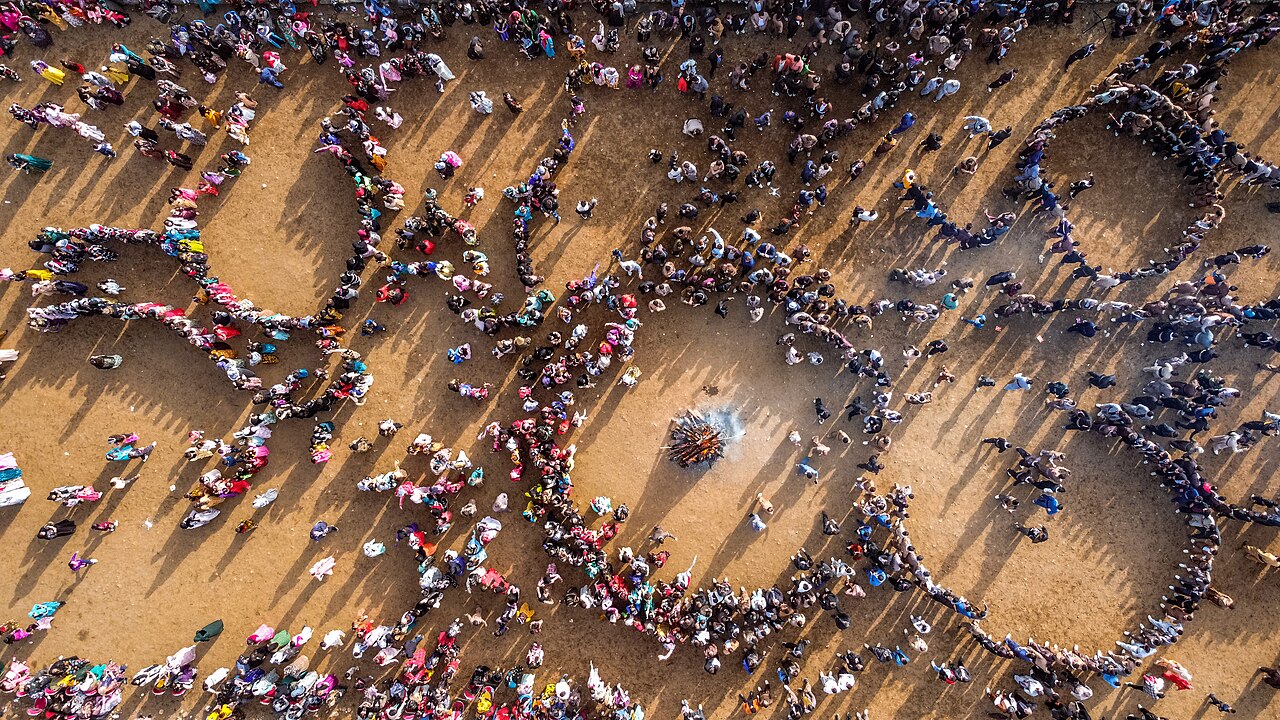

Kawa and the story of resistance to Zahhak
In the Shahnameh episode analysed by Mahmoud Omidsalar, the blacksmith Kawa confronts Zahhak after the ruler’s agents seize his son to feed the serpents on the king’s shoulders. Although the son is released, Kawa refuses to endorse a declaration praising the king’s justice and tears it apart. Outside the court, he raises his leather apron as a banner and leads supporters to Fereydun. [1] This version gives the smith a decisive role in rebellion while Fereydun ultimately defeats the tyrant. Omidsalar also identifies oral variants in which Kawa captures or kills Zahhak himself. The differences are part of the story’s transmission.
How Kawa became connected with Kurdish Newroz
Delal Aydin’s 2026 study traces the modern association between Kawa, Newroz fire and Kurdish political recognition through movement publications, party materials, state documents and press coverage. She argues that the link between the blacksmith and Newroz was developed through modern reinterpretation, rather than being present in the Shahnameh’s Kawa episode. [2] Her analysis follows changing uses of the story, including resistance to oppression and later appeals to shared life. Celebrations can therefore carry inherited images and meanings shaped by more recent political experience. A legend’s importance to a community does not establish every detail as an ancient historical event.
Mem û Zîn: love, obstruction and interpretation
Ehmedê Xanî’s late-seventeenth-century Kurmanji poem gives a particular literary form to the story of Mem and Zîn. Michiel Leezenberg describes their meeting during Newroz, the opposition encouraged by the prince’s counsellor Bekir, Mem’s imprisonment and the lovers’ deaths. [3] He also examines mystical love within the poem and its later interpretation as a Kurdish national epic. Reading the story solely as political symbolism leaves out its sustained attention to human and divine love. Its characters, narrative and religious vocabulary support more than one kind of reading. Naming the version matters when explaining what the story means.
Oral versions preserve a varied storytelling tradition
Michael Chyet’s 1991 dissertation compares eighteen oral versions of the romance and provides English translations. His research examines performance, poetic language, recurring motifs and regional patterns of variation. [4] This corpus makes the diversity visible: an oral tradition includes individual tellings and local forms, alongside the written poem associated with Xanî. A recording, transcription or translation preserves a particular telling, with its own circumstances. Readers looking for the story can therefore compare an edition of the poem with an identified oral version, rather than expecting every source to contain the same sequence of episodes.
Dimdim: a historical siege and its epic afterlife
Dimdim has a documented setting near Lake Urmia. Amir Hassanpour describes Amir Khan’s rebuilding of the fortress around 1609 and the Safavid siege from November 1609 to the summer of 1610, ending in its capture and the killing of the defenders. [5] He contrasts Safavid accounts presenting the conflict as rebellion with Kurdish traditions emphasising resistance to foreign domination. The story circulated in Kurmanji, Sorani and Armenian, with an early literary account attributed to Feqiyê Teyran. The siege and its later poetic retellings offer related kinds of evidence: one concerns the conflict’s chronology, the other how its protagonists were remembered.
Following the stories through their sources
These examples show why Kurdish storytelling benefits from attention to form and provenance. Kawa’s literary and oral variants allocate the victory differently; Mem and Zîn appear in a named author’s poem and a comparative corpus of oral performances; Dimdim connects a recorded siege with an epic tradition. [1] [3] [4] [5] The sources below provide specific starting points for exploring those differences. When discussing another version, identifying its narrator or author, language, collector and edition makes the comparison clearer and allows readers to follow the narrative themselves.
Sources and further reading
- Mahmoud Omidsalar, Kāva, Encyclopaedia Iranica XVI/2, 130–132, 2013, updated 2016; comparison of Shahnameh and oral narrative variants.
- Delal Aydin, The Making of Newroz: Intangible Cultural Heritage and Kurdish Ethnopolitical Mobilisation, International Journal of Heritage Studies, published online 24 August 2026, DOI 10.1080/13527258.2026.2723881.
- Michiel Leezenberg, “The Kurds Have Not Made Love Their Aim”: Love, Sexuality, Gender, and Drag in Ehmedê Xanî’s Mem û Zîn, IJMES 54/4, 705–724; online 27 January 2023; introduction and analysis.
- Michael Lewisohn Chyet, “And a Thornbush Sprang Up Between Them”: Studies on Mem û Zîn, a Kurdish Romance, PhD dissertation, University of California, Berkeley, 1991, vol. I; abstract, preface and comparative research framework.
- Amir Hassanpour, Dimdim, Encyclopaedia Iranica VII/4, 404–405, 1995, updated 2013; siege chronology and Kurdish oral and literary traditions.