Kurdish regional history connects places in Turkey, Iraq, Iran and Syria through settlement, language, political institutions and cultural exchange. Understanding the region requires attention to the different meanings of Kurdistan, the diversity of local landscapes and the dates of political arrangements.

What does Kurdistan mean in a regional description?
Kurdistan is used for a wider historical and cultural geography and for particular administrative territories. Kurdish communities are concentrated across parts of southeastern Turkey, northern Iraq, western Iran and northern Syria, with other communities beyond those areas. Martin van Bruinessen’s geographical introduction distinguishes the broader area from historical provinces bearing the name. He also notes that Iran’s Kurdistan Province covers only part of its Kurdish-inhabited territory. [1] A place-name therefore needs context: a historical writer, a provincial administration and a modern political movement may use the same word with different territorial reference points.
Mountains, valleys and a documented cultural landscape
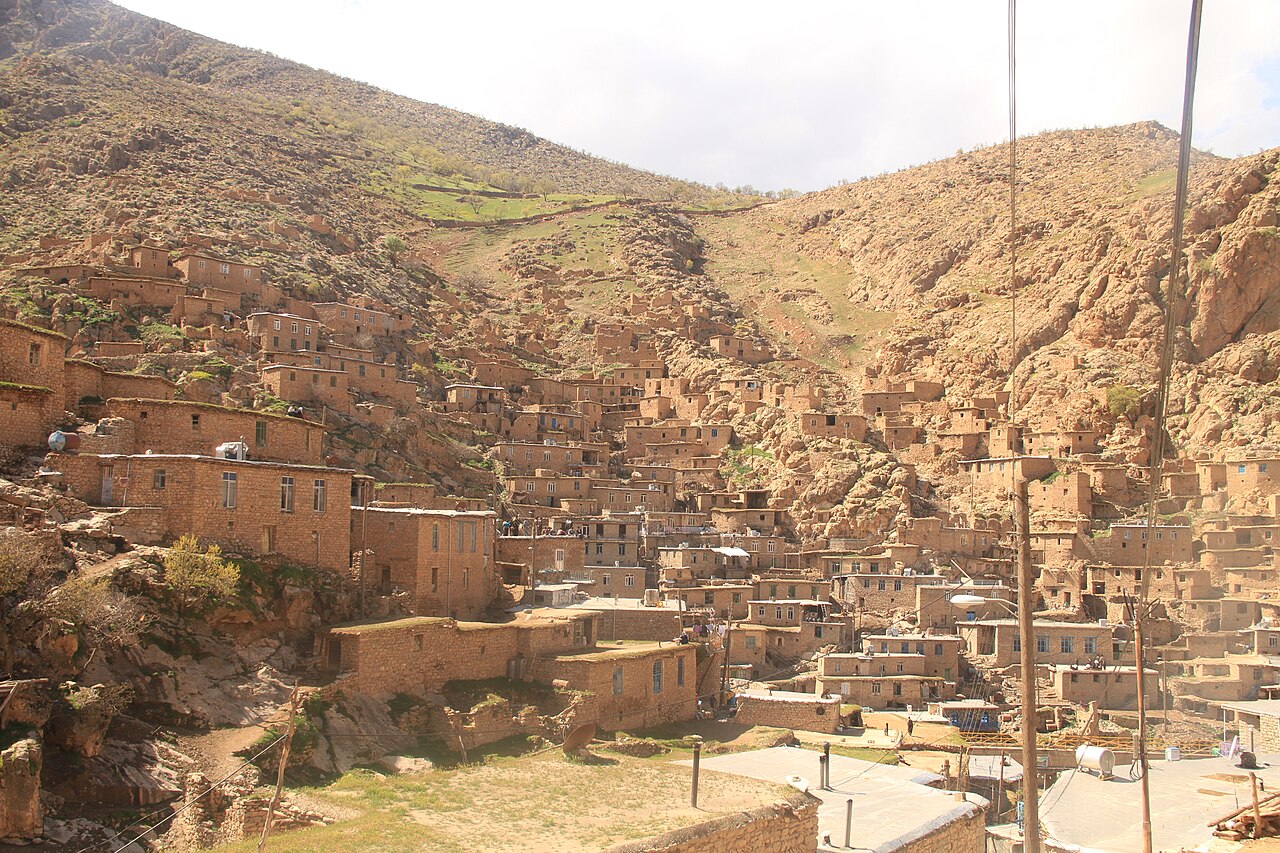
Van Bruinessen describes the eastern Taurus and Zagros as a mountainous backbone extending towards plateaux and the Mesopotamian plains. [1] Within the Zagros, UNESCO’s Cultural Landscape of Hawraman/Uramanat offers a specific example of settlement adapted to terrain. The inscribed property lies in Iran’s Kurdistan and Kermanshah provinces and includes the Zhaverud–Takht and Lahun valley components. UNESCO identifies steep-slope villages, dry-stone terraces, gardening, livestock breeding and seasonal movement between lower and higher ground. [2] The Palangan photograph shows the stepped form characteristic of the wider Hawraman area. Such local examples reveal relationships between housing, productive land and mobility that a broad regional label cannot convey by itself.
Historical regions through a named source: the Sharafnama
Sharaf Khan Bidlisi’s Sharafnama provides a major source for the histories of Kurdish dynasties and ruling houses. The Austrian Academy of Sciences describes Persian versions written in 1596–1599 by the ruler of Bitlis, southwest of Lake Van. [3] Its manuscript and translation history also matters: surviving copies and later editions transmit variations that researchers compare. This is a way into the historical geography of particular courts, dynasties and places. It also identifies the perspective of the writer—a ruling figure concerned with princely histories—when using the work to understand the region’s past.
Language geography includes several varieties and identities
Geoffrey Haig and Ergin Öpengin’s research overview distinguishes Northern Kurdish or Kurmanji, Central Kurdish or Sorani, Southern Kurdish, Gorani and Zazaki as five groups for discussion, while examining disagreements over classification. [4] They emphasise that historical linguistic relationships and speakers’ social identities are different questions. Kurmanji and Sorani contain regional varieties of their own; a national border does not neatly separate their speech communities. Presenting Kurdish as exactly three universally agreed dialects loses this complexity. A useful regional account specifies the local variety and the evidence for a classification, while recognising how speakers identify themselves.
Iraq: a defined federal use of the name
Article 117 of Iraq’s 2005 Constitution recognises the Kurdistan Region and its existing authorities as a federal region. [5] This is a particular constitutional meaning of the name, tied to Iraqi institutions. It should be identified clearly when discussing regional government, rather than extending the same administrative status to every Kurdish-inhabited area across neighbouring countries. The distinction helps readers follow whether a source concerns the Iraqi federal region, another administrative province or a broader cultural geography.
Syria: reading a dated language-rights document
Syria’s Decree No.13, published by SANA on 16 January 2026, illustrates another political setting. Its text recognises Kurdish as a national language and permits teaching in public and private schools in areas with substantial Kurdish populations through elective curricula or cultural and educational activities. It also addresses citizenship measures associated with the 1962 Hasakah census and declares 21 March a paid national holiday. [6] These provisions have their own wording and date. Reading the document alongside local accounts of education and citizenship helps distinguish the announced framework from its implementation in particular communities.
Sources and further reading
- Martin van Bruinessen, Agha, Shaikh and State: Social and Political Structures of Kurdistan, Zed Books, 1992, geographical introduction, especially pp.10–12; author’s university repository.
- UNESCO World Heritage Centre, Cultural Landscape of Hawraman/Uramanat, inscribed 2021; location, valley components, settlement and agropastoral landscape.
- Austrian Academy of Sciences, Sharaf-nāma: A Persian Source for the History of Kurds; research project by Sacha Alsancakli and Mustafa Dehqan, manuscript history and editions.
- Geoffrey Haig and Ergin Öpengin, Kurdish: A Critical Research Overview, Kurdish Studies 2/2 (2014), 99–122, especially pp.103–111; language classification and social identity.
- Constitution of Iraq, 2005, Article 117; recognition of the Kurdistan Region and its existing authorities as a federal region.
- SANA, text of Syrian Presidential Decree No.13 of 2026, published 16 January 2026, especially Articles 3–5 and 7; language, citizenship, holiday and implementing instructions.