Pertek’s island castle and two relocated mosques preserve different parts of an older river settlement. Archaeological research and conservation records explain how the Keban reservoir transformed this landscape in the Dersim region.

From the Murat valley to a reservoir
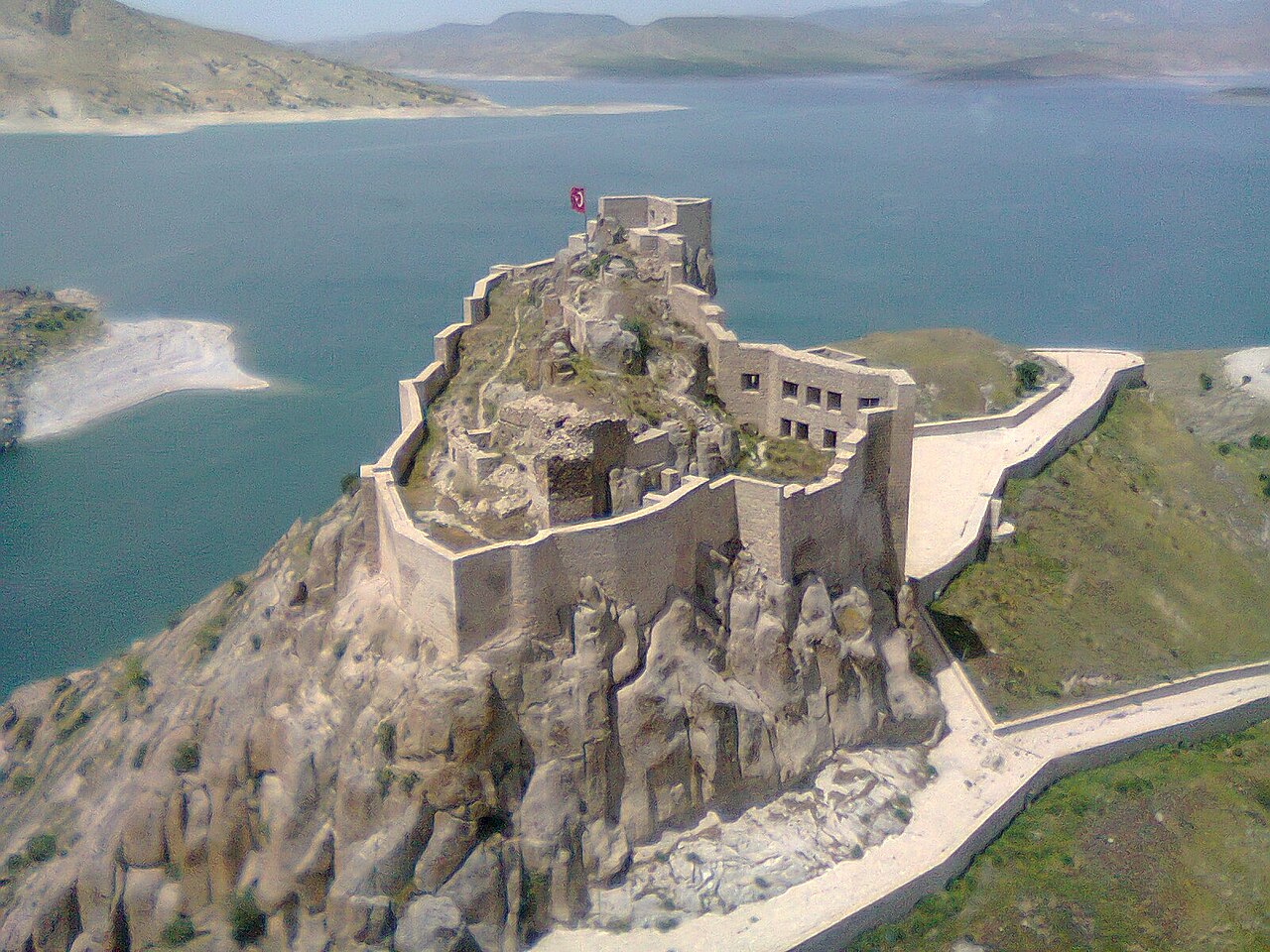
Pertek lies in Tunceli province, in the Dersim region. Its castle occupied a hill beside the Murat River before the Keban reservoir surrounded its rocky base. The island appearance is a result of the dam project, rather than the fortress’s original setting. [1] DSİ, Turkey’s water authority, dates the start of dam construction to 1965 and its commissioning to 9 September 1974. [2] The castle remained above water; two mosques were moved, while other buildings were submerged. [4]
How old is the castle?
The provincial culture directorate states that the construction date is unknown and records repairs under Ottoman rule. It describes two enclosing walls, building remains between them, and cut stone, red bricks and blue tiles on the southern side. [1] Ertuğrul Danık’s architectural study proposes a Late Roman or Early Byzantine arrangement subsequently developed in the medieval period and partly repaired under the Ottomans. He also discusses earlier rock-working and the gaps in written evidence. This is an archaeological interpretation of successive phases, rather than a securely dated foundation inscription establishing one building year. [3]
Two mosques saved by dismantling
Sungur Bey, also called Baysungur, and Çelebi Ağa were both relocated. They are sixteenth-century mosques with a central domed prayer hall and a three-bay entrance portico. The culture directorate describes their contrasting stone colours and carefully carved architectural details. Its account credits the Middle East Technical University Restoration Department with numbering the stones, taking the buildings apart and assembling them again in Pertek. [5] The move saved selected monuments rather than the entire old town. [4]
What survived the move
Gizem Nur Özcan and Neslihan Dalkılıç’s 2025 study compares archive photographs with field observations and later repairs. It records reuse of numbered original stones alongside replacements for missing or damaged elements. At Çelebi Ağa, numbers remain visible around the entrance; a missing portico column was replaced in reinforced concrete. These details show that relocation involved reconstruction decisions as well as transport. The researchers found the mosques still serving their original religious function, while examining changes in material, workmanship and setting. The researchers treat relocation as a last resort. The landmarks preserve older architecture and twentieth-century intervention. [4]
Sources and further reading
- Tunceli Provincial Directorate of Culture and Tourism, “Pertek Kalesi”: location, surviving fabric and uncertain construction date.
- DSİ, “Keban Barajı 50 Yaşında!”, 9 September 2024: construction and commissioning dates.
- Ertuğrul Danık, “Pertek Kalesi,” Vakıflar Dergisi 29 (2005), pp. 397–428, especially the architectural analysis and conclusion.
- Gizem Nur Özcan and Neslihan Dalkılıç, study of the relocation of Çelebiağa and Sungurbey mosques, Kent Akademisi 18/5 (2025), pp. 2762–2785, doi:10.35674/kent.1632876.
- Tunceli Provincial Directorate of Culture and Tourism, “Cami ve Türbeler”: Sungur Bey and Çelebi Ağa mosque architecture and stone-numbering relocation method.