Shahrokh Sultan Zanganeh, who died in 1639, belonged to a Kurdish family whose members served the Safavid court. His documented career connects responsibility for the royal stables with leadership of the Zanganeh tribe.

A family in royal service
Rudi Matthee identifies Shahrokh Sultan as the eldest brother of Shaykh Ali Khan Zanganeh. Their father, Ali Beg, served Shah Abbas I as holder of the rein and became master of the royal stables in 1618. He later joined the royal guard under Shah Safi. Shahrokh also held the office of amirakhor-bashi before becoming amir of the Zanganeh; Shaykh Ali succeeded him in the stable office. [1]
Appointments and the problem of dates
The Persian study republished as پژوهشى درباره شيخعلى خان زنگنه records an earlier appointment for Shahrokh at Khaf in 1039 AH. It associates his later tribal leadership with Sonqor, Harsin, Kermanshah, Bisotun and Kalhor, and gives 9 Jumada I 1049 AH for his death. [2] The appointment chronology differs between accounts: that study places Shaykh Ali’s replacement of him at the stables in Ramadan 1047 AH, while Matthee places Shahrokh’s move to tribal leadership in 1048 AH/1639. Both place his death in 1049 AH/1639. [1] [2]
What the stable office involved
Amirakhor-bashi was an office concerned with the ruler’s horses. Ali Soltani Gordfaramarzi’s study of horses in Islamic Iran explains the scale of their upkeep: veterinarians, trainers, grooms and suppliers of fodder were needed, alongside makers of saddles, reins, stirrups and other equipment. He identifies mir-akhor-bashi as the Safavid title for the chief official responsible for royal horses. [3] This institutional setting helps explain why a stable appointment belongs in the political history of a court family.
Succession and the surviving record
After Shahrokh’s death, Shaykh Ali became amir of the Zanganeh and eventually, in June 1669, grand vizier. [1] The documented succession links the brothers’ careers, but the later minister’s reforms belong to his own tenure. The sources cited here preserve appointments and family relationships; they give little basis for reconstructing Shahrokh’s personality or assigning him particular reforms. His brief profile is best understood through those named offices and dated transitions.
A material trace of the same reign
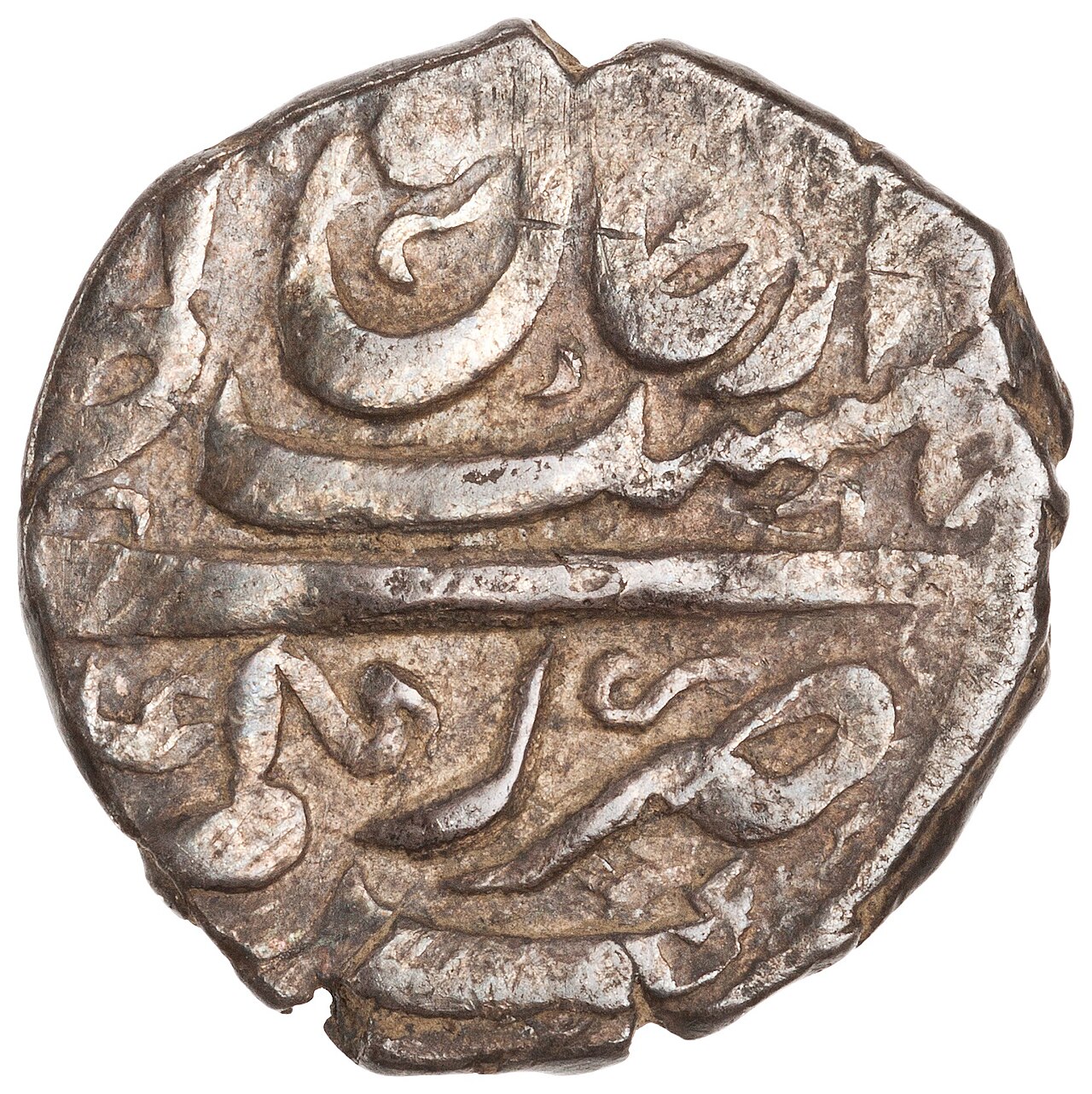
The accompanying coin is catalogued by the American Numismatic Society as a silver issue of Safi I minted at Zagam, with its date unspecified. [4] It places the profile alongside an artefact of Safavid rulership while retaining the coin’s own mint attribution.
Sources and further reading
- Rudi Matthee, Šayḵ-ʿAli Khan Zangana, Encyclopaedia Iranica, 2000, updated 2015; family offices and succession.
- پژوهشى درباره شيخعلى خان زنگنه, research article republished by Shia Studies; sections on Zanganeh history and early family appointments.
- Ali Soltani Gordfaramarzi, Asb iii. In Islamic Times, Encyclopaedia Iranica II/7, 1987, pp. 731–736; royal horses and offices.
- American Numismatic Society, silver coin of Safi I, Zagam, date unspecified, 1922.216.804; collection record.