In the rugged landscapes of 19th-century Kurdistan, where the Tigris River winds through ancient valleys and towering mountains guard forgotten secrets, emerged a figure whose life encapsulated the turbulence of an era. Bedir Khan Beg (1803–1869), the last hereditary ruler of the Emirate of Bohtan, stands as a complex symbol in Kurdish history. Born into a lineage of emirs claiming descent from legendary figures like Sharaf Khan Bidlisi and even Khalid ibn al-Walid, a companion of the Prophet Muhammad, Bedir Khan's rule from 1821 to 1847 marked a brief but intense period of autonomy amid the crumbling Ottoman Empire.
His story is one of ambitious governance, fierce independence, and tragic conflicts that left indelible scars on the region's diverse communities. As we delve into his life, we'll explore not just the man, but the historical forces that shaped him – from Ottoman centralization efforts to intertribal rivalries – drawing on accounts that highlight both his achievements and the controversies surrounding his actions.
Early Life and Rise to Power
Bedir Khan Beg was born in 1803 in Cizre, a historic town in what is now southeastern Turkey, then part of the Ottoman Empire's vast domains. Cizre, nestled along the Tigris, was the heart of the Bohtan Emirate, a semi-autonomous Kurdish principality that had endured for centuries under loose Ottoman suzerainty. The Azizan family, to which Bedir Khan belonged, traced its roots to the Rozhaki house, whose ancient seat was the Bitlis castle. This noble heritage instilled in him a sense of destiny, but his early years were far from secure. The region was plagued by instability following the death of his father, Abdullah Beg, and the brief, ineffective rule of his cousin Sayfuddin Beg and brother Said Bey.
By 1821, at the young age of 18, Bedir Khan assumed leadership after his predecessors failed to stabilize the emirate. The timing was precarious: the Ottoman Empire was reeling from defeats in the Russo-Turkish War of 1828–1829, and local power vacuums invited chaos. Bedir Khan, however, proved adept at navigating these challenges. He refused to provide troops to the Sultan during the war, a bold move that signaled his intent to prioritize Bohtan's interests. In the aftermath, he consolidated control, implementing reforms that fostered recovery. European diplomats and travelers, such as those reporting to consulates in the 1830s, noted the remarkable security under his rule. Banditry vanished, caravans traversed the territory safely, and the population grew as migrants fled less stable neighboring districts.
His administrative prowess shone through in practical measures: he raised taxes efficiently but fairly, minted his own coins – a symbol of sovereignty – and organized a justice system that earned him popularity. By the mid-1830s, Bohtan's economy boomed, with agriculture and trade flourishing in an atmosphere of relative peace. Bedir Khan's pride in this stability was evident; he often boasted of the safety his governance provided, contrasting it with the lawlessness elsewhere in Kurdistan. This period also saw him participating in larger conflicts, such as the Battle of Nizip in 1839, where he fought alongside Ottoman forces against Egyptian invaders led by Ibrahim Pasha. His valor on the battlefield elevated his status, making him the preeminent Kurdish ruler in central Kurdistan.
Yet, this rise was not without shadows. Bedir Khan's ambitions extended beyond Bohtan, leading to alliances and rivalries that would define his legacy. In 1840, he formed a triple alliance with Han Mahmud of Müküs and Nurullah Bey of Hakkari, a pact that strengthened his position but also entangled him in regional feuds. The Ottoman Tanzimat reforms of 1839, aimed at centralizing power and eroding local autonomies, posed an existential threat. Bedir Khan responded by modernizing his forces, creating cross-tribal militias and even delivering Friday sermons in his name – acts that bordered on rebellion.
The Emirate Under Bedir Khan: Governance and Expansion
At its zenith, Bedir Khan's domain stretched from Diyarbakir to Mosul in the west and Urmia in the east, encompassing diverse ethnic and religious groups: Kurds, Assyrians, Yazidis, Armenians, and others. This multi-ethnic mosaic required deft management, and for a time, Bedir Khan succeeded. His rule is often romanticized in Kurdish narratives as a golden age of autonomy, where fair taxation and social solidarity prevailed. He established a consultative council that advised on governance, ensuring economic prosperity and public order. Migrants flocked to Bohtan, drawn by the promise of security and opportunity.
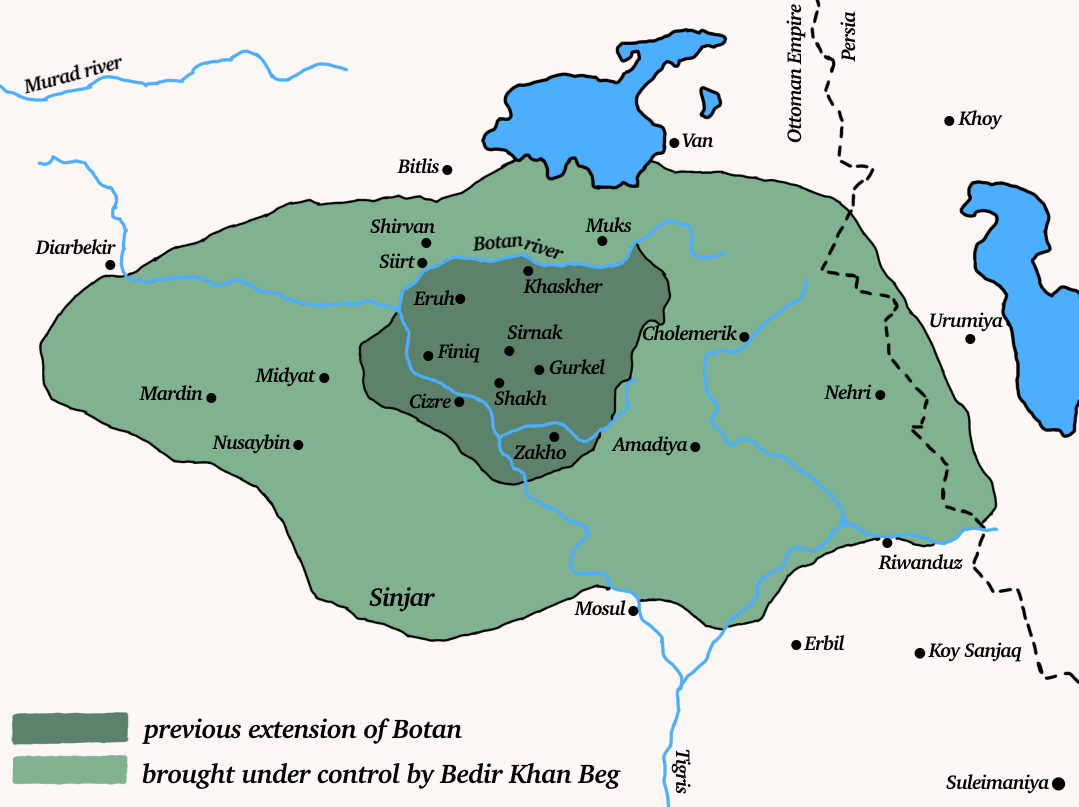
Bohtan - Wikipedia
From a Kurdish perspective, Bedir Khan embodied resistance against Ottoman encroachment. Historians like those chronicling Kurdish history view him as a proto-nationalist, whose efforts to unify tribes and assert independence inspired later movements. His participation in the 1839 battle and subsequent dominance in central Kurdistan underscored his strategic acumen. Yet, this expansion came at a cost. To fund his ambitions and maintain alliances, Bedir Khan demanded tributes from neighboring communities, leading to conflicts that escalated into violence.
The emirate's prosperity masked underlying tensions. The Ottoman state's push for integration, including shifting Cizre's administrative jurisdiction from Diyarbakir to Mosul in 1842, signaled impending confrontation. Bedir Khan's response – bolstering his military and forging pacts – set the stage for the dramatic events that followed.
Conflicts, Massacres, and Controversy
Bedir Khan's rule is inextricably linked to a series of violent campaigns that have polarized historical interpretations. In 1832, he collaborated with Muhammad Pasha of Rawanduz in attacks on Yazidi communities in the Shekhan area (Ain Sifni), resulting in thousands of deaths, village burnings, and forced conversions to Islam. Yazidi sources describe these as genocidal acts, with women and children enslaved and entire populations decimated. Bedir Khan's goal, according to contemporary accounts, was to compel conversion and assert dominance.
The most infamous episodes occurred in 1843 and 1846, when Bedir Khan, allied with Nurullah Bey and Han Mahmud, targeted Assyrian (Nestorian) Christians in the Hakkari mountains. The 1843 massacre began after Assyrians refused tribute to the Emir of Hakkari in 1841. Bedir Khan's forces invaded, slaughtering up to 10,000 in districts like Tiyari and Diz, destroying villages, churches, and enslaving survivors. British diplomat Austen Henry Layard, surveying the aftermath, reported systematic killings, with bodies thrown into rivers and captives sold in markets.
In 1846, a second wave struck, even targeting Assyrians who had allied with Bedir Khan earlier. Estimates suggest another 7,000-20,000 deaths, with total casualties across both campaigns reaching 20,000-30,000. Assyrian perspectives frame these as precursors to the 20th-century Sayfo genocide, emphasizing ethnic and religious targeting amid Ottoman weakness. Survivors' accounts, preserved in missionary reports, detail horrific atrocities: beheadings, burnings, and forced marches.
Kurdish viewpoints, however, contextualize these within intertribal power struggles and Ottoman pressures. Some sources portray Bedir Khan as defending autonomy against recalcitrant groups, though modern Kurdish scholars like Ahmet Kardam, a descendant, acknowledge the massacres as genocidal acts that demand reckoning. European powers, alarmed by reports of Christian persecution, pressured the Ottomans to intervene, leading to Bedir Khan's downfall.
These events highlight the era's complexities: religious tensions, tribute systems, and imperial rivalries fueled violence in a region where Kurds, Assyrians, and Yazidis coexisted uneasily under Ottoman rule.
Downfall, Exile, and Later Years
The massacres prompted Ottoman retaliation. In 1846–1847, forces under Omer Pasha, bolstered by 12,000 troops and vengeful Yazidi allies, invaded Bohtan. Initial victories gave way to defeats; Bedir Khan fled to Evruh Castle, enduring an eight-month siege. Betrayed by commander Yezdanşer, who defected for Ottoman favors, he surrendered on July 4, 1847. His family was chained and detained before transfer to Constantinople.
Exile followed: first to Heraklion, Crete, where he bought a farm and mediated local disputes despite earthquakes and financial woes. His Ottoman salary sustained him, but requests to return were denied until 1863, when Sultan Abdul Aziz allowed settlement in Istanbul's Fatih quarter. There, his descendants integrated into Ottoman society. In 1868, he moved to Syria, dying in Damascus in 1869 at age 66, buried in Rukneddin cemetery.
Legacy and Descendants
Bedir Khan's legacy is multifaceted. In Kurdish lore, he is a hero of resistance, inspiring nationalists like his grandsons Celadet, Süreyya, and Kamuran Bedirxan, who advanced Kurdish language and culture. His rule symbolized a lost era of autonomy, with economic and security achievements lauded.
Yet, for Assyrians and Yazidis, he remains a perpetrator of atrocities, with massacres seen as ethnic cleansing. Modern discussions, including from Kurdish voices, call for acknowledgment to foster reconciliation. His life reflects the Ottoman-Kurdish nobility's decline amid Tanzimat reforms, marking the end of hereditary emirates.
Bedir Khan left behind a large family whose descendants became influential figures in Kurdish intellectual and political life. Today, his story urges reflection on history's gray areas – power's allure and its human cost.
In conclusion, Bedir Khan Beg's life, spanning from Cizre's courts to Damascus exile, encapsulates 19th-century Kurdistan's drama. A ruler who brought prosperity yet unleashed devastation, his tale reminds us that history is woven from triumphs and tragedies, demanding balanced remembrance. As the Tigris flows on, so does the debate over his enduring shadow.
References
Below is a compiled list of key historical sources and references related to Bedir Khan Beg (1803–1869), drawing from reliable biographical, academic, and archival materials. These cover his life, rule over the Emirate of Bohtan, governance, conflicts, massacres, downfall, and legacy.
Bedir Khan Beg - Wikipedia entry on his biography, rule, and involvement in massacres against Yazidis and Assyrians. Comprehensive overview with citations to primary sources.
Bedir Khan Beg (Kurmanji: Bedirxan Beg, Turkish: Bedirhan Bey) - Detailed historical account from History of Kurd, focusing on his rise, alliances, massacres, and conflicts with the Ottoman Empire.
1843 and 1846 Massacres in Hakkari - Wikipedia article detailing the massacres carried out by Bedir Khan Beg and Nurullah Beg against Assyrian Christians, including historical context and casualty estimates.
Bedir Khan Beg - Grokipedia entry summarizing his rule, expansions, and specific atrocities against Yazidis and Assyrians, with references to contemporary accounts.
1840: The Attack on Tiyari and Tkhuma by Bedr Khan Beg - Historical documentation from Atour.com on the assaults in the Hakkari region, including survivor accounts and aftermath descriptions.
Published: August 21, 2000
The Bloody Shadow of Bedirkhan Beg - Article from ÊzîdîPress analyzing persecutions and massacres against Yazidis in Tur Abdin (1840–1844), with a focus on Bedir Khan's campaigns and exile.
Published: December 7, 2017
URL: https://www.ezidipress.com/en/the-bloody-shadow-of-bedirkhan-beg/
The Bedr Khan and Nurallah Massacres of Hakkari Assyrians Part I - YouTube video lecture on Assyrian History, covering the 1843–1846 events, alliances, and tensions leading to the massacres.
Published: February 23, 2023
The Kurdish Nobility in the Ottoman Empire: Loyalty, Autonomy and Privilege - Book by Nilay Özok-Gündoğan exploring Kurdish emirs like Bedir Khan in the context of Ottoman centralization, including references to massacres and the decline of nobility.
Publisher: Edinburgh University Press (2022)
Cizre - Wikipedia entry on the historical town, including Bedir Khan Beg's rule, munitions factory, massacres, and eventual Ottoman intervention leading to his exile.
The Ottoman East in the Nineteenth Century - PDF compilation of documents and essays on Ottoman policies, including references to massacres in regions affected by Bedir Khan's actions and broader Kurdish-Ottoman relations.
URL: http://lib.ysu.am/disciplines_bk/e95aac102d19de43354a84cc78f2bff3.pdf