Bingöl is a city and province in eastern Turkey, known locally through names including Çewlîg and Çolig. Its history connects a small valley settlement with provincial administration, expanding neighbourhoods and Zaza and Kurdish cultural study.

The city name and the province name
Bingöl names both a provincial capital and a larger administrative territory. Earlier names recorded for the settlement include Çevlik and Çolig, alongside the Kurdish spelling Çewlîg; Çapakçur was the official town name before the mid-twentieth century. The distinction matters in dating the province. The law establishing Bingöl province appeared in the official gazette on 4 January 1936, with Çapakçur as its centre. The city itself took the name Bingöl in 1945. It is therefore misleading to describe every earlier event anywhere within today’s provincial boundaries as an event in the same modern city. [1] [2]
A small town on regional routes
Geographer Metin Tuncel places the town within the upper Euphrates drainage and on the east–west route linking Elazığ with the Lake Van basin. His historical account describes Çapakçur as an Ottoman hereditary district, later a district within the Genç subdivision of Bitlis province. Nineteenth-century descriptions show a small settlement among orchards and vineyards, with shops, a bakery and coarse cloth production. This combination of administration, trade and agricultural surroundings explains more about the old town than a list of successive empires alone. [2]
Moving out of the old valley
Yaşar Baş and Vedat Avcı’s 2021 urban-history study combines historical records, topographic analysis and satellite images from 1985 to 2019. It traces the expansion from the old Çapakçur valley onto terraces and along major roads. Flooding, rockfall and limited building space contributed to relocation in the 1950s; the 1971 earthquake prompted further reconstruction and settlement growth. Later migration and new public institutions helped reshape neighbourhoods around the Elazığ–Muş and Diyarbakır routes. The study also records Armenian communities in the Ottoman district. Those historical administrative populations should not be converted into an unsupported ethnic percentage for the present city. [3]
Languages as a field of study
Bingöl’s Zaza and Kurdish cultural life includes institutions of teaching, research and publication. The university’s 2013–17 strategic plan identifies its Living Languages Institute and programmes in Zaza Language and Literature and Kurdish Language and Literature. This provides a dated institutional record of local languages entering postgraduate study. The university profile of Murat Varol documents work on Zaza classical literature, including his editions and analysis of the divans of Cebexçuri and Huni. These are specific forms of cultural production, alongside oral transmission. A programme’s name describes an academic unit; it does not settle every speaker’s ethnic or political identification. [4] [5]
The 2003 earthquake and the built city
The earthquake of 1 May 2003 was a defining event in Bingöl’s recent history. Turel Gur and colleagues’ field investigation reports magnitude Mw 6.4 and 168 deaths. Its particular focus was 23 reinforced-concrete school buildings and four dormitories. The researchers examined why damage varied between buildings, including the interaction of masonry infill, columns and concrete walls. Their work connects the disaster with the construction of public buildings and the experience of school communities, rather than treating destruction as an inevitable feature of mountain life. The report describes buildings surveyed in 2003, not the condition of every building standing today. [6]
The provincial landscape beyond the city
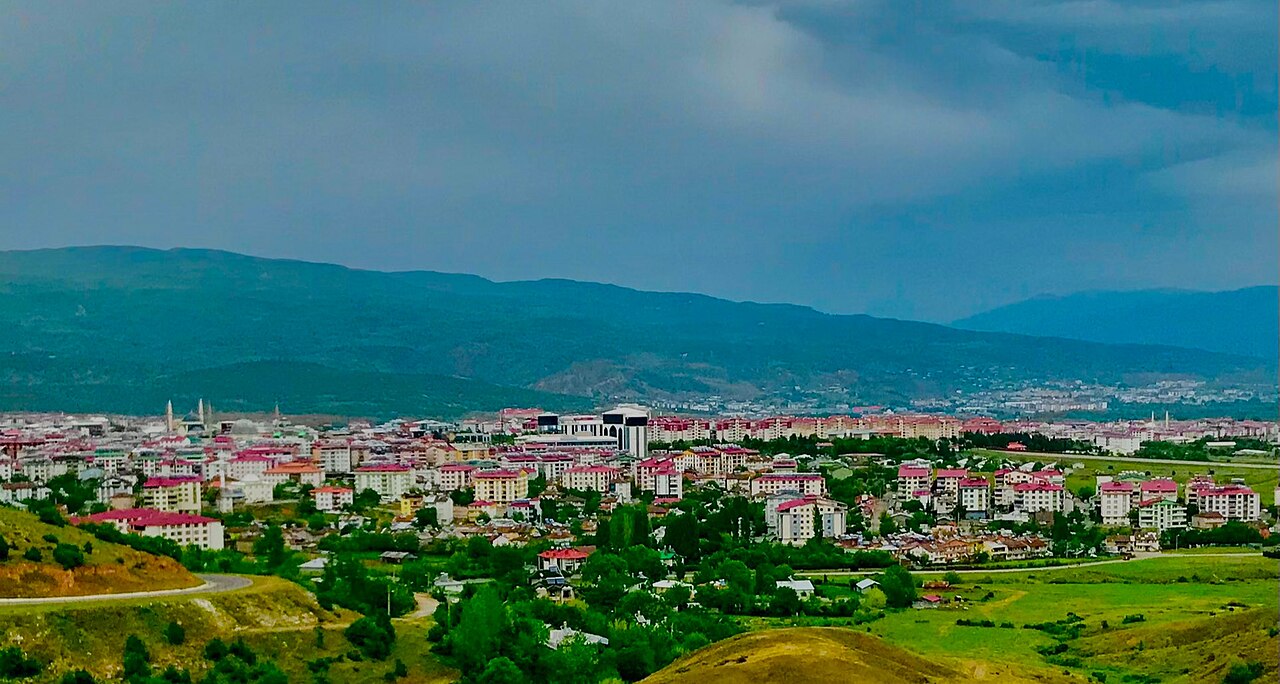
The Turkish name Bingöl means a thousand lakes and refers to the mountain landscape associated with the name, rather than a verified count of lakes inside the city. Tuncel discusses upland grazing and glacial lakes on Bingöl mountain. A different provincial attraction, the floating islands at Aksakal near Hazarşah in Solhan district, is listed by the provincial cultural directorate. Keeping these locations distinct makes the relationship between the urban capital and its wider surroundings easier to understand. The accompanying 2020 photograph shows the city itself. [2] [7] [8]
Sources and further reading
- Bingöl Municipality, city history (29 August 2021): Çevlik/Çolig, provincial establishment and the city’s 1945 renaming.
- Metin Tuncel, “Bingöl,” TDV İslâm Ansiklopedisi (1992): historical settlement, routes, provincial naming and mountain geography.
- Yaşar Baş and Vedat Avcı, “Bingöl’ün Tarihi Çevre ve Şehircilik Bakımından Gelişimi,” BUSBED 22 (2021), pp. 11–62, DOI 10.29029/busbed.849214: urban-history and geographic research.
- Bingöl University, Strategic Plan 2013–2017, p. 19: primary institutional record of the Living Languages Institute and its programmes.
- Bingöl University, Murat Varol academic profile: Zaza literary research and Cebexçuri/Huni divan theses.
- Turel Gur et al., “Performance of School Buildings in Bingöl During the 1 May 2003 Earthquake,” 13th World Conference on Earthquake Engineering (2004), paper 1017: original building survey.
- Bingöl Provincial Directorate of Culture and Tourism: location of the floating islands at Aksakal, Hazarşah, Solhan district.
- Bingolll, Bingöl city centre, 16 May 2020, CC BY-SA 4.0: original photograph.