The Bedirxan editors, Shifa Gardi, Behrouz Boochani and Sherwan Sherwani illuminate different histories of Kurdish journalism through identifiable publications, reporting and dated records.
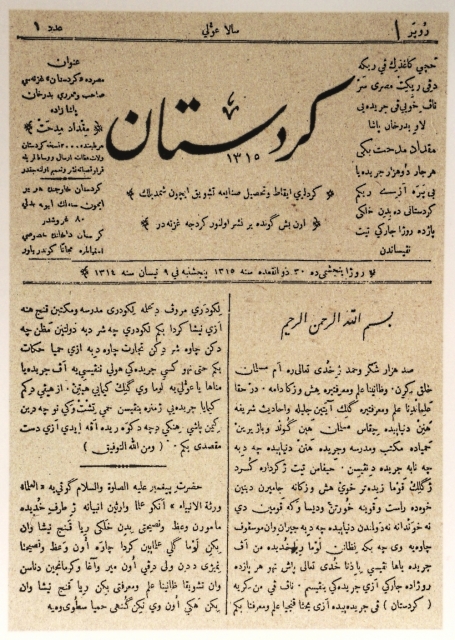

Mikdad Midhat and Abdurrahman Bedirxan: an early newspaper
Kurdistan began publication in Cairo in April 1898 under Mikdad Midhat Bedirxan, with his brother Abdurrahman subsequently taking over its editorship. The University of Kurdistan Hewlêr library catalogues a collection of thirty issues from 1898–1902 in Kurmanji Kurdish, written in Arabic script and published across Cairo, Geneva and London. Historian Djene Rhys Bajalan examines the newspaper’s bilingual Kurdish–Turkish character and opposition to Sultan Abdülhamid II. He cautions against equating emerging Kurdish national consciousness with an automatic programme for an independent state. Reading these editors through their actual publication makes their politics more specific than a timeless claim that all Kurdish journalism pursued the same goal. [1] [2]
Shifa Gardi: reporting the Mosul offensive
Shifa Zikri Ibrahim, professionally known as Shifa Gardi, reported for Rudaw during the battle against ISIS in Mosul. Her employer identifies her work presenting Focus Mosul, a programme begun with the offensive in October 2016, alongside reporting from the fighting. The Committee to Protect Journalists recorded her death on 25 February 2017 in a roadside-bomb explosion while covering the offensive in western Mosul. Cameraman Younis Mustafa was injured. The programme, newsroom and named colleague place her within a reporting team, rather than leaving only an honorary description of courage. Her case also documents the lethal danger of working around an active battlefield. [3] [4]
Behrouz Boochani: journalism from detention
Boochani is a Kurdish-Iranian journalist and co-founder of the Kurdish magazine Werya. The Australian National Portrait Gallery’s biography records his flight from Iran in 2013, offshore detention on Manus Island and reporting by mobile-phone messages to journalists and human-rights organizations. It also describes Chauka, Please Tell Us the Time, released in 2017, and the Persian-language memoir No Friend but the Mountains, transmitted in fragments through WhatsApp. He received refugee status in New Zealand in July 2020. This career connects Kurdish publishing with reporting in other languages, film, translation and writing from inside the system being investigated. A shared Kurdish background does not mean every article had to be written in Kurdish. [5]
Sherwan Sherwani: reporting and a contested prosecution
CPJ identifies Sherwan Amin Sherwani’s contributions to Kiwan and his reporting and political commentary on human rights and corruption. Its case record describes his October 2020 arrest and 2021 conviction on allegations involving security information and foreign parties; he pleaded not guilty. It also records the regional government’s assertion that the arrest concerned conduct outside journalism, disputed by his family and lawyer. On 20 August 2025 an Erbil court imposed a further four years and five months over an alleged threat to a prison officer; his lawyer told CPJ that Sherwani denied it. In a statement dated 24 September 2025, CPJ and partner organizations called for release and described the proceedings as judicial harassment. This account distinguishes charges, denial and the organizations’ assessment rather than presenting allegations as established personal conduct. [6] [7]
Different routes to readers, different conditions of work
These examples span a printed newspaper in exile, a television newsroom, phone-based reporting and online commentary. They also concern different kinds of pressure: restrictions on circulation, battlefield hazards, detention and contested criminal proceedings. One case cannot stand for the experience of every Kurdish journalist, and prominence is not a measurable ranking supplied by an admiring label. The surviving newspaper, a named broadcast programme, a documented body of writing and attributed case records give readers concrete ways to follow the work and its circumstances. They preserve the distinctions between an editor’s politics, a reporter’s observations and an institution’s judgment about press freedom. [1] [2] [3] [5] [6] [7]
Sources and further reading
- University of Kurdistan Hewlêr Library, Kurdistan, catalogue record 15069: collection of thirty early issues, 1898–1902, Kurmanji in Arabic script, Cairo/Geneva/London publication.
- Djene Rhys Bajalan, “Kurdish responses to imperial decline: The Kurdish movement and the end of Ottoman rule in the Balkans (1878 to 1913),” Kurdish Studies 7/1 (2019), pp. 51–71, especially p. 61, DOI 10.33182/ks.v7i1.481: original analysis of Kurdistan and late Ottoman political positions.
- Rudaw Media Network, “Rudaw reporter and anchor Shifa Gardi killed by roadside bomb near Mosul,” 25 February 2017: employer’s statement, reporting role and Focus Mosul programme.
- Committee to Protect Journalists, “Iraqi Kurdish journalist killed by roadside bomb in Mosul,” 25 February 2017: Gardi’s professional name, date, reporting assignment and injured cameraman.
- National Portrait Gallery of Australia, Behrouz Boochani, biography updated 2023: Werya, mobile reporting, film, Persian memoir and New Zealand refugee status.
- Committee to Protect Journalists, Sherwan Amin Sherwani case record: contributions to Kiwan, arrest and convictions, official position, family and lawyer responses, and August 2025 sentence. Compiled reporting with attributed allegations and denials.
- CPJ and partner organizations, “CPJ, partners urge Iraqi Kurdistan to free journalist Sherwan Sherwani,” 24 September 2025: dated joint assessment and call for release, not a court finding.
- Kurdistan newspaper front page, 1898; Kurdish Academy of Language / Wikimedia Commons, public domain.