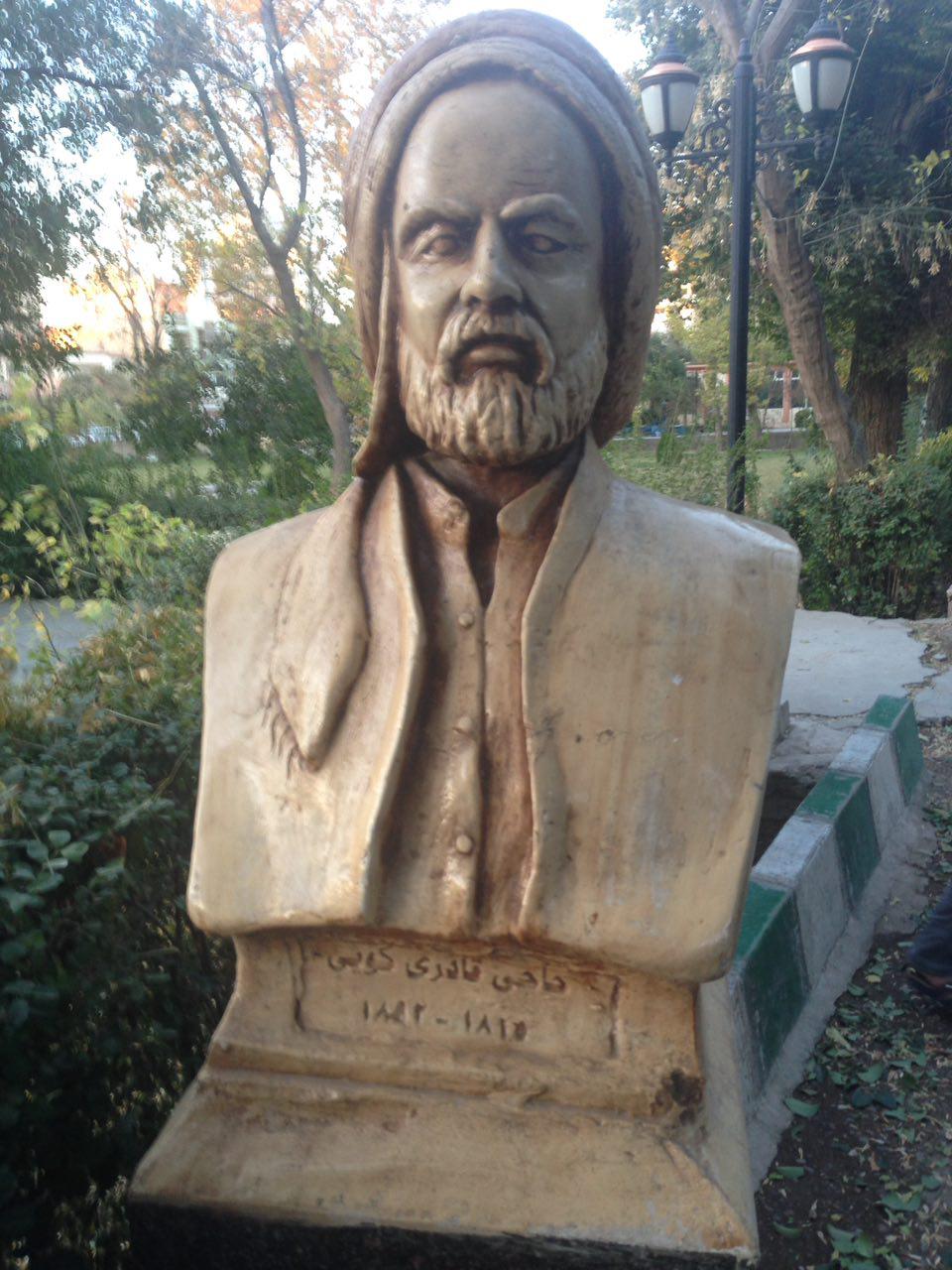
Haji Qadir Koyi: The Pioneer of Kurdish Awakening and Nationalism
- Daniel Rasul

- Jan 7
- 8 min read

In the rich tapestry of Kurdish history, few figures stand as tall as Haji Qadir Koyi. Born in the early 19th century amid the crumbling edges of the Ottoman Empire, Koyi emerged not just as a poet but as a visionary who ignited the flames of Kurdish nationalism. His verses, sharp as a mountain dagger, cut through the veils of ignorance, religious dogma, and colonial oppression that shrouded his people. Often hailed as the "father of modern Kurdish poetry," Koyi's work transcended mere literature; it was a call to arms for cultural revival, political unity, and intellectual enlightenment. This blog post delves into the life, works, and enduring legacy of Haji Qadir Koyi, exploring how a humble mullah from a remote Kurdish town became the harbinger of a nation's awakening. We'll journey through his biography, his poetic evolution, his bold political ideas, and the ripples he sent across Kurdish society that continue to resonate today.
At a time when the Kurdish people were fragmented across empires—Ottoman, Persian, and later British and French mandates—Koyi's voice echoed a profound yearning for self-determination. His poetry wasn't confined to romantic odes or mystical musings; it was laced with critiques of societal ills and blueprints for progress. Drawing from the nationalist ethos of earlier Kurdish luminaries like Ahmad Khani, Koyi adapted these ideas to the realities of the industrializing world he witnessed in Istanbul. He urged his fellow Kurds to embrace science, education, and modern media, envisioning a path to independence that was as practical as it was poetic. As we mark over a century since his passing, Koyi's relevance feels more urgent than ever in an era where Kurdish identity continues to navigate geopolitical storms.
Early Life and Education: Roots in the Kurdish Heartland
Haji Qadir Koyi was born around 1817 in the town of Koi Sanjaq, a picturesque settlement nestled in the rolling hills of what is now northern Iraq, then part of the vast Ottoman Empire. The exact date of his birth remains somewhat shrouded in mystery, with some sources suggesting 1816, but 1817 is the most commonly accepted year based on historical records. Koi Sanjaq, known in Kurdish as "Koye," was a hub of Kurdish culture, surrounded by rugged mountains that symbolized both the resilience and isolation of the Kurdish people. Growing up in this environment, young Koyi was immersed in the oral traditions of Kurdish folklore, ballads, and epics that had been passed down through generations.
Details of his early education are sparse, reflecting the limited formal schooling available in rural Ottoman Kurdistan. However, as a mullah—a religious scholar—Koyi likely received his initial training in Islamic studies at local madrasas. These institutions emphasized Arabic and Persian texts, the lingua franca of the empire's elite, but Koyi would later rebel against this linguistic dominance, championing Kurdish as the medium for intellectual expression. His upbringing coincided with a turbulent period: the Ottoman Empire was grappling with internal reforms under the Tanzimat era, which aimed to modernize administration but often marginalized ethnic groups like the Kurds.
Koyi's family background remains largely undocumented, but it's believed he came from a modest lineage of scholars or landowners. The "Haji" in his name indicates he performed the Hajj pilgrimage to Mecca, a journey that would have exposed him to diverse Islamic thought and perhaps planted the seeds of his later critiques against religious fanaticism. By his teenage years, Koyi had already begun composing poetry, drawing inspiration from classical Persian and Arabic forms while infusing them with Kurdish idioms. This early phase of his life laid the foundation for his worldview: a blend of spiritual devotion and a growing awareness of Kurdish marginalization.
As a young man, Koyi navigated the complexities of Ottoman society, where Kurds were often conscripted into military service or caught in tribal feuds exacerbated by imperial divide-and-rule tactics. The overthrow of the last Kurdish principalities in the mid-19th century—such as the Baban and Soran emirates—left a power vacuum that Ottoman governors filled with heavy-handed control. Koyi's education extended beyond books; it was forged in the fires of these political upheavals. He witnessed firsthand the erosion of Kurdish autonomy, which fueled his later calls for unity. By the 1840s, he had established himself as a local poet and teacher, using his verses to comment on social issues like poverty and injustice.
This period of his life, though obscure, was crucial in shaping his identity. Koyi's early poems, often in the ghazal form—a lyrical style focused on love and beauty—hinted at deeper themes. He mourned the loss of Kurdish heritage while subtly critiquing the complacency of religious leaders who prioritized dogma over progress. His education, informal yet profound, equipped him with the tools to bridge traditional Kurdish culture with emerging modernist ideas. As he matured, Koyi's gaze turned outward, leading him on travels that would transform his poetry into a weapon for national revival.
Travels and Influences: From Kurdistan to the Heart of Empire
Koyi's life took a pivotal turn in his later years when he relocated to Istanbul, the Ottoman capital, around the 1870s or 1880s. This move exposed him to a cosmopolitan world far removed from the insular valleys of Koi Sanjaq. Istanbul, then a melting pot of ethnicities, ideologies, and innovations, was buzzing with the winds of change. The city hosted intellectuals from across the empire, including Armenians, Greeks, and Arabs, many of whom were stirring nationalist sentiments amid the empire's decline. Koyi arrived during the reign of Sultan Abdul Hamid II, a time of both reform and repression, where the "Young Ottomans" advocated for constitutionalism.
Living in Istanbul until his death in 1897, Koyi absorbed the material advancements of Europe—railways, telegraphs, and printing presses—that filtered into the Ottoman world. These experiences profoundly influenced his poetry, shifting it from personal reflection to societal critique. He contrasted the backwardness he perceived in Kurdish society—plagued by illiteracy, tribalism, and religious extremism—with the progress of modern nations. Koyi's travels weren't extensive beyond the empire, but his Hajj pilgrimage likely took him through Arab lands, broadening his perspective on pan-Islamic unity versus ethnic nationalism.
Influences on Koyi were multifaceted. He revered Ahmad Khani, the 17th-century Kurdish poet whose epic "Mem û Zîn" subtly advocated for Kurdish independence. Koyi carried this torch forward, adapting Khani's ideas to the 19th-century context of rising European nationalism. The works of Persian poets like Hafez and Saadi also shaped his style, but he infused them with Kurdish vernacular to make them accessible. In Istanbul, he encountered the "Young Turks" movement, which inspired his calls for media and education as tools for empowerment.
Koyi's interactions with Kurdish elites in the capital, including those from influential families like the Bedirkhans, further honed his views. He criticized shaikhs and mullahs who exploited the masses through superstition, urging instead a turn to science and rationalism. This phase marked his evolution into a journalist-poet; he advocated for Kurdish newspapers, seeing them as vital for mass communication. His time in Istanbul wasn't without hardship—poverty and illness plagued his final years—but it crystallized his mission: to awaken Kurds from their slumber.
Literary Career and Major Works: Poetry as a Catalyst for Change
Koyi's literary career spanned decades, evolving through distinct phases that mirrored his ideological growth. Early on, he experimented with ghazals, short lyrical poems that explored themes of love, nature, and spirituality. These works, while beautiful, were conventional, adhering to classical forms prevalent in Ottoman literature. However, as his nationalist consciousness deepened, Koyi transitioned to qasidas—longer odes that allowed for descriptive and didactic content. In this middle phase, he began weaving in critiques of Kurdish society, lamenting the neglect of the Kurdish language and the people's subjugation.
The pinnacle of his career came in his later masnavi poems, couplets that enabled expansive narratives. Here, Koyi's nationalism shone brightest, with motifs of unity, independence, and cultural revival dominating. His collected works, "Dîwanî Hacî Qadirî Koyî," were posthumously published in 1986, compiling poems that span his oeuvre. Though no full English translations exist widely, excerpts reveal his fiery rhetoric. For instance, he defined a Kurd simply as "one who speaks Kurdish," emphasizing language as the cornerstone of identity.
Koyi's poetry attacked illiteracy and fanaticism head-on. In one verse, he implored Kurds to "open their eyes to the world," decrying leaders who kept them in darkness. He celebrated Kurdish history, referencing ancient princes and warriors to instill pride. His works also touched on technology and culture, urging adoption of modern tools while preserving traditions. As a journalist, Koyi didn't publish extensively himself, but his advocacy paved the way for the first Kurdish newspaper, "Kurdistan," in 1898.
Scholars like Farangis Ghaderi argue that modern Kurdish poetry begins with Koyi, marking him as its originator.
His style blended classical elegance with vernacular accessibility, making his messages resonate with the masses. Themes of liberation recur, with Koyi envisioning a Kurdistan free from Ottoman and Persian yokes. His masnavis, rich in nationalist motifs, critiqued empires while fostering hope. Though he wrote in Sorani Kurdish, his influence spanned dialects, inspiring poets across regions.
Political Views and Nationalism: A Vision for Kurdish Independence
At the heart of Koyi's legacy lies his unyielding political vision: a united, independent Kurdistan. In the 1880s, amid the empire's fragmentation, he called for Kurds to form their own state, rejecting Ottoman assimilation. He viewed nationalism not as separatism but as self-preservation, drawing parallels with emerging Balkan nations. Koyi's politics were progressive; he advocated for education to combat backwardness, seeing knowledge as the key to liberation.
He lambasted religious leaders for perpetuating division, promoting secular enlightenment instead. His views on language were revolutionary: by insisting on Kurdish media, he aimed to forge a national consciousness. Koyi confronted imperial plots against Kurds, using poetry to expose divide-and-rule tactics. In historical context, his era saw the Russo-Ottoman Wars and the Treaty of Berlin (1878), which redrew maps without Kurdish input. The Sheik Ubaydullah Revolt of 1880 echoed his ideas, though he wasn't directly involved.
Koyi's nationalism was inclusive, defining Kurds linguistically rather than tribally. He envisioned a society embracing science, literature, and journalism for progress. His critiques extended to Kurdish elites who collaborated with empires, urging collective action. Though he died before seeing independence, his ideas influenced the 20th-century Kurdish movements.
Legacy and Impact: Echoes in Modern Kurdistan
Koyi's death in 1897 marked the end of an era, but his legacy endures. He is celebrated as a classical poet who bridged old and new, inspiring figures like Abdullah Goran and modern activists. The 200th anniversary of his birth in 2016 saw commemorations in Kurdistan, highlighting his role in national awareness.
His influence on Kurdish literature is profound; poets today draw from his nationalist themes. Politically, his calls for unity resonate in ongoing struggles for autonomy in Iraq, Syria, Turkey, and Iran. Institutions like Koya University honor him, and sculptures in Sulaimaniya parks immortalize his image. Koyi's emphasis on media foreshadowed the digital age's role in Kurdish activism.
Critics note his poetry's occasional elitism, but his overall impact is transformative. He planted seeds of self-determination that bloomed in treaties like Sèvres (1920) and continue in contemporary politics.
Conclusion: A Timeless Voice for the Kurds
Haji Qadir Koyi's life was a testament to the power of words in forging nations. From his humble beginnings in Koi Sanjaq to his final days in Istanbul, he wove poetry and politics into a fabric of resistance and hope. His 2500-word-worthy story reminds us that true awakening comes from within—through education, unity, and cultural pride. As Kurds navigate today's challenges, Koyi's verses remain a beacon: "Awaken, O Kurds, and claim your destiny." In honoring him, we honor the enduring spirit of a people unbreakable.
References
Haji Qadiri Koyi - Wikipedia - https://en.wikipedia.org/wiki/Haji_Qadiri_Koyi
The manifestation of the history of the kurdish princes in the poetry of ... - https://www.hjuoz.uoz.edu.krd/index.php/hum/article/view/1338
Haji Qadir Koya - Kurdipedia.org - https://www.kurdipedia.org/default.aspx?q=20230131163703462908&lng=7
The 200th Anniversary of the Birth of Haji Qadri Koyi 1816 - 2016 - https://koyauniversity.org/node/115
Haji Qadir Koyi - Simple English Wikipedia, the free encyclopedia - https://simple.wikipedia.org/wiki/Haji_Qadir_Koyi
The 200th Anniversary of the Birth of Haji Qadri Koyi 1816 - 2016 - https://university5194.rssing.com/chan-65612570/all_p1.html
History of the Kurds - The Kurdistan Memory Programme - https://kurdistanmemoryprogramme.com/history-of-the-kurds/
From the Wandering Poets to the Stateless Novelists (Chapter 27) - https://www.cambridge.org/core/books/cambridge-history-of-the-kurds/from-the-wandering-poets-to-the-stateless-novelists/4391592FAE6992F72CEABB0E56DF8FF6
Ferment and Fetters in the Study of Kurdish Nationalism - MR Online - https://mronline.org/2008/11/24/ferment-and-fetters-in-the-study-of-kurdish-nationalism/
The Progressive Process of Kurdish Nationalist Discourse in Haji ... - https://www.academia.edu/42921179/The_Progressive_Process_of_Kurdish_Nationalist_Discourse_in_Haji_Qadir_Koyi_s_Poetry


Comments