A guide to Kurdish food through breads, stuffed dishes, rice and bulgur, spring salads and festive baking. Named cooks and regional field studies show how ingredients, techniques and family memories come together.

A kitchen with many kinds of food
Kurdish cooking includes everyday breads, grain dishes, vegetables, meat preparations, pickles and sweets. Pary Baban’s Nandên groups recipes into stuffed dishes and dumplings, soups and stews, rice and bulgur, grills, sides, breads and sweet foods. [1] The table gives a starting vocabulary, with the source number beside each example. A dish name is most useful alongside a locality, cook and preparation: those details make regional and household differences visible.
| Food or category | Documented example | Source |
|---|---|---|
| Yaprax û kifta | Stuffed dishes and dumplings in Baban’s cookbook categories | 1 |
| Brinj û sawar | Rice and bulgur dishes | 1 |
| Nanê tenûrê | Bread baked in a tandoor | 2 |
| Kulera | Round bread, served plain or with toppings | 2 |
| Kalana | Herb-filled flatbread cooked on a griddle | 2 |
| Zalatay Kuzala | Watercress, radish and pomegranate salad | 5 |
| Kulicha / klêçe | Filled pastries, including date and walnut versions | 6, 7 |
Bread: different shapes and different heat
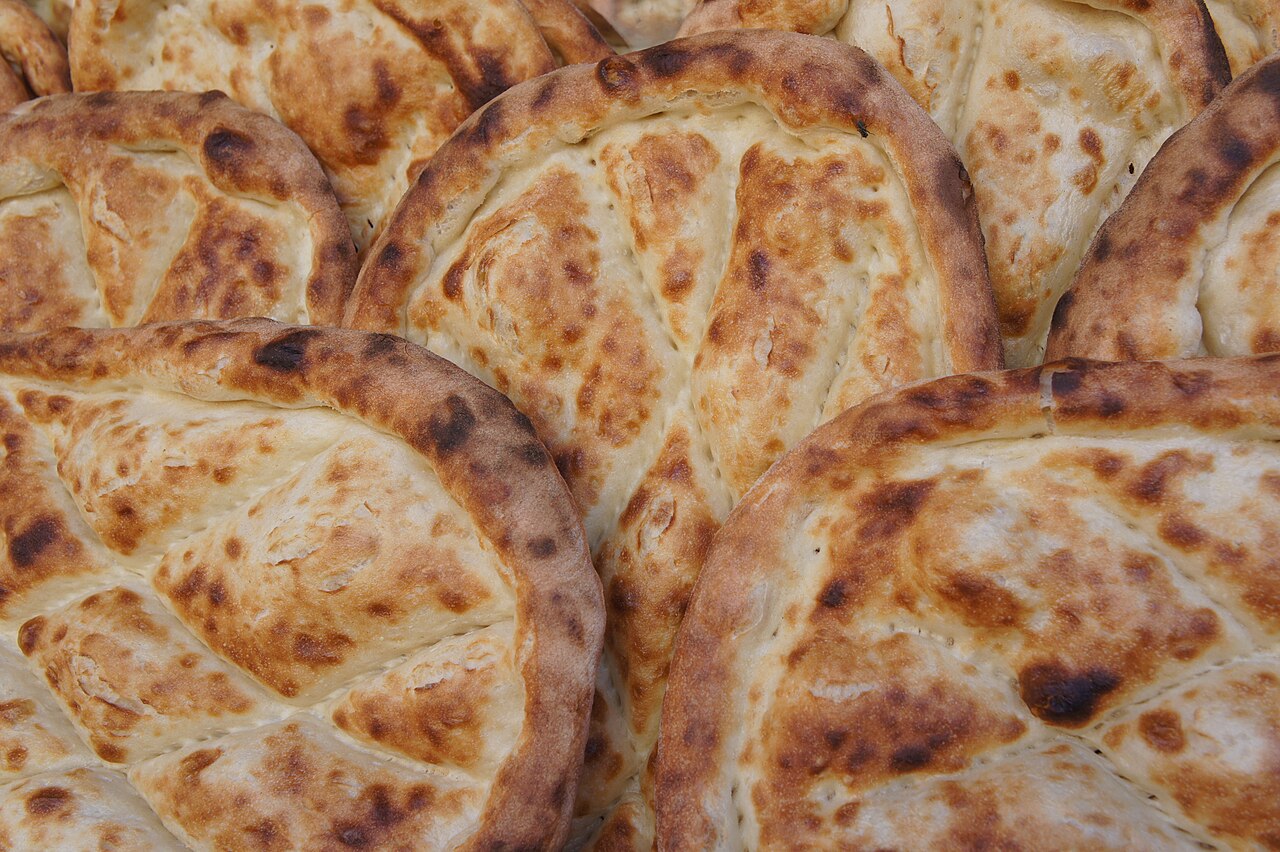
Goran Sabah Ghafour’s 2021 visit to an Erbil bakery describes dough stretched by hand before baking in a tandoor. Baker Ayed Ahmed serves kulera with cheese and sweet tea; customers also take plain bread home. The report distinguishes thin teeri, thicker round kulera and samoon hajari, which needs a larger kiln-like oven. Kalana encloses herbs such as chives, spring onion and garlic and cooks on a griddle. [2] Bread is therefore a family of foods and techniques. Oven type, thickness and filling matter when comparing names or choosing a recipe.
Spring plants and local knowledge
A 2019 study by Andrea Pieroni and colleagues interviewed 123 Kakai and Muslim Kurdish participants in twelve villages of southern Iraqi Kurdistan. It records many shared wild-food uses, including plants eaten as snacks and ingredients brought into household cooking. [3] Research by Abdullatif Yılmaz and Hasan Akan in Mardin interviewed 66 people in eleven neighbourhoods in 2021–2022. Their study spans Kurdish, Syriac and Arab communities and records fifty food plants. [4] These studies document specific places and people. They show why seasonal greens belong in the story of Kurdish food alongside grains and meat, and why neighbouring cuisines can share ingredients.
Newroz: herbs and a shared table
In her own introduction to Zalatay Kuzala, Pary Baban describes a Newroz picnic where food is placed on one xwan, or table, and people eat together. She connects watercress, mint and wild pistachio with spring gathering. Her published salad combines watercress, radish, pepper and pomegranate; its dressing includes lemon, dill and gazwan, with capers offered as a substitute. [5] The recipe provides both a particular bowl of food and a cook’s explanation of its place in the celebration. It also makes adaptation explicit, rather than requiring an identical pantry in every country.
Kulicha: shapes, fillings and learning from family
Tara’s Dalia’s Table essay describes date-filled spirals and walnut half-moons served with tea. She recounts translating and discussing her mother’s handwritten recipes during the pandemic, making baking a practical way to maintain family connections. [6] Laurena’s Kurdish kulicha recipe, published for Eid in July 2020, makes both spirals and crescents with dates and cardamom and allows dairy-free ingredients. [7] Together these accounts show that a shape does not dictate one filling. They also identify the labour of learning, folding and repeating a household recipe.
Recipes travelling with their cooks
Baban’s publisher presents Nandên as a collection shaped by her movement from Qaladzê and the recipes gathered along the way, later associated with her family’s South London restaurant Nandine. [1] Tara’s calls with relatives offer another form of transmission across distance. [6] Migration can carry a notebook, a remembered method or a conversation into a new kitchen. To explore further, begin with a named recipe, follow its proportions and technique, and record your own changes. That preserves useful cooking knowledge alongside the story of the person who shared it.
Sources and further reading
- Pary Baban, Nandên: Recipes from My Kurdish Kitchen, Ryland Peters & Small, 2026; publisher’s description and recipe categories.
- Goran Sabah Ghafour, Naan, a delicious staple of Kurdish culture, Kurdistan24, 12 August 2021; firsthand bakery reporting and interview with Ayed Ahmed.
- Andrea Pieroni, Hawre Zahir, Hawraz Ibrahim M. Amin and Renata Sõukand, Where tulips and crocuses are popular food snacks, Journal of Ethnobiology and Ethnomedicine 15, 59 (2019); research abstract.
- Abdullatif Yılmaz and Hasan Akan, Gastronomic Research of Wild Food Plants in Different Ethnic Groups in Mardin, OKUFBE Dergisi 6, special issue (2023), pp. 533–554; research abstract.
- Pary Baban, Zalatay Kuzala: Watercress, Radish and Pomegranate Salad, authorised Nandên guest recipe on Nigella.com; cook’s introduction, ingredients and method.
- Tara, Kulicha/Kleicha, more than a cookie, for Kurds, Dalia’s Table; firsthand family essay, posted 21 March, year not displayed.
- Laurena, Traditional Kurdish Kulicha for Eid, Life Diet Health, 31 July 2020; author’s household recipe.