Kurtalan, known in Kurdish as Misircê, is a town and district centre in Siirt Province. Its history connects the changing administration of Garzan, the arrival of the railway in 1944 and a wider landscape where archaeological research documents settlement long before the modern station.

Town and district in the Siirt landscape
Kurtalan belongs to Siirt Province in southeastern Turkey. The provincial culture directorate describes Başur, Garzan and Botan waterways as important features of the district’s eastern, western and southern boundaries. It also identifies the older administrative name Garzan and notes that the district centre changed location several times. [1] These details place the town within a larger rural and river landscape. The present built-up centre, the administrative district and older settlements within that district have different histories and should be identified carefully.
Misircê and the history of local names
Murat Boran’s 2024 local-history article records the Kurdish names Misirç and Misircê and connects them with the village incorporated into the later town. His account distinguishes that settlement from the broader district and its successive administrative centres. [2] Historical documents use variant spellings, including Mısrıç or Mısriç in Turkish records. Reading the names together helps follow changes in administration without assuming that an old district name and the modern station town always referred to precisely the same place.
A contemporary document for the 1944 move
The Ministry of Education’s Tebliğler Dergisi, issue 301 of 6 November 1944, reproduces an Interior Ministry notice concerning Kurtalan. The notice, dated 29 September, cites decree 18944 of 12 September 1944 and records the transfer of the district centre from Ayınkası to Mısriç. It also sets out changes assigning villages to administrative subdivisions. [3] This provides a contemporary record for the move. It gives the town’s development a firmer chronology than simply saying that a market town grew around a railway sometime in the twentieth century.
The railway and the Ankara connection
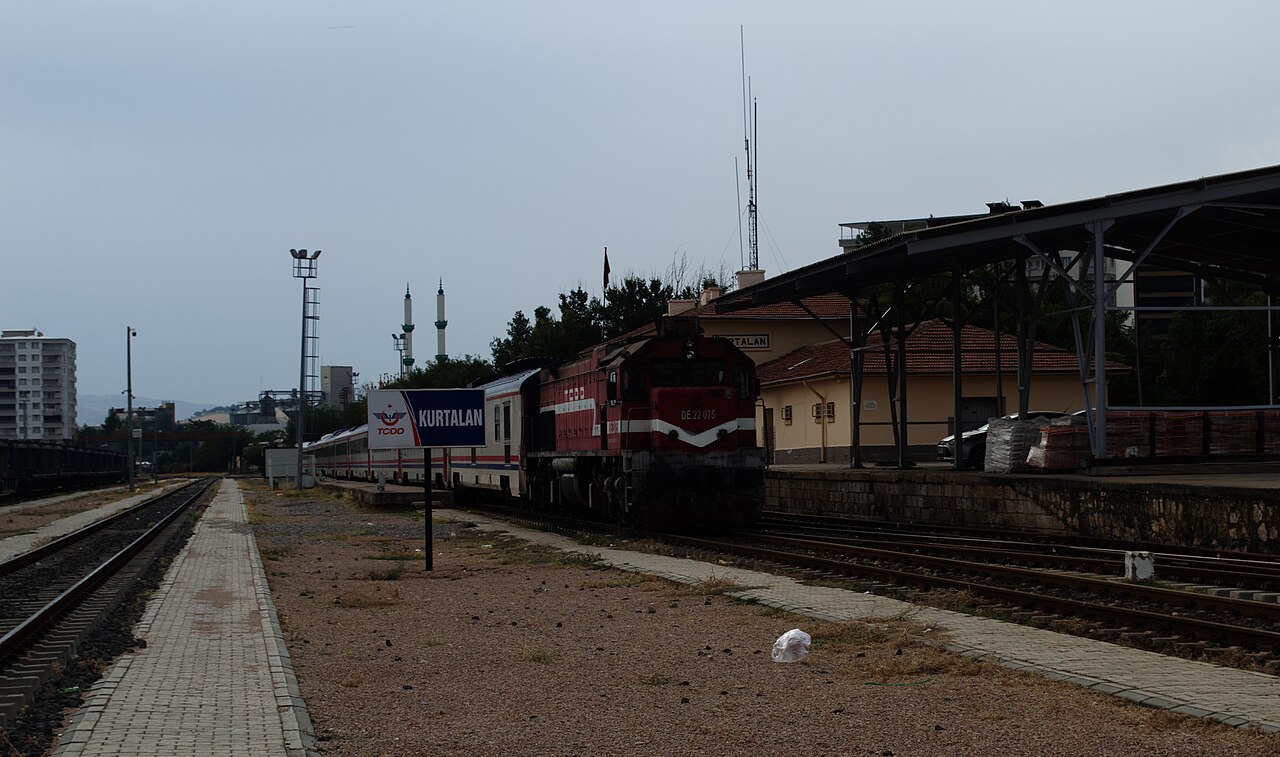
In a 2018 interview with Anadolu Agency reporter Bestami Bodruk, station chief Selahattin Yıldırım dated the first service to 29 October 1944. [4] GoTürkiye’s Southern Express guide describes the Ankara–Kurtalan service, with principal stops including Kayseri, Sivas, Malatya and Diyarbakır. [5] Kurtalan is the terminus of this service and branch. The wider Turkish railway network includes other eastern routes, so describing it as the single endpoint of the entire network is misleading. The station photograph records a specific train and setting in October 2026.
Railway workers and the experience of travel
Bodruk also interviewed retired railway worker Mehmet Şimşek, who began work at Kurtalan in 1972. Şimşek recalled a period when roads were less developed and passengers travelling toward Bitlis and Tatvan used the train through Kurtalan. His recollections explain the station’s regional importance through an individual working life. [4] They also suggest why the terminus mattered beyond the town itself: passengers continued toward other destinations after the railway journey ended. This dated testimony gives substance to the often repeated description of the train as a connection between the region and western cities.
Çattepe: a history older than the station
Eda Güngör Alper’s 2021 research places Çattepe Mound near the village of the same name in Kurtalan district, at the junction of the Botan and Tigris. She describes occupation from prehistoric times into the Middle Ages and studies the site’s terracotta lamps, including glazed and unglazed examples. Traces of burning on lamp nozzles help establish their use for illumination; some finds also show effects associated with a tenth-century fire. [6] The study offers evidence for everyday material life in the district’s older settlements. Çattepe is a separate archaeological site, rather than an ancient name for the modern town.
Sources and further reading
- Siirt Provincial Directorate of Culture and Tourism, Kurtalan: Tarihi Gelişimi; historical district name, changing centre and river geography.
- Murat Boran, Kurtalan Tarihine Kısa Bir Yolculuk, Kurtalan Gazetesi, 19 August 2024; local-history account identifying Misirç/Misircê and distinguishing settlement from district.
- Maarif Vekilliği Tebliğler Dergisi 301, 6 November 1944, p.68, notice 1316 and reproduced Interior Ministry letter of 29 September 1944; decree 18944, 12 September 1944.
- Bestami Bodruk, Demir Ağlarda Son Durak: Kurtalan, Anadolu Agency, 19 February 2018, updated 20 February; interviews with station chief Selahattin Yıldırım and retired railway worker Mehmet Şimşek.
- GoTürkiye, Güney Kurtalan (Southern) Express; official tourism guide identifying the Ankara–Kurtalan route and main stopping points.
- Eda Güngör Alper, Çattepe Höyüğü’nde Bulunan Pişmiş Toprak Kandiller, Süleyman Demirel University Journal of Social Sciences 52, 30 April 2021; published research abstract on the site and terracotta lamps.