Sheikhan, also written Shekhan or Şêxan, is a district of northern Iraq whose centre is Ain Sifni. Its towns, villages, shrines and proximity to Lalish make it an important landscape of Yazidi life. Its history also includes forced displacement, contested returns and rebuilding.
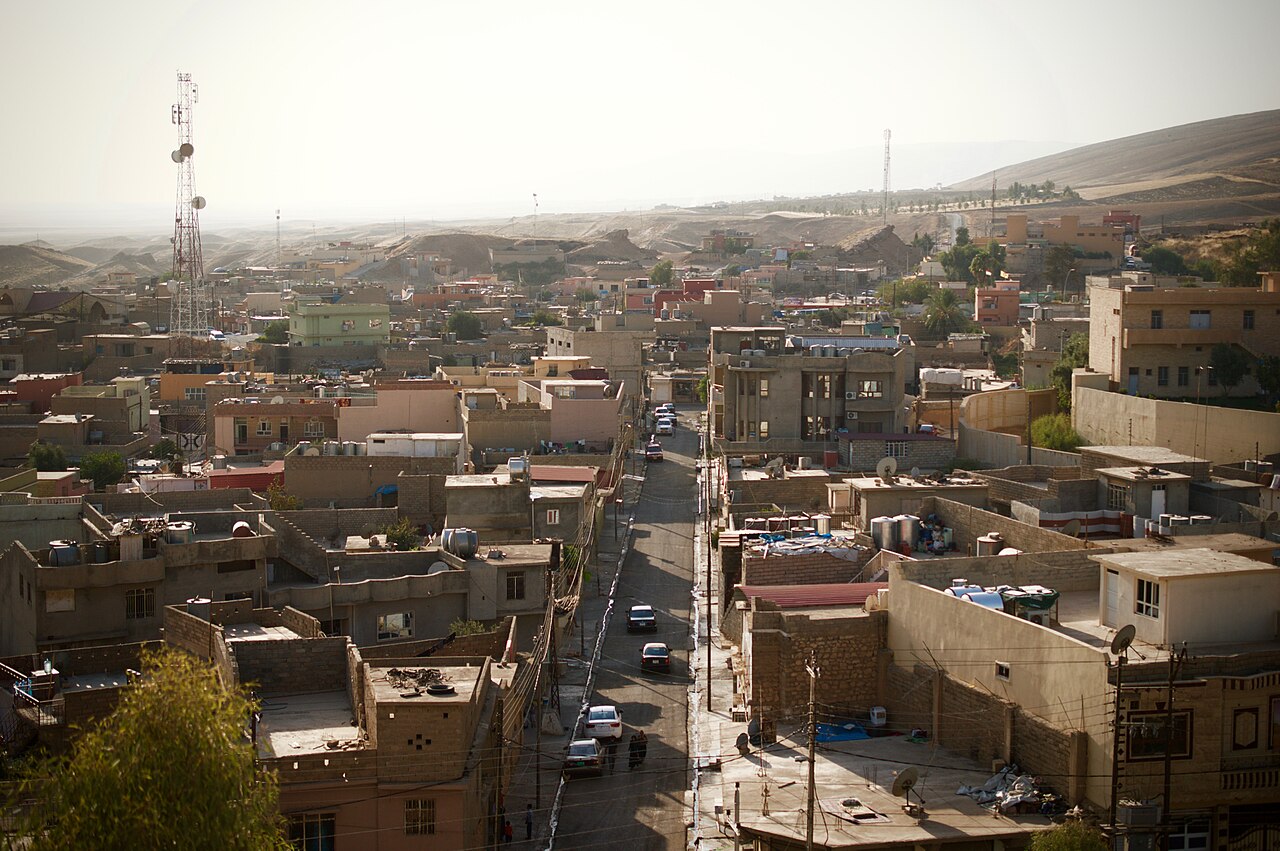

The district and its centre
Ain Sifni is Sheikhan’s administrative centre, north of Mosul. Mesopotamia’s survey places it about 11 kilometres south of Lalish, with Ba’adrê west and Mahad east. [1] Accounts use Sheikhan for both the settlement and the district; its religious landscape extends through neighbouring villages.
Sacred places within Ain Sifni
The survey records Sheikh ‘Alî Chamse’s hilltop mausoleum, Sheikh Hantuch’s smaller shrine outside town and Sheikh Mand’s cemetery memorial. The last is a cenotaph, a memorial without a buried body, resembling a small crenellated citadel with a black snake beside its entrance. [1] Each provides a distinct setting for devotion.
Lalish and the sanctuary of Sheikh Adi
Columbia University’s Mapping Mesopotamian Monuments project documents Sheikh Adi’s sanctuary as the central shrine of the Lalish valley. Its profile dates the beginning of the building around his tomb to shortly after his death in 1162 and describes later expansion as pilgrimage developed. The project recorded the monument in autumn 2013. [2] That history places a medieval sanctuary within a living landscape of religious practice, with different parts of the complex shaped by successive periods of use.
Arabization and the history of return
Human Rights Watch’s 2004 investigation records an agricultural official’s list of 46 originally Kurdish and Yazidi villages in Shaikhan that had been Arabized during the 1970s. Its Kis Qal’a case study documents expulsions in April 1975, the settlement of Arab families and the return of displaced Kurdish villagers after 2003. The report also records Arab settlers who fled the 2003 war and were prevented from returning. [3] These accounts show how forced displacement, landholding and competing experiences of return became intertwined in the district. They provide specific evidence behind a history often compressed into a general account of persecution.
Displacement and returns: a dated snapshot
IOM’s January 2025 Master List report compares data gathered in September–December 2024 with the corresponding 2023 period. It records a reduction of 6,275 internally displaced people in Al-Shikhan district. The report links returns from Al-Shikhan and Al-Hamdaniya to facilitated voluntary movement, government support, preparations for camp closures and, for some families, improved services and reunification. [4] This measures a change in the displaced population during a defined period; it is neither the district’s total population nor a count of everyone whose displacement had ended permanently.
The heritage record
Iraq submitted Lalish Temple to its UNESCO Tentative List on 15 April 2020, under cultural criteria (iii) and (vi). The entry identifies it with Sheikhan district in Nineveh. [5] A Tentative List entry records a state’s proposed heritage nomination; it does not mean the property has been inscribed on the World Heritage List. Together, architectural documentation and community histories explain the district’s importance through identifiable places and events.
Sources and further reading
- Birgül Açıkyıldız-Şengül and Mesopotamia’s field team, The Yazidi mausoleums in Ain Sifni, architectural survey and June 2018 observations.
- Matthew Peebles and Helen Malko, Sanctuary of Shaykh ‘Adī, Mapping Mesopotamian Monuments, Columbia University, 2020; documentation from autumn 2013.
- Human Rights Watch, Claims in Conflict: Reversing Ethnic Cleansing in Northern Iraq, 2004, sections III and V, including the Kis Qal’a village case study.
- IOM Iraq, Master List Report 134, January 2025, pp. 1–2; data collection September–December 2024.
- Ministry of Culture, Tourism and Antiquities of Iraq, Lalish Temple, UNESCO Tentative List submission, 15 April 2020, reference 6467.