Assess a specific claim by tracing its source, date and evidence. This guide uses published journalism standards, AFP’s verification methods and dated Kurdish news examples to distinguish reporting, public statements and unsupported conclusions.

Write down the claim before judging the outlet
Record who is alleged to have done what, where and when. Separate the date of the event from the date of publication or a later repost, and keep the original wording beside any translation. A recognisable outlet or a calm writing style does not, by itself, establish a particular claim. The Society of Professional Journalists’ code calls for verification before publication, original sources where possible, clear attribution and context. [1] These are concrete reporting practices, rather than a list of approved political viewpoints.
Trace the evidence behind repeated reports
AFP says it requires at least two independent sources for the central claim of its fact-checks and shows the evidence and verification steps to readers. It seeks original studies, recordings or transcripts where relevant. [2] For a reader, the important question is whether apparently separate reports have separate evidence. Five sites repeating one unnamed official or copying one agency story do not supply five independent observations. An on-record eyewitness, an original document and an authenticated recording can answer different parts of a claim; explain which part each actually supports.
A Kurdish example: what a denial establishes
On 5 March 2026, KRG spokesperson Peshawa Hawramani denied that the Kurdistan Region was part of a plan to arm Kurdish opposition parties and send them into Iran. [4] The primary statement establishes what the KRG publicly denied, who said it and when. It does not independently establish every party’s movements, rule out every covert contact or speak for every Iranian Kurdish organisation. A careful report can cite the denial while separately examining the underlying allegation. Attribution preserves that distinction.
Check the photograph as a separate piece of evidence
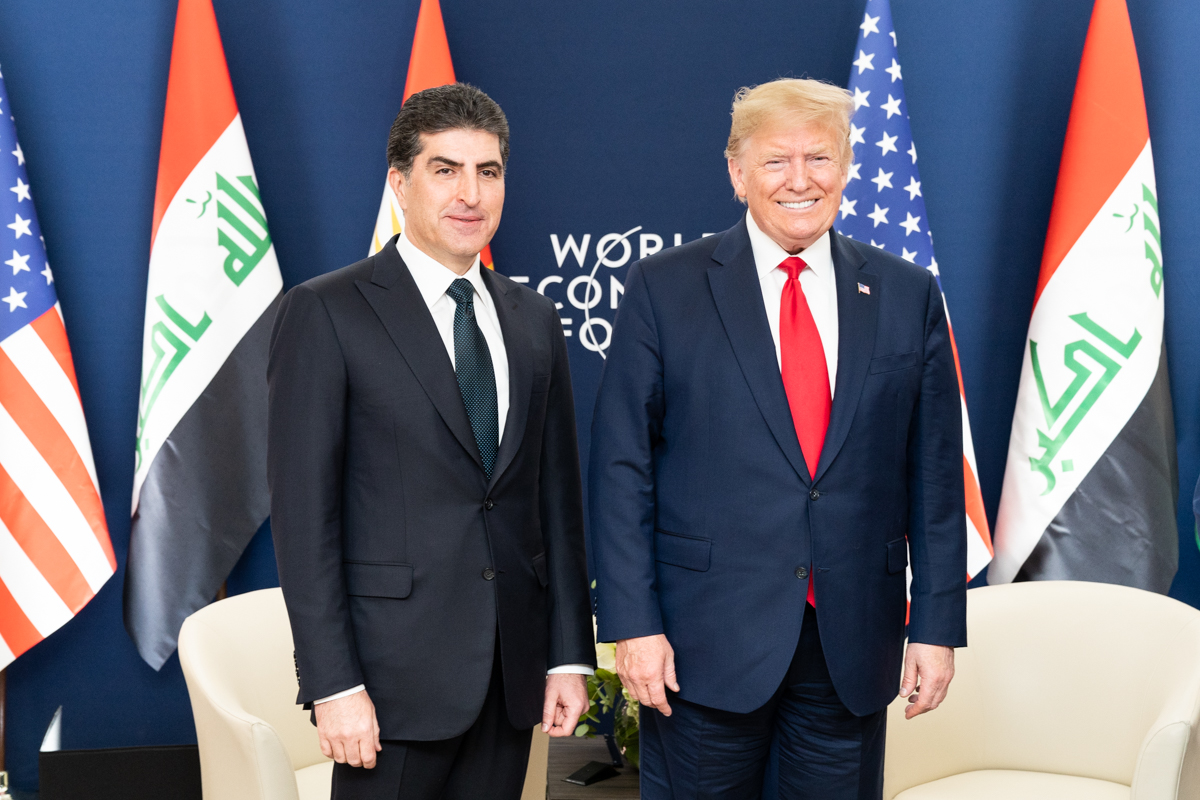
The image on this page shows Barzani and Trump at Davos on 22 January 2020, according to its White House caption. [5] If it were presented as a 2026 meeting, the photograph could be genuine while the accompanying event claim was wrong. AFP’s reverse-image guide explains how searching a picture can locate earlier appearances and reveal a changed date or setting. [3] Compare captions, photographer credit, visible landmarks and the earliest traceable publication. A search with no match leaves the origin unresolved; it does not authenticate the picture.
Keep uncertainty visible
Use words that match the evidence: announced, alleged, reported, denied or independently verified are different descriptions. AFP notes that it does not base a conclusion about AI-generated material on an AI detector alone. [2] A convincing-looking image, a viral repost or a confident translation is therefore a starting point for checking. Record what remains unknown instead of filling gaps with an attractive explanation or treating every unverified report as already disproved.
Look for corrections and a clear source trail
SPJ’s code calls for prompt, prominent corrections and explanations of clarifications, and for advocacy or commentary to be labelled. [1] Useful reporting lets readers find the documents and understand updates. This revised guide replaces the earlier suggestions that awards, influential recommendations, neutral tone or repeated publication are sufficient indicators of truth. Evaluate the evidence for the individual claim and revisit it when new information appears.
Sources and further reading
- Society of Professional Journalists, SPJ Code of Ethics, revision adopted 6 September 2014; verification, attribution, context, commentary labels and corrections.
- AFP Fact Check, How we work; independent sources, original evidence, transparent methods and limits of AI-detection tools.
- Gaelle Faure, How to do a reverse image search, AFP Fact Check, 26 December 2024; locating earlier appearances and misleading context.
- Peshawa Hawramani, Statement by the Spokesperson of the Kurdistan Regional Government, 5 March 2026; primary text of the denial discussed here.
- Shealah Craighead / White House, President Trump at Davos with Nechirvan Barzani, 22 January 2020; official photograph and caption, Wikimedia Commons, public domain.