Allahqoli Khan Zanganeh was a Zand-era governor of Kermanshah who died in conflict with Khosrow Khan of Ardalan in 1785. A regional chronicle preserves a detailed, partisan account of his final campaign.

A governor in the Zand period
Allahqoli Khan belonged to the Zanganeh, also written Zangana, a Kurdish group whose leaders held important offices in western Iran. Jean Calmard identifies him as a powerful beglerbegi, or provincial governor, of Kermanshah during the Zand period. The published evidence used here is strongest for his office and his final campaign. It does not provide a securely established birth date, education or account of his childhood. [1]
Why Kermanshah mattered
Kermanshah lay on an important route between Mesopotamia and the Iranian plateau. Its nearby fortress and artillery became prizes in the struggles following Nader Shah’s assassination in 1747. Calmard describes Zangana and Kalhor support for the Zand capture of the fortress in 1753. This setting helps explain the military importance of a provincial governorship. It does not by itself prove that Allahqoli personally built every regional fortification or introduced particular trade reforms. [1]
The succession crisis before his last campaign
Karim Khan Zand died in 1779, leaving rival members of his dynasty fighting over power. John R. Perry traces Ali-Morad Khan’s rise, the weakening of Zand control in the north and his death in February 1785. British Library specialist Louis Allday uses East India Company correspondence to show how reports of killings and changing rulers reached British officials at Bushire. These accounts establish the wider crisis within which local leaders sought support; they are not personal administrative records of Allahqoli’s government. [4] [5]
What the Ardalan chronicle reports
In Sara Zandi Karimi’s translation, the History of the Ardalanids says that tribes formerly moved to Shiraz gathered around Allahqoli after Ali-Morad’s death. It portrays him as claiming sovereignty and describes an advance through Bisotun, a force sent towards Ardalan, a defeat near Mirabad and a further confrontation near Sonqor. These events place him within active struggles for regional power rather than an uninterrupted period of peaceful provincial administration. Troop numbers and motives in the narrative remain the chronicler’s claims. [2]
Defeat, death and a continuing family presence
Calmard dates Allahqoli’s defeat and killing by Khosrow Khan Bozorgi’s forces to 1785. The translated chronicle locates the final clash at Rizleh in the Sonqor area and names a man called Mirza Beg as his killer. It presents Khosrow as disapproving of the killing and returning the body towards Kermanshah. Both accounts then identify Allahqoli’s paternal uncle, Haji Ali Khan Zangana, as governor under Khosrow. His death therefore did not remove every Zangana leader from provincial office. [1] [2]
Read the source as a court history
Zandi Karimi explains that the underlying continuation of the Sharafnameh was written in Persian in the early nineteenth century by Mohammad Ibrahim Ardalan, on Amanullah Khan’s commission, for presentation to John Malcolm in 1810. Its praise of the Ardalan house helps explain its portrayal of Khosrow and his opponents. It is a valuable narrative witness, but not an eyewitness transcript of Allahqoli’s thoughts or a neutral verdict on his rival. [2]
Distinguishing the Zangana officials
The earlier Safavid grand vizier Shaykh Ali Khan Zangana is a different individual. Rudi Matthee dates his grand vizierate to 1669–1689 and discusses his fiscal and diplomatic policies in detail. Those policies cannot automatically be assigned to Allahqoli a century later. Shared group affiliation also does not establish an exact father-to-son genealogy. For Allahqoli, a responsible biography centres on the documented governorship, the contested campaign and the limits of the surviving evidence. [3]
Sources and further reading
- Jean Calmard, “Kermanshah iv. History to 1953”, Encyclopaedia Iranica XVI/3 (2017), pp. 319–324, updated 2018: strategic setting, Zand-era governors and the events of 1785.
- Sara Zandi Karimi, “History of Ardalānids (1590–1810) by Sharaf al-Dīn bin Shams al-Dīn”, Kurdish Studies 5/1 (May 2017), pp. 56–79; introduction pp. 56–58 and campaign narrative pp. 71–72. Critical translation of a later continuation of the Sharafnameh.
- Rudi Matthee, “Šayḵ-ʿAli Khan Zangana”, Encyclopaedia Iranica (2000; updated 2015): the separate seventeenth-century grand vizier and his policies.
- John R. Perry, “Zand Dynasty”, Encyclopaedia Iranica (2000; updated 2016): the succession struggles after 1779 and Ali-Morad’s death in 1785.
- Louis Allday, British Library, “The Brutal End of Persia’s Zand Dynasty, 1779–1794”, Qatar Digital Library, 7 June 2017: contemporary East India Company reporting and links to archival letters.
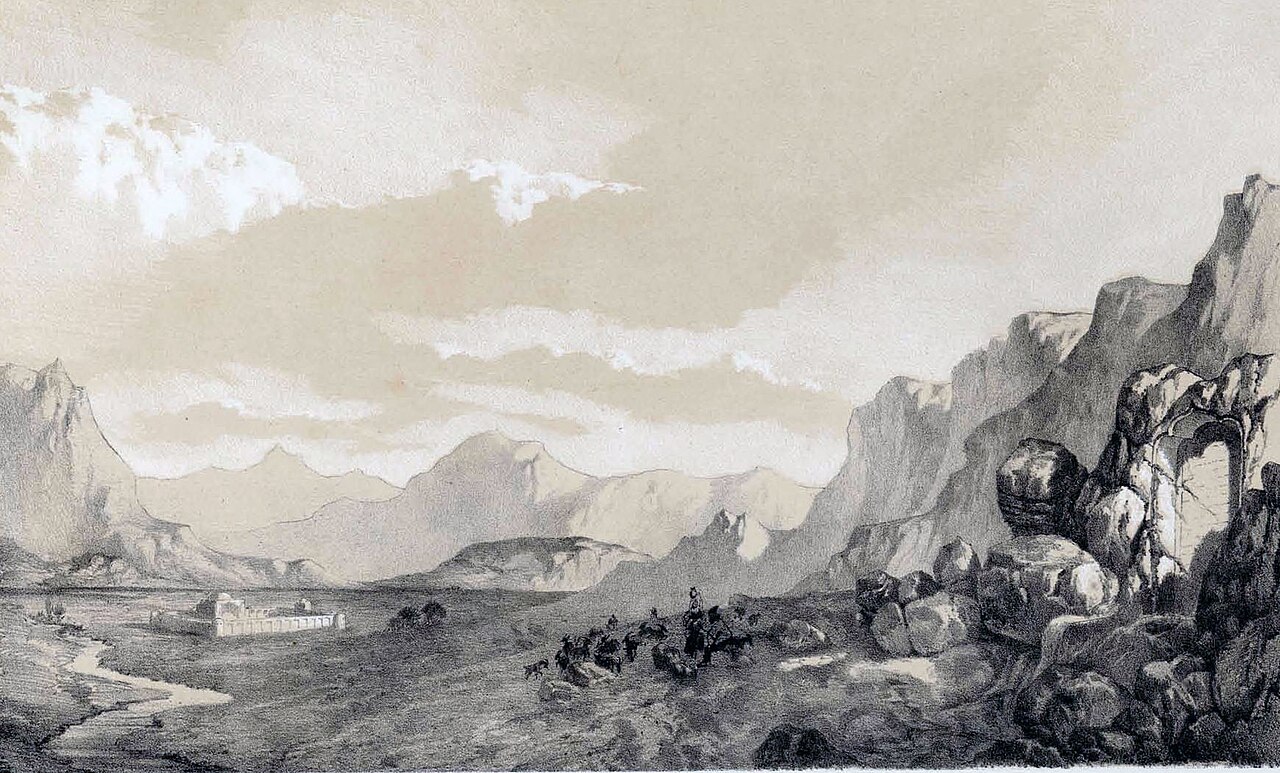
- Eugène Flandin, Caravanserai Bi Sutoun, 1840, published in Voyage en Perse (1851); public-domain print via Wikimedia Commons.