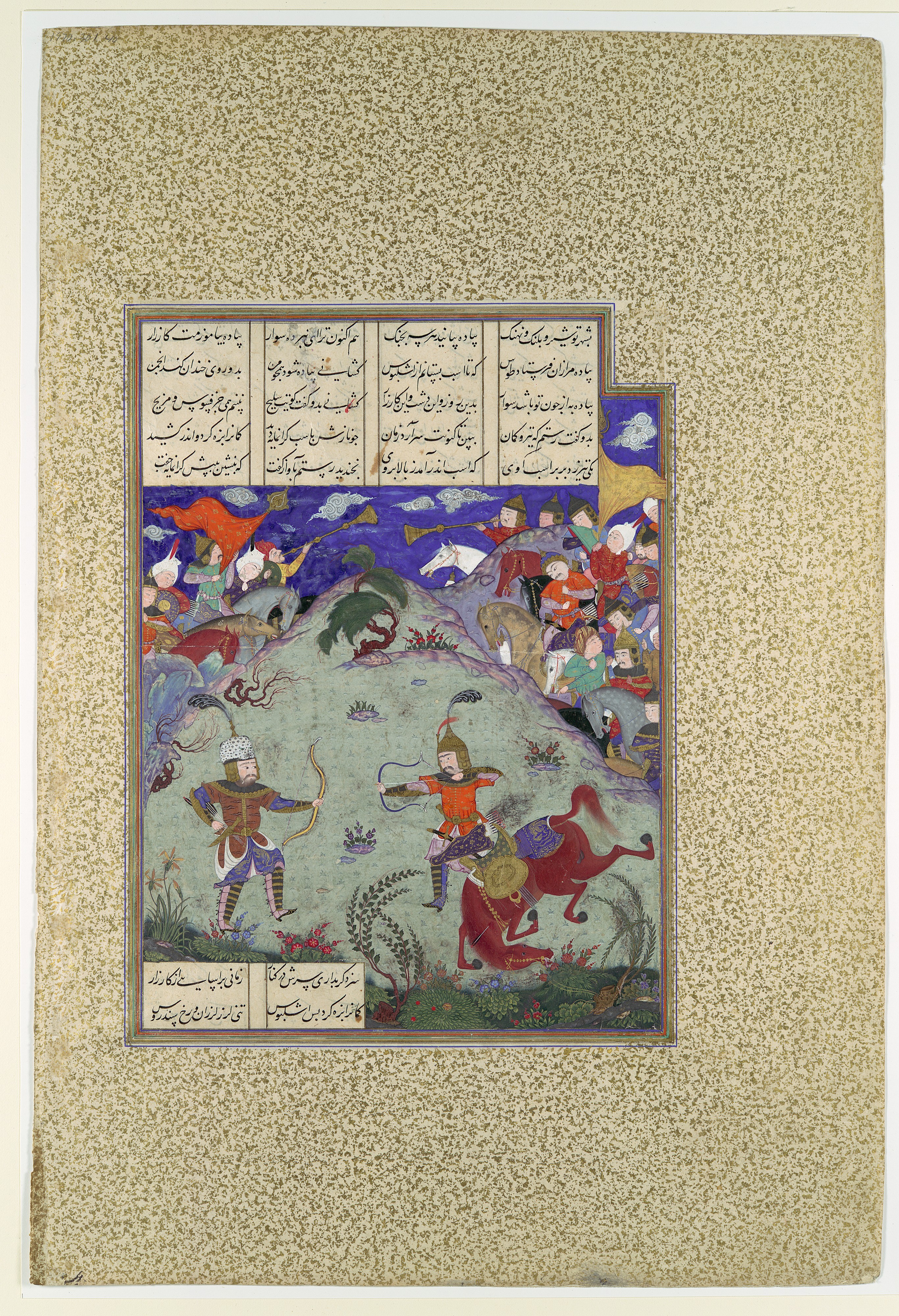
Ashkbus: The Champion Felled by Rostam's Arrow
- Sherko Sabir

- Jun 3
- 13 min read

Introduction
Ashkbus is the proud champion of the Shahnameh, the Persian Book of Kings, whose duel with the great Rostam is among the most celebrated and beloved single combats of the entire epic, immortalized in countless Persian miniatures. A foreign warrior allied to the Turanian cause, Ashkbus first overcame an Iranian hero, only to meet his end at the hands of Rostam, who felled him with a single arrow while fighting on foot, his horse having been slain.
Ashkbus appears in the war of Kamus, the great conflict in which the Turanian Afrasiab gathered a host of foreign allies against Iran during the reign of Kay Khosrow. In that war, Ashkbus defeated the Iranian champion Rohham, but then, in his pride, he faced Rostam, and the combat that followed, the hero on foot bringing down the mounted champion with one well-aimed shaft, became one of the epic's most famous and admired scenes.
Like all the figures of the Book of Kings, Ashkbus belongs to the shared epic heritage of the Iranian peoples, a tradition the Kurds hold in common with the Persians, the Lurs, and others of the Iranic world. To know Ashkbus is to encounter one of the memorable adversaries of Rostam, the proud champion whose fall to a single arrow is among the best-loved combats of the Shahnameh, a scene beloved of poets and painters alike. His duel with Rostam is a small masterpiece of the epic's art of the heroic combat.
Contents
Who Is Ashkbus?
Ashkbus, also spelled Ashkabus or Askbos, is a champion of the Shahnameh, a proud foreign warrior who fought on the side of the Turanian cause against Iran in the war of Kamus, during the reign of Kay Khosrow. In that war he first met and defeated the Iranian hero Rohham, but he was then confronted by the greatest of all champions, Rostam, who slew him with a single arrow while fighting on foot, his own horse Rakhsh not under him in the combat. The duel of Rostam and Ashkbus, in which the hero on foot brought down the mounted champion with one shaft, became one of the most celebrated and frequently depicted combats in the entire epic. Ashkbus is remembered as the proud champion whose fall to Rostam's single arrow is among the best-loved scenes of the Shahnameh.
A Champion of the War of Kamus
Ashkbus appears in the war of Kamus, one of the great war-cycles of the Shahnameh, fought during the reign of Kay Khosrow. In this conflict, the Turanian Afrasiab, hard-pressed in his long war with Iran, summoned a great coalition of foreign allies, led by the Khaqan of Chin and including mighty champions such as Kamus of Kashan, to overwhelm the Iranian army.
Ashkbus was one of the champions of this coalition, a foreign warrior, called of Keshan or a Keshanian in the tradition, who came to fight against Iran. When the Iranian army found itself hard-pressed by the powerful host that Afrasiab had gathered, and was in grave difficulty, the champions of the coalition, Ashkbus among them, came forward to challenge and overcome the Iranian heroes. It was in this perilous situation, before the arrival of the great Rostam turned the tide, that Ashkbus made his mark by defeating an Iranian champion sent against him. His role in the war of Kamus is thus that of one of the formidable foreign foes whose prowess threatened Iran in its hour of peril, and whose defeat would come only with the coming of the greatest of the Iranian heroes. As a champion of the war of Kamus, Ashkbus belongs to the same great conflict as the mighty Kamus himself, one of the host of foreign allies whose challenge to Iran was met and broken by Rostam. His place in this war-cycle sets the stage for his famous duel with the hero.
Key Takeaways
Ashkbus is a proud foreign champion of the Shahnameh, allied to the Turanian cause.
He appears in the war of Kamus during the reign of Kay Khosrow.
He first defeated the Iranian hero Rohham in combat.
He was then slain by Rostam, who fought him on foot without Rakhsh.
Rostam killed him with a single, famous arrow.
The duel is one of the most beloved subjects in Persian miniature painting.
Quick Facts
Name: Ashkbus (also Ashkabus, Askbos)
Role: Proud foreign champion against Iran
Allegiance: The coalition allied to Afrasiab and Turan
War: The war of Kamus, under Kay Khosrow
First victory: Defeated the Iranian hero Rohham
Slain by: Rostam, the greatest hero of Iran
Manner of death: A single arrow, Rostam fighting on foot
Fame: A favourite subject of Persian miniature painting
Linked champion: Kamus of Kashan, of the same war
Heritage: Shared Iranic epic tradition
The Defeat of Rohham
Ashkbus first made his mark in the war by defeating the Iranian champion Rohham, a hero of the great House of Gudarz. When the proud Ashkbus came forward to challenge the Iranians, Rohham went out against him, but in the combat that followed, Ashkbus proved the stronger and overcame the Iranian hero, forcing him to withdraw.
The defeat of Rohham by Ashkbus served to establish the foreign champion as a formidable warrior and to heighten the drama of the duel to come. Rohham was no mean fighter but a champion of one of Iran's great heroic houses, and his defeat showed that Ashkbus was a foe of real prowess, not to be lightly overcome. This setback for the Iranians, coming amid the wider difficulties of the war of Kamus, added to the peril of their situation and to the pride and confidence of Ashkbus, who now stood victorious on the field, having bested an Iranian champion. It is a common pattern in the epic that a foe first defeats a lesser hero before being overcome by the greatest, and the defeat of Rohham by Ashkbus follows this pattern, building up the foreign champion's prowess so that his own defeat by Rostam may be the more striking. The victory over Rohham thus marks Ashkbus as a worthy and formidable adversary, and sets the stage for the famous duel in which the proud champion, flushed with his success, would face the greatest hero of Iran and meet his end.
The Duel with Rostam
With the Iranian hero Rohham defeated and the proud Ashkbus victorious on the field, it fell to the greatest of all champions, Rostam, to confront the foreign warrior. The duel that followed is one of the most famous single combats of the Shahnameh, remarkable for the circumstance that Rostam fought it on foot, without his great horse Rakhsh under him.
The tradition relates that Rostam came forward against Ashkbus on foot, and the mounted champion, seeing the hero without a horse, mocked and taunted him, confident in his own advantage. But Rostam was unperturbed by the taunts of his proud foe. In the combat that followed, the hero first dealt with the champion's horse, and then turned his bow upon Ashkbus himself. The image of the great Rostam, on foot and seemingly at a disadvantage against a mounted and boastful foe, yet calm and assured in his supreme prowess, is central to the fame of this duel. It is a scene that displays the hero's mastery and composure, his ability to overcome even from a position of apparent disadvantage, and to humble the pride of a boastful enemy. The duel of Rostam and Ashkbus, the hero on foot against the mounted champion, is one of the epic's memorable contests, a small masterpiece of heroic drama in which the proud foe's confidence is met by the quiet, unanswerable mastery of the greatest of champions. It would be settled, famously, by a single arrow.
The Single Arrow
The duel of Rostam and Ashkbus is most famous for its conclusion: the slaying of the proud champion by a single arrow from Rostam's bow. Having dealt with the champion's mount, the hero drew his bow and loosed a single, perfectly aimed shaft at Ashkbus, striking him down and slaying him with that one arrow.
The single arrow that felled Ashkbus is the celebrated heart of the tale, an image of the hero's supreme skill and the effortless mastery with which he overcame his boastful foe. Where the proud Ashkbus had mocked Rostam for fighting on foot, the hero answered not with words but with one unerring shot, bringing down the mounted champion with a single arrow, a deed that displayed both his matchless archery and the futility of the champion's pride. The motif of the single, decisive arrow is a powerful one in the epic, expressing the idea that the greatest of heroes need only one shaft to fell even a formidable foe, and the slaying of Ashkbus is among its most famous instances. The contrast between the boasting of the mounted champion and the quiet, single arrow that ends him is the dramatic core of the scene, a lesson in the humbling of pride by true mastery. The single arrow that slew Ashkbus is the detail that fixed this combat in the memory of the tradition, the image of the hero on foot felling the proud horseman with one perfect shot, and it is for this that the duel is so beloved and so often retold and depicted.
A Beloved Scene of Persian Art
The duel of Rostam and Ashkbus holds a special place not only in the text of the Shahnameh but in the visual tradition of Persian art, for it became one of the most popular and frequently depicted of all the epic's combats in Persian miniature painting.
Across the centuries, the painters who illustrated the great manuscripts of the Shahnameh returned again and again to the scene of Rostam and Ashkbus, drawn by its dramatic power and its memorable imagery: the hero on foot, bow drawn, calm and assured; the proud champion mounted and boastful; the single arrow in flight. The composition, with its clear contrast between the two figures and its moment of decisive action, lent itself beautifully to the art of the miniature, and depictions of this duel are found in many of the illustrated copies of the epic. This popularity in the visual tradition is a measure of the fame and appeal of the combat, which captured the imagination not only of the reciters and readers of the epic but of its painters as well. The scene of Rostam felling Ashkbus with a single arrow became one of the iconic images of the Shahnameh, a favourite of the miniaturists and a testament to the enduring appeal of this small but perfect episode of heroic drama. That the duel of Rostam and Ashkbus was so beloved a subject of Persian art is itself part of the figure's significance, for Ashkbus lives on not only in the verses of the epic but in the brushwork of the great painters who immortalized his famous fall.
Symbolism and Meaning
Ashkbus embodies, above all, the humbling of pride by true mastery. As the boastful champion who mocked Rostam for fighting on foot, only to be felled by a single arrow, he represents the vanity of pride and arrogance before genuine greatness, the boastful foe whose confidence is answered not by words but by the quiet, unanswerable skill of the true hero. In his fall, the epic offers a lesson in the emptiness of arrogance and the supremacy of real prowess over mere boasting.
Ashkbus embodies, too, the motif of the single decisive stroke, the idea that the greatest of heroes need only one arrow to fell even a formidable and proud foe. His defeat displays the matchless skill of Rostam, the hero who triumphs from a position of apparent disadvantage, on foot against a mounted enemy, and humbles his boastful opponent with a single perfect shot. In this, Ashkbus serves, like other foes of the epic, to magnify the hero who overcomes him, his pride and his prior victory over Rohham building him up so that his fall may be the more striking. And in becoming a beloved subject of Persian art, the duel of Rostam and Ashkbus embodies the way the great combats of the epic lived on in the visual as well as the literary tradition. In all this, Ashkbus is a meaningful figure, embodying the humbling of pride, the motif of the single decisive arrow, the supremacy of Rostam, and the enduring appeal of the epic's heroic combats. He is the proud champion whose famous fall to a single arrow is among the best-loved scenes of the Shahnameh.
Ashkbus and the Kurds
Ashkbus, like all the figures of the Shahnameh, belongs to the shared epic and mythological heritage of the Iranian peoples, a tradition that the Kurds hold in common with the Persians, the Lurs, and others of the Iranic world. The great epic of Ferdowsi, with its heroes and its famous combats, is the common inheritance of these peoples, who share in the ancient Iranian mythological tradition from which it springs. It is honest and accurate to understand Ashkbus and his famous duel with Rostam as part of this shared heritage, rather than as uniquely Kurdish material.
For the Kurds, as an Iranian people, the figures and tales of the Shahnameh are part of the wider cultural and mythological world to which they belong, and the epic and its figures hold a place in the broad Iranic heritage that the Kurds share. The figure of Ashkbus, and the celebrated duel in which he fell to Rostam's arrow, is part of the common store of Iranian epic tradition, known and valued across the Iranic lands. In presenting Ashkbus, then, we present not a specifically Kurdish figure but one of the memorable adversaries of the shared Iranian epic, belonging to the heritage that the Kurds hold in common with the other peoples of the Iranic world. This honest framing places Ashkbus accurately within the broad and rich tradition of Iranian epic to which the Kurds, as an Iranic people, are heirs alongside their neighbours. The famous tale of his fall, like the wider epic, is part of the shared treasury of heroic story that the Kurds value as their own alongside the other heirs of the Iranian tradition.
Debates and Misconceptions
Is Ashkbus a specifically Kurdish figure? No; like all the figures of the Shahnameh, he belongs to the shared epic heritage of the Iranian peoples, a tradition the Kurds hold in common with the Persians, the Lurs, and others of the Iranic world, rather than a uniquely Kurdish figure. Indeed, he is a foreign champion allied to the Turanian cause, an enemy of Iran. As an Iranian people, the Kurds share in the broad Iranic heritage of the epic, whose figures are part of the common Iranian tradition to which the Kurds, alongside their neighbours, are heirs.
Why is the duel of Rostam and Ashkbus so famous if Ashkbus is a minor figure? It is precisely the duel, rather than the figure of Ashkbus in himself, that is famous. Ashkbus is a secondary character whose importance lies entirely in his celebrated combat with Rostam. The fame of the duel rests on its memorable imagery and drama, the hero fighting on foot, the boastful mounted foe, and above all the single arrow that fells him, which made it a favourite of poets and a beloved subject of Persian miniature painting. Ashkbus is thus a minor figure who features in a major and much-loved scene, his significance bound to that one famous combat rather than to any larger role in the epic.
Did Rostam really fight Ashkbus on foot, without Rakhsh? Yes; this is one of the distinctive and famous features of the combat as the tradition relates it. In the duel, Rostam fought on foot, without his great horse Rakhsh under him, and the mounted Ashkbus mocked him for this apparent disadvantage. The detail is important to the fame of the scene, for it heightens the contrast between the boastful, mounted champion and the hero who, though seemingly at a disadvantage, overcomes him with effortless mastery, felling both the champion's horse and then the champion himself with his bow. The image of Rostam on foot, calmly bringing down the proud horseman with a single arrow, is central to why the duel became so celebrated and so often depicted.
Related Topics
Rostam: the greatest hero of Iran, who felled Ashkbus with one arrow
Rohham: the Iranian hero whom Ashkbus first defeated
Kamus of Kashan: the mighty champion of the same war, also slain by Rostam
Afrasiab: the Turanian king who summoned the foreign coalition
Kay Khosrow: the Iranian king during whose reign the war was fought
Tus: a leading Iranian commander of the campaigns
Esfandiyar: another great warrior of the epic
The Shahnameh: the Persian Book of Kings, the great epic of Iran
Frequently Asked Questions
Who is Ashkbus in the Shahnameh?
Ashkbus, also spelled Ashkabus, is a proud foreign champion of the Shahnameh who fought on the side of the Turanian cause against Iran in the war of Kamus, during the reign of Kay Khosrow. He first defeated the Iranian hero Rohham, but was then slain by the greatest of all champions, Rostam, who killed him with a single arrow while fighting on foot. The duel of Rostam and Ashkbus is one of the most celebrated and frequently depicted combats in the entire epic.
How did Rostam kill Ashkbus?
Rostam killed Ashkbus with a single arrow. Famously, Rostam fought the duel on foot, without his horse Rakhsh, and the mounted Ashkbus mocked him for this apparent disadvantage. But Rostam, unperturbed, dealt with the champion's horse and then drew his bow and loosed one perfectly aimed shaft at Ashkbus, striking him down and slaying him with that single arrow. The image of the hero on foot felling the proud horseman with one shot is the celebrated heart of the tale.
Whom did Ashkbus defeat before facing Rostam?
Before facing Rostam, Ashkbus defeated the Iranian champion Rohham, a hero of the great House of Gudarz. When the proud Ashkbus challenged the Iranians, Rohham went out against him but was overcome and forced to withdraw. This victory established Ashkbus as a formidable warrior and heightened the drama of his duel with Rostam, following the epic's common pattern in which a foe first defeats a lesser hero before being overcome by the greatest.
Why is the duel of Rostam and Ashkbus so famous?
The duel is famous for its memorable drama and imagery: Rostam fighting on foot without his horse, the boastful mounted champion mocking him, and above all the single arrow with which the hero fells his proud foe. It became a favourite of poets and one of the most popular subjects in Persian miniature painting, depicted in many illustrated manuscripts of the Shahnameh. The scene captures the humbling of arrogance by true mastery and the effortless skill of the greatest of heroes.
Was Ashkbus a major character?
No; Ashkbus is a secondary figure whose importance lies almost entirely in his celebrated duel with Rostam. He appears in the war of Kamus, defeats Rohham, and is then slain by Rostam's arrow. It is the duel, with its memorable imagery and its fame in Persian art, rather than the figure of Ashkbus in himself, that is significant. He is thus a minor character who features in a major and much-loved scene of the epic.
Is Ashkbus a Kurdish figure?
Ashkbus belongs to the shared epic heritage of the Iranian peoples, a tradition the Kurds hold in common with the Persians, the Lurs, and others of the Iranic world, rather than a uniquely Kurdish figure. Indeed, he is a foreign champion allied to the Turanian cause, an enemy of Iran. As an Iranian people, the Kurds share in the broad Iranic heritage of the epic, whose figures are part of the common Iranian tradition to which the Kurds are heirs alongside their neighbours.
References and Further Reading
Comments