Fuad Masum served as Iraq’s president from 2014 to 2018 after leading the Kurdistan Region’s first cabinet. Parliamentary records, constitutional provisions and his own statements clarify the offices he held and the limits of his authority.

A politician from Koy Sanjaq
Kurdistan Parliament’s biographical record identifies Muhammad Fuad Masum Khidr as Kurdish, born in 1938 in Koy Sanjaq, Erbil, and holding a doctorate. It lists his membership in the Patriotic Union of Kurdistan’s political bureau, leadership of the first Kurdistan regional cabinet in 1992 and later parliamentary work in Baghdad. Koy Sanjaq, also called Koya, is therefore the supported birthplace here. The 1992 regional premiership and the later Iraqi presidency were different offices, in different institutions; his career connects early regional government-building with participation in Iraq’s federal political system. [1]
Election and the constitutional office
A White House readout of 24 July 2014 records Joe Biden congratulating Masum on his selection and swearing-in as Iraq’s president. It also records Masum’s emphasis on restoring trust among Iraq’s communities. [2] The constitution identifies the president as head of state and a guarantor of constitutional order. Parliament elects the president; Article 68’s eligibility conditions do not reserve the office for a Kurdish candidate. Kurdish occupancy is a political practice, not an ethnic qualification written into that article. Article 78 assigns direct executive responsibility and military command to the prime minister. Calling Masum president should not imply that he personally directed every government or battlefield decision. [3]
The 2014 government-formation decision
Masum’s role became consequential during the selection of a new prime minister. The White House’s 11 August 2014 call record discusses his nomination of Haider al-Abadi and American support for the president’s constitutional role. It connects the transition to forming a more inclusive government capable of confronting the Islamic State threat. This contemporary diplomatic record establishes a specific action and the position of the United States at the time. Nomination was a stage in forming a cabinet, not the same event as parliamentary approval of that cabinet. The distinction matters when reading a timeline of the transition. [4]
War, reconciliation and relations with Erbil
At their 26 September 2014 meeting, Ban Ki-moon and Masum discussed government formation, ISIL, neighbouring states and humanitarian needs. The UN readout specifically emphasized harmonizing Baghdad–Erbil relations and providing resources for displaced people and Syrian refugees. [5] In a Kurdish-language interview published by VOA on 28 May 2015, Masum argued for social and political reconciliation, described weaknesses in rebuilding the army and discussed both Iranian assistance and US-led air support. He rejected negotiation with Islamic State. These were his assessments during the war, not proof that reconciliation had been achieved or that one president controlled the entire campaign. [6]
A dialogue initiative during the referendum crisis
On 16 September 2017, Alsumaria published a statement it said it had received from Masum. He called for intensive talks between political leaders and the federal and regional authorities, seeking peaceful, democratic solutions based on partnership and understanding Kurdish aspirations. He also cancelled his planned journey to the UN General Assembly and assigned Abadi to deliver Iraq’s address. This supplies concrete evidence of his attempt to mediate the referendum crisis. It records an initiative and an appeal for trust, rather than establishing that the competing parties accepted it or that the crisis was resolved. [7]
The end of the presidency and the record he left
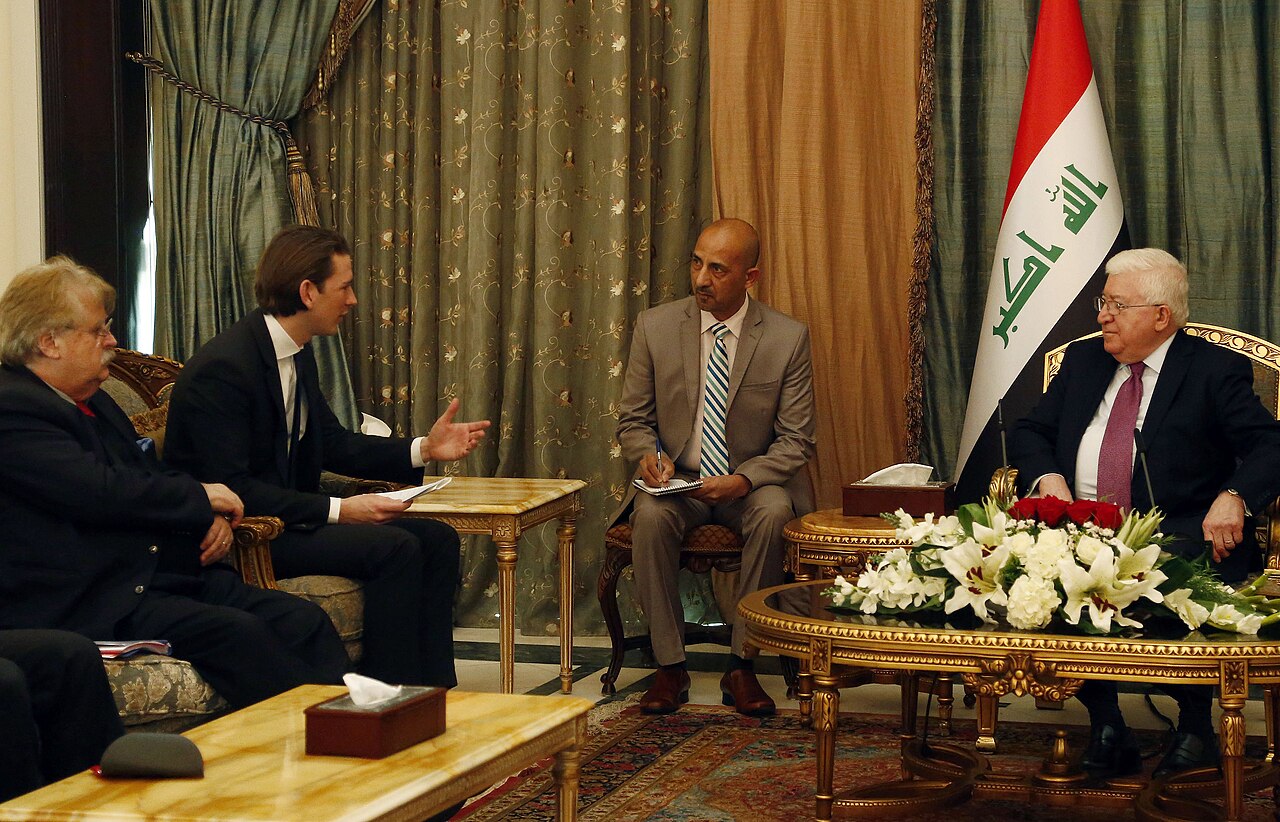
The UN Secretary-General’s statement of 3 October 2018 confirms that Barham Salih had been elected and sworn in on 2 October. That marks the end of Masum’s presidential tenure. [8] His record is best examined through these identifiable responsibilities: leading a regional cabinet, occupying a federal constitutional office, participating in government formation and advocating dialogue during conflict. The 2015 diplomatic photograph belongs to that public record too, with its date, participants and photographer identified. It shows a meeting in Baghdad, not his election or the later transfer of office. [9]
Sources and further reading
- Kurdistan Parliament, official biographical record for Dr Muhammad Fuad Masum Khidr: Koy Sanjaq, 1938, doctorate, PUK political bureau and first regional cabinet in 1992.
- White House, readout of Vice-President Biden’s conversation with President Fuad Masum, 24 July 2014: selection, swearing-in and intercommunal trust.
- Constitution of Iraq (2005), UNAMI English translation marked unofficial, hosted by UNHCR Refworld; Articles 67–70, 76 and 78: presidential role, eligibility, election and prime-ministerial authority.
- White House, readout of Biden’s call with Masum, 11 August 2014: nomination of Haider al-Abadi and government formation.
- UN Secretary-General, own meeting readout, 26 September 2014: Masum, government formation, Baghdad–Erbil relations and humanitarian needs.
- Ali Javanmardi, own Kurdish-language interview with Masum, VOA, published 28 May 2015; English excerpts on reconciliation, army reconstruction, foreign assistance and Islamic State.
- Fuad Masum statement, received and reproduced by Alsumaria, 16 September 2017: dialogue initiative over the referendum crisis and cancellation of his UN General Assembly journey.
- UN Secretary-General spokesperson, statement of 3 October 2018: Barham Salih elected and sworn in on 2 October.
- Dragan Tatic / Austrian Ministry for Europe, Integration and Foreign Affairs, Masum–Kurz meeting, Baghdad, 1 February 2015; Wikimedia Commons, CC BY 2.0.