A sourced account of the Kurdish Iraqi politician’s opposition work, ministerial career and contested removal and presidential candidacy.
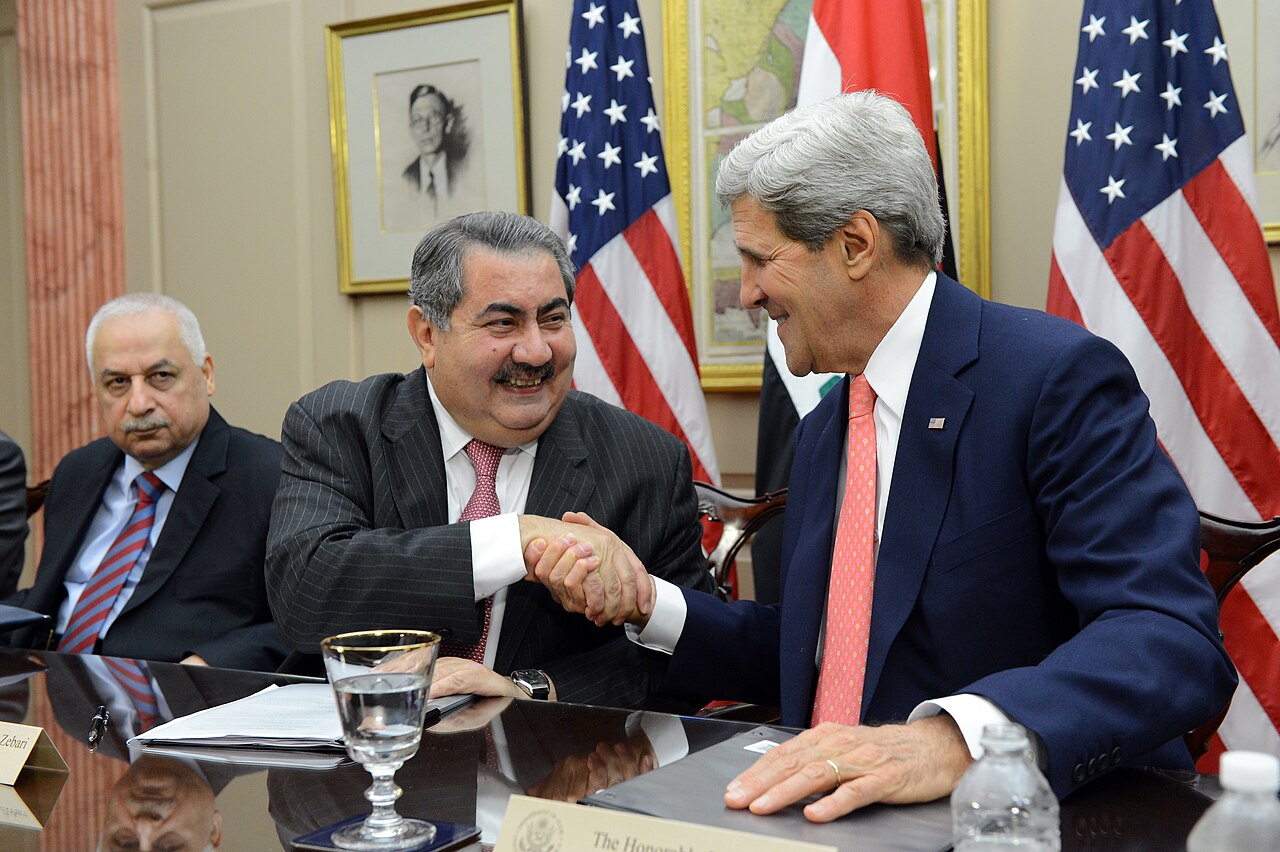

From Kurdish opposition to national diplomacy
Hoshyar Zebari is a Kurdish Iraqi politician associated with the Kurdistan Democratic Party. A ministerial biography archived by the European Parliament in 2008 places his birth in Akra, north of Mosul, in 1953. It records study in Jordan and a sociology master’s degree at Essex, Kurdish opposition activity against Saddam Hussein’s government, and international representation for the KDP before 2003. This gives his later diplomacy an organizational background: he had represented an opposition movement abroad before becoming a minister representing Iraq. [1]
Rebuilding a foreign ministry
Zebari served as foreign minister from 2003 to 2014. [2] The rebuilding of diplomatic institutions can be seen in a contemporary administrative record: a May 2004 statement preserved by the U.S. presidential archive says that his ministry and staff had reopened nearly fifty embassies. That statement came from the Coalition Provisional Authority’s side of the transfer of ministerial authority, and is best read as its contemporary account of the process. It documents institutional work without establishing that every foreign-policy result was the achievement of one minister. [3]
Iraq and Kuwait at the United Nations
On 27 June 2013 the Security Council unanimously adopted resolution 2107. The UN’s account records Zebari’s address welcoming the decision as progress in Iraq’s relations with Kuwait and the international community. The resolution concerned specified Chapter VII obligations over missing Kuwaiti and third-country nationals, their remains and property, including archives; UNAMI received a continuing role. It should not be summarized as the ending of every Iraqi international obligation. The case provides a dated example of the post-1990 issues that occupied the foreign ministry during his tenure. [4]
Finance during war and an oil-price shock
He moved to the finance ministry in October 2014. [2] The IMF approved a three-year arrangement of about US$5.34 billion on 7 July 2016, aimed at balance-of-payments pressures, debt sustainability and reforms while protecting social spending. The IMF described the combined impact of war with ISIS and lower oil prices on Iraq’s finances. [5] A separate IMF mission statement records meetings with Finance Minister Zebari in Amman between 28 August and 10 September 2016, alongside central-bank and other officials. These records locate his work within a wider government and international negotiation. [6]
Removal from office and his response
Parliament withdrew confidence from Zebari on 21 September 2016 following allegations of corruption and misuse of public funds. In an interview with Kurdistan24 the next day, conducted by Kamaran Omer, he denied the allegations and argued that the vote was politically motivated and procedurally unlawful. Those are his stated responses, not findings adopted here. [2] The parliamentary decision ended his ministerial tenure; a no-confidence vote is a political act and should not be presented as a criminal conviction.
The presidential candidacy decision
His attempted presidential candidacy later became the subject of Federal Supreme Court case 17/Federal/2022, decided on 13 February 2022. Ali Hadi Attia Al-Hilali’s legal analysis, published on the Supreme Judicial Council’s website, explains the court’s rejection in relation to the constitutional requirement of good reputation and its reliance on the earlier withdrawal of confidence. Al-Hilali also questions whether a politically coloured parliamentary decision alone adequately establishes failure of that requirement. This is an attributed critique of the legal reasoning. The ruling on eligibility, the 2016 allegations and any question of criminal guilt are distinct matters. [7]
Sources and further reading
- Curriculum Vitae of Minister of Foreign Affairs of Iraq: Hoshyar Zebari, European Parliament meeting-document archive, 2008; contemporary ministerial biography.
- Kamaran Omer, interview with Hoshyar Zebari, Kurdistan24, 22 September 2016; denial, political response and dates of ministerial service.
- Foreign Ministry Returns to Iraqi Governance, U.S. presidential archive, 14 May 2004; contemporary statement on the ministry and embassy network.
- United Nations, Security Council meeting coverage SC/11050, 27 June 2013; resolution 2107 and Zebari’s address.
- International Monetary Fund, Executive Board Approves US$5.34 Billion Stand-By Arrangement for Iraq, press release 16/321, 7 July 2016.
- International Monetary Fund, Statement at the End of an IMF Mission on Iraq, press release 16/401, 12 September 2016; meetings with Zebari and other officials.
- Ali Hadi Attia Al-Hilali, analysis of the good-reputation condition and Federal Supreme Court ruling 17/Federal/2022 of 13 February 2022, Supreme Judicial Council, 14 March 2022; author’s legal analysis, not the court judgment itself.
- U.S. Department of State, Zebari and Kerry at the Political and Diplomatic Joint Coordination Committee, Washington, 15 August 2013; public-domain photograph via Wikimedia Commons.