The modern Iraqi state emerged after the First World War on land with a much longer history. Mesopotamian cities, changing languages, Kurdish border politics and archaeology help explain how ancient heritage and modern statehood relate.

Why Mesopotamia matters to the history of cities
Mesopotamia was an ancient region centred on the Tigris and Euphrates river systems. Much of its heartland lies in present-day Iraq. The Getty’s exhibition identifies the convergence of urban institutions, monumental buildings, administration and early writing in southern Mesopotamia around 3400–3000 BCE. Uruk was a major centre of these developments. Irrigation agriculture, temple estates and record-keeping were connected parts of city life. [1] Calling the region a cradle of civilisation describes its importance in early urban history. It does not date the establishment of the modern state or make all ancient societies one nation.
An ancient source with its own political message
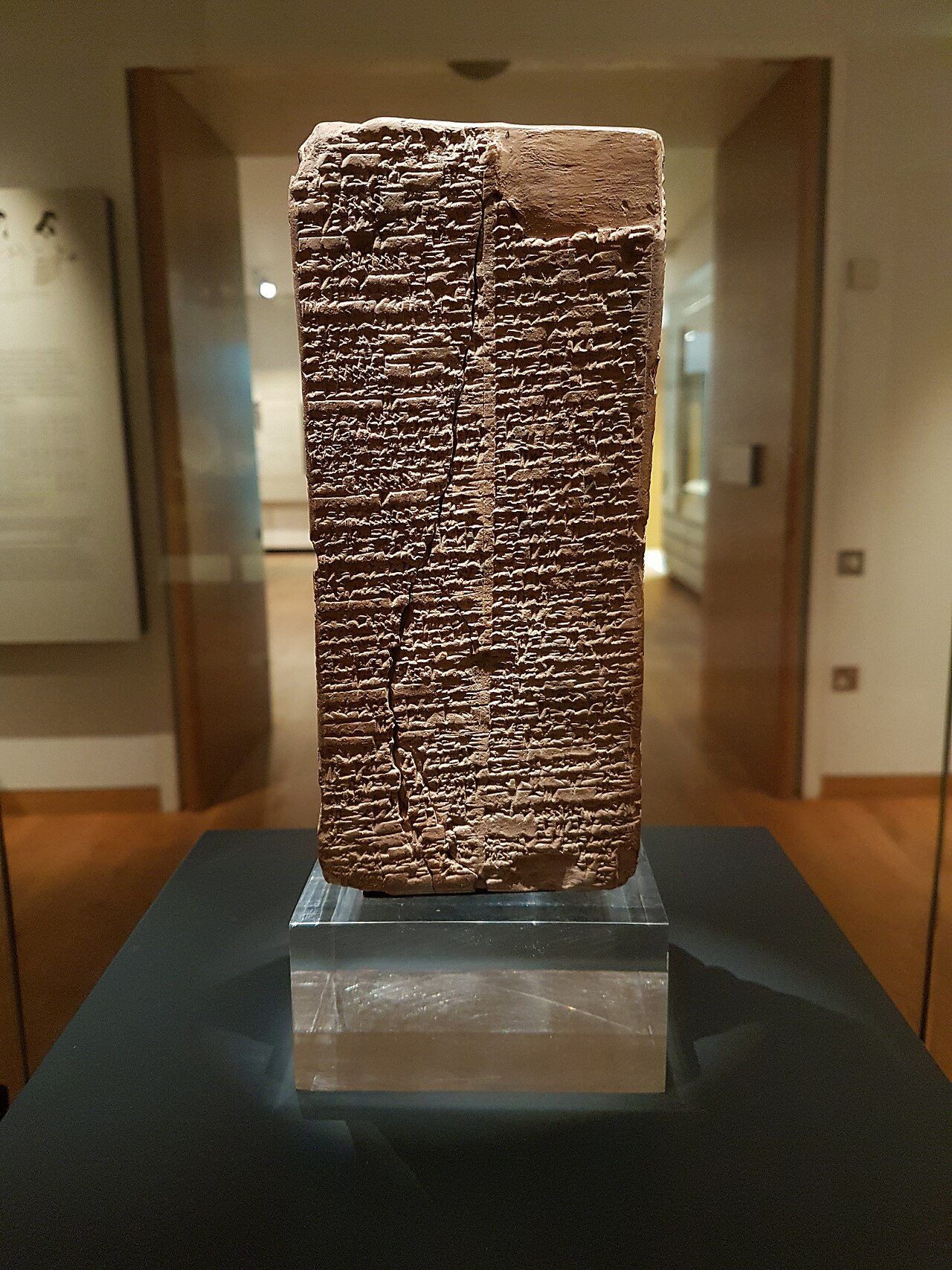
The Sumerian King List survives in several versions. The Ashmolean’s clay prism, dated about 1800 BCE and probably from Larsa, names ruling cities, kings and lengths of reign. Its four sides each carry two columns of Sumerian cuneiform. The museum explains that it combines myth, legend and historical information, presenting kingship as divinely assigned to one city at a time. [2] This object offers evidence for how ancient people organised the past. Its political message also makes it a source to interpret critically, rather than a transparent modern chronology.
How the modern state took shape
Burcu Kurt traces state formation through British wartime occupation, the mandate settlement and Iraqi opposition. A broad uprising challenged British rule in 1920. Faisal was crowned on 23 August 1921; the Anglo-Iraqi agreement followed on 10 October 1922. Iraq entered the League of Nations on 3 October 1932, ending the mandate. Britain nevertheless retained military bases and influence under the 1930 treaty. [3] State formation was a process involving imperial power, resistance and institution-building. A single founding date in 1923 cannot explain these distinct events.
Mosul and the Kurdish border question
Lausanne did not settle Mosul’s status in 1923. Kurt describes referral to the League in 1924, a frontier commission in 1925 and the Turkey–Britain–Iraq agreement of June 1926. Kurdish demands and promised guarantees formed part of this contested settlement. [3] This history concerns political representation and borders; it does not erase the region’s earlier societies.
Languages change while communities continue to make history
Silvie Zamazalová’s ORACC study distinguishes Sumerian, Akkadian and the cuneiform script. Akkadian is a Semitic language; Sumerian is linguistically unrelated to it. They were used together, and Sumerian remained a language of scholarship and worship long after it ceased to be a mother tongue. Scribes used bilingual learning materials. [4] Modern diversity belongs to another period: a 2025 UN report describes Arabic and Kurdish alongside protected languages including Turkmen, Syriac, Armenian and Mandaic. [5] A state need not possess a language named after it to have a history. Language use is one kind of evidence, rather than a test of whether a population belongs.
What genetic ancestry can and cannot establish
The US National Human Genome Research Institute distinguishes genetic ancestry, nationality, ethnicity and language as different population descriptors. Genetic ancestry is statistically estimated using comparisons with reference samples; results depend on available data and methods. Ethnicity includes shared histories and cultural practices and is not a biological characteristic. [6] Accordingly, a language or a single paternal marker cannot establish an exclusive national ancestry. Claims that an entire modern population has no connection to an ancient region require evidence that sweeping assertions about bloodlines do not supply. Heritage, citizenship and political rights cannot be reduced to a genetic percentage.
Protecting heritage through accurate interpretation
UNESCO inscribed Babylon in 2019, recognising the city’s archaeological and wider cultural significance. Its assessment distinguishes ancient remains from twentieth-century reconstructions and warns that conjectural rebuilding can weaken authenticity. It also stresses conservation, documentation and research. [7] The useful questions are which structures survive, when particular objects were made and how later generations used them. Iraq’s ancient heritage and its modern political history can both be studied with care. That approach makes room for regional and community histories without assigning the entire past exclusively to one present-day identity.
Sources and further reading
- J. Paul Getty Museum, Mesopotamia: Civilization Begins; exhibition sections on first cities and writing.
- Ashmolean Museum, Sumerian King List, AN1923.444; date, probable Larsa origin and political interpretation.
- Burcu Kurt, Mesopotamia, British Mandate for, 1914–1918-online (16 April 2018); DOI 10.15463/ie1418.11242.
- Silvie Zamazalová, The Sumerian language, Nimrud project, ORACC, updated 18 December 2019; bilingual scholarship and script.
- United Nations, A/80/352 (2025), paragraph 11; account of Iraq’s official and protected languages.
- National Human Genome Research Institute, Use of Population Descriptors in Genomics; distinctions and limits of ancestry estimates.
- UNESCO World Heritage Centre, Babylon, inscribed 2019; significance, integrity, authenticity and conservation.
- Gts-tg, Weld-Blundell prism, 15 March 2017; own-work photograph, CC BY-SA 4.0, Wikimedia Commons.