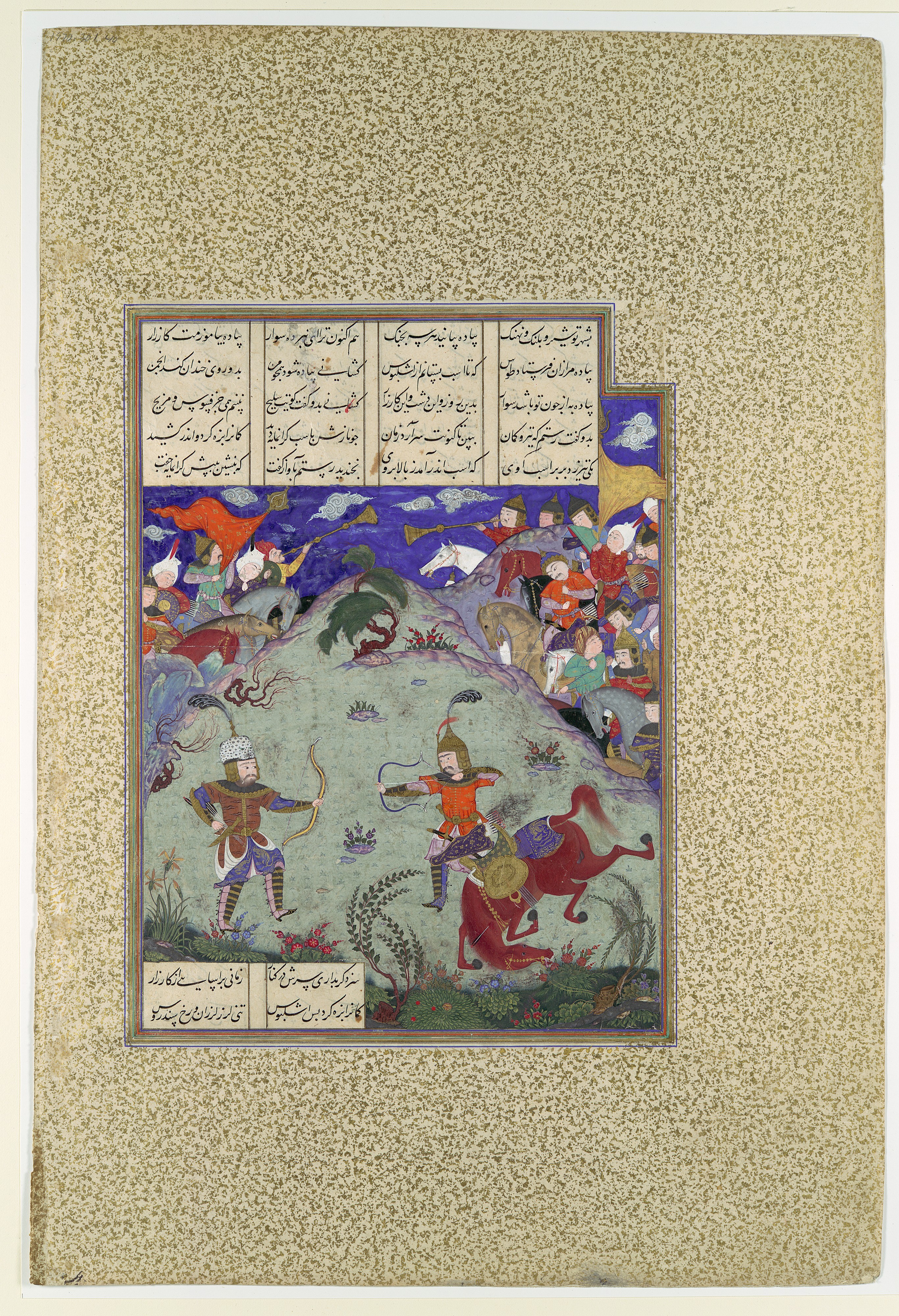
Kamus of Kashan: The Champion Slain by Rostam
- Dala Sarkis

- Jun 3
- 13 min read

Introduction
Kamus of Kashan is one of the mightiest of all the foreign champions of the Shahnameh, the Persian Book of Kings: a formidable warrior-king who came from distant lands as an ally of the Turanian Afrasiab to make war on Iran, and who proved so powerful that none of the Iranian heroes could withstand him, until he was at last brought down by the greatest champion of all, Rostam.
His tale belongs to one of the great war-cycles of the epic, the war of Kamus, fought during the reign of the Iranian king Kay Khosrow, when Afrasiab summoned a vast host of allies from distant lands, led by the Khaqan of Chin and including the mighty Kamus, to overwhelm the Iranian army. So formidable was Kamus that he defeated the Iranian champions sent against him, and it took the might and cunning of Rostam himself, who brought him down with his famous lasso, to end the threat he posed.
Like all the figures of the Book of Kings, Kamus belongs to the shared epic heritage of the Iranian peoples, a tradition the Kurds hold in common with the Persians, the Lurs, and others of the Iranic world. To know Kamus is to encounter one of the great adversaries of Rostam, a foreign champion of tremendous power whose defeat was among the mightiest of the hero's feats, and a central figure of one of the epic's great war-cycles. His fall to Rostam's lasso is one of the celebrated combats of the Shahnameh.
Contents
Who Is Kamus of Kashan?
Kamus of Kashan, also written Kamus-e Kashani, is a mighty foreign champion of the Shahnameh, a warrior-king who came as an ally of the Turanian Afrasiab in the great war against Iran during the reign of Kay Khosrow. He was one of the most formidable warriors in the entire epic, a champion of such strength and prowess that the Iranian heroes sent against him were defeated, and he could be overcome only by the greatest of all champions, Rostam. In the war that bears his name, the war of Kamus, Rostam at last confronted and defeated him, bringing him down with his famous lasso and slaying him. He is remembered as one of the mightiest of the foreign adversaries of Iran and one of the great foes overcome by Rostam, his defeat among the celebrated feats of the hero.
A Champion from Distant Lands
Kamus of Kashan was one of a host of champions and kings whom the Turanian Afrasiab, hard-pressed in his long war with Iran, summoned from distant lands to his aid. When the tide of the wars turned against him, Afrasiab called upon allies from far countries, gathering a great coalition led by the Khaqan, the emperor of Chin, the lands of the far East, and including mighty warriors such as Kamus.
These foreign champions, drawn from lands beyond Turan itself, represented a new and formidable threat to Iran, for they brought fresh and powerful warriors into the long conflict, untested against the Iranian heroes and confident in their strength. Kamus, called of Kashan in the tradition, was among the mightiest of these allies, a warrior-king of tremendous power who came at the head of his forces to join the war against Iran. The gathering of this great coalition of foreign kings and champions, led by the Khaqan of Chin and including Kamus, marked one of the gravest perils that Iran faced in the wars, for it brought against the Iranian army not merely the familiar Turanian foe but a vast host of powerful allies from distant lands. Kamus stood among the foremost of these, a champion whose strength would prove greater than that of any Iranian hero who faced him, save one. His coming from distant lands as an ally of Afrasiab sets the stage for his role in the great war that would bear his name, the mighty foreign champion whose power threatened to overwhelm Iran until he met the greatest of its heroes.
Key Takeaways
Kamus of Kashan is one of the mightiest foreign champions of the Shahnameh.
He came as an ally of Afrasiab in the war against Iran under Kay Khosrow.
He was part of the great coalition led by the Khaqan of Chin.
He was so powerful that the Iranian heroes could not withstand him.
He was at last defeated by Rostam, who brought him down with his lasso.
The war-cycle in which he appears is named the war of Kamus after him.
Quick Facts
Name: Kamus of Kashan (Kamus-e Kashani)
Role: Mighty foreign champion; ally of Afrasiab
Allegiance: Allied to Turan against Iran
Part of: The coalition led by the Khaqan of Chin
Era: The reign of Kay Khosrow
Renowned for: Tremendous strength; defeating Iranian heroes
Defeated by: Rostam, the greatest hero of Iran
Manner of defeat: Caught and brought down by Rostam's lasso
War-cycle: The war of Kamus, named after him
Heritage: Shared Iranic epic tradition
The War of Kamus
The war of Kamus is one of the great war-cycles of the Shahnameh, a major episode of the long conflict between Iran and Turan during the reign of Kay Khosrow. It takes its name from the mighty champion Kamus, one of the foremost of the foreign allies whom Afrasiab had summoned, and whose defeat by Rostam was its central event.
The war arose when the Iranian army, campaigning in Turan, found itself hard-pressed by the great coalition that Afrasiab had gathered, the host of foreign kings and champions led by the Khaqan of Chin. The Iranian forces, under their commanders, were in grave difficulty against this powerful array, and the mighty champions of the coalition, Kamus foremost among them, threatened to overwhelm them. In their peril, the Iranians sent for the greatest of all their heroes, Rostam, to come to their aid. The arrival of Rostam turned the tide of the war, for he confronted and overcame the foreign champions one by one, including the mighty Kamus, and broke the power of the coalition. The war of Kamus is thus one of the great set-piece war-cycles of the epic, a major conflict in which Iran, hard-pressed by a formidable host of foreign allies, was saved by the coming of Rostam and his defeat of the enemy champions. The cycle is named for Kamus because his defeat was its central and most celebrated event, the overcoming of the mightiest of the foreign foes by the greatest of the Iranian heroes. It stands among the memorable war-cycles of the Shahnameh, a tale of Iran's peril and of Rostam's prowess in its hour of need.
The Mightiest of Foes
Kamus of Kashan is presented in the epic as one of the mightiest of all the foes that Iran faced, a champion of such tremendous strength and prowess that no ordinary hero could withstand him. When the Iranian champions went out against him, they were defeated, for his power exceeded theirs, and he proved more than a match for the warriors of Iran.
So formidable was Kamus that he overcame the Iranian heroes who faced him in the war. The tradition relates that even valiant champions of Iran were defeated by him, unable to stand against his might. This established Kamus as a foe of the very first rank, a warrior whose strength placed him above the common run even of the great champions, and who could be overcome only by the mightiest of all. In this, Kamus serves a particular role in the epic: he is the formidable foe whose power demonstrates, by contrast, the supreme might of Rostam, for it is precisely because Kamus was so mighty, too mighty for any other Iranian hero, that his defeat by Rostam is so great a feat. The epic often builds up the power of a foe in order to magnify the hero who overcomes him, and Kamus is one of the supreme examples of this: a champion of tremendous strength, the conqueror of lesser heroes, whose own defeat could come only at the hands of the greatest of all. As the mightiest of the foreign foes, Kamus stands as a measure of Rostam's supremacy, the formidable adversary whose fall confirmed that Rostam was beyond compare among the warriors of the age.
The Lasso of Rostam
The means by which Rostam overcame the mighty Kamus was his famous lasso, the kamand, one of the hero's celebrated weapons. Where brute strength alone might not quickly settle a contest between two such mighty warriors, Rostam employed the lasso with which he was so skilled, casting it to entrap his powerful foe.
In the combat between them, Rostam cast his lasso and caught Kamus, entangling the mighty champion and dragging him from his horse, so bringing down by skill and cunning a foe whose strength might otherwise have made the contest long and uncertain. The lasso was one of Rostam's signature weapons throughout the epic, and his skill with it was famous; many a foe was caught and overcome by the hero's well-aimed cast. In the case of Kamus, the lasso proved the decisive instrument, allowing Rostam to capture and bring down the formidable champion who had defeated the other heroes of Iran. The use of the lasso to overcome Kamus is a characteristic touch of the epic's portrayal of Rostam, who triumphs not by strength alone but by the skilled use of his weapons and his cunning in combat. The bringing down of the mighty Kamus by Rostam's lasso is one of the memorable images of the war that bears the champion's name, the great foreign foe entrapped and overcome by the hero's famous cast. It is a fitting end for so mighty a warrior, brought low not by a stronger arm but by the skill of the greatest of champions.
The Fall of the Champion
Having caught Kamus with his lasso and brought him down, Rostam slew the mighty champion, ending the threat that he had posed to the Iranian army. The fall of Kamus was a turning-point in the war, for with the defeat of one of the mightiest of the foreign allies, the power of the great coalition that Afrasiab had gathered was broken.
The death of so formidable a champion sent a shock through the ranks of the enemy. The tradition records that the Khaqan of Chin and his advisors took grave stock of the death of their champion Kamus, recognizing in his fall a heavy blow to their cause, for if even the mighty Kamus could be overcome, then the coming of Rostam had changed the whole course of the war. The fall of Kamus was thus not merely the death of a single warrior but a decisive moment in the conflict, the breaking of the confidence and the power of the foreign coalition. With Kamus slain and the other champions of the host in turn confronted by Rostam, the great peril that had threatened to overwhelm Iran was turned aside, and the tide of the war turned in Iran's favour. The fall of the champion Kamus, caught by Rostam's lasso and slain, is the central and decisive event of the war that bears his name, the overcoming of the mightiest of the foreign foes by the greatest of the Iranian heroes, and one of the celebrated feats in the long and glorious career of Rostam. In his fall, the threat of the great coalition was broken, and Iran was delivered from one of the gravest perils of the wars.
Symbolism and Meaning
Kamus of Kashan embodies, above all, the role of the mighty foe whose power magnifies the hero who overcomes him. As a champion of tremendous strength, the conqueror of lesser heroes, too mighty for any Iranian warrior save Rostam, Kamus serves to demonstrate, by contrast, the supreme might of the greatest of champions. The epic builds up his power precisely so that his defeat by Rostam may be the greater feat, and in this Kamus is one of the supreme examples of the formidable adversary whose chief function is to confirm the supremacy of the hero.
Kamus embodies, too, the theme of the foreign champion and the great coalition against Iran, the gathering of distant powers to threaten the Iranian land. As one of the mighty allies summoned by Afrasiab from far countries, he represents the peril of the great host of foreign foes, the moment when Iran faced not merely its familiar Turanian enemy but a vast coalition of distant powers. His defeat by Rostam embodies the deliverance of Iran from this peril, the breaking of the foreign coalition by the might of the greatest hero. In all this, Kamus is a significant figure, embodying the role of the formidable foe whose fall magnifies the hero, the theme of the great coalition against Iran, and the supremacy of Rostam among the champions of the age. He is the mighty foreign champion whose defeat by Rostam's lasso is among the celebrated combats of the epic, a measure of the hero's prowess and a turning-point in one of the great wars of the Shahnameh.
Kamus and the Kurds
Kamus, like all the figures of the Shahnameh, belongs to the shared epic and mythological heritage of the Iranian peoples, a tradition that the Kurds hold in common with the Persians, the Lurs, and others of the Iranic world. The great epic of Ferdowsi, with its heroes and its mighty foes, is the common inheritance of these peoples, who share in the ancient Iranian mythological tradition from which it springs. It is honest and accurate to understand Kamus and the war of Kamus as part of this shared heritage, rather than as uniquely Kurdish material.
For the Kurds, as an Iranian people, the figures and tales of the Shahnameh are part of the wider cultural and mythological world to which they belong, and the epic and its figures hold a place in the broad Iranic heritage that the Kurds share. The figure of Kamus, the mighty foreign champion overcome by Rostam, is part of the common store of Iranian epic tradition, known and valued across the Iranic lands. In presenting Kamus, then, we present not a specifically Kurdish figure but one of the great adversaries of the shared Iranian epic, belonging to the heritage that the Kurds hold in common with the other peoples of the Iranic world. This honest framing places Kamus accurately within the broad and rich tradition of Iranian epic to which the Kurds, as an Iranic people, are heirs alongside their neighbours. The tale of his defeat by Rostam, like the wider epic, is part of the shared treasury of heroic story that the Kurds value as their own alongside the other heirs of the Iranian tradition.
Debates and Misconceptions
Is Kamus a specifically Kurdish figure? No; like all the figures of the Shahnameh, he belongs to the shared epic heritage of the Iranian peoples, a tradition the Kurds hold in common with the Persians, the Lurs, and others of the Iranic world, rather than a uniquely Kurdish figure. Indeed, he is a foreign champion allied to Turan, the enemy of Iran. As an Iranian people, the Kurds share in the broad Iranic heritage of the epic, whose figures are part of the common Iranian tradition to which the Kurds, alongside their neighbours, are heirs.
How does Kamus relate to the other champions of his war? Kamus was one of several mighty foreign champions in the great coalition that Afrasiab gathered, led by the Khaqan of Chin, against Iran. Among the others was the champion Ashkbus, who fought in the same war and was likewise slain by Rostam. The war-cycle takes its name, the war of Kamus, from Kamus because he was among the foremost and mightiest of these foreign foes, and his defeat was its central event. The presence of several such formidable champions in the one war reflects the gravity of the peril that the great coalition posed to Iran, and the magnitude of Rostam's achievement in overcoming them.
Where was Kamus from? The tradition calls him Kamus of Kashan, or Kamus-e Kashani, associating him with Kashan, and places him among the foreign allies summoned by Afrasiab from distant lands, in the great host led by the Khaqan of Chin, the ruler of the far Eastern lands. As with much of the legendary geography of the Shahnameh, these place-names belong to the epic's mythic ordering of the world rather than to precise history, and serve chiefly to mark Kamus as a powerful champion from distant parts, summoned to swell the coalition against Iran. What matters in the epic is his role as one of the mightiest of the foreign foes, a champion from afar whose great strength threatened Iran until he was overcome by Rostam, rather than any precise geographical identification.
Related Topics
Rostam: the greatest hero of Iran, who slew Kamus with his lasso
Afrasiab: the Turanian king who summoned Kamus as an ally
Kay Khosrow: the Iranian king during whose reign the war was fought
Rohham: an Iranian hero of the wars of this era
Tus: a leading Iranian commander of the campaigns in Turan
Piran Viseh: the noble commander of the Turanian forces
Gudarz: the patriarch of a great Iranian warrior-house
The Shahnameh: the Persian Book of Kings, the great epic of Iran
Frequently Asked Questions
Who is Kamus of Kashan in the Shahnameh?
Kamus of Kashan, or Kamus-e Kashani, is a mighty foreign champion of the Shahnameh, a warrior-king who came as an ally of the Turanian Afrasiab in the great war against Iran during the reign of Kay Khosrow. He was one of the most formidable warriors in the epic, so powerful that the Iranian heroes sent against him were defeated, and he could be overcome only by the greatest of all champions, Rostam, who at last brought him down with his famous lasso and slew him.
How did Rostam defeat Kamus?
Rostam defeated Kamus with his famous lasso, the kamand, one of the hero's celebrated weapons. In the combat between them, Rostam cast his lasso and caught the mighty champion, entangling him and dragging him from his horse, so bringing down by skill a foe whose great strength might otherwise have made the contest long. Having caught and brought down Kamus, Rostam slew him, ending the threat he posed and breaking the power of the foreign coalition.
What is the war of Kamus?
The war of Kamus is one of the great war-cycles of the Shahnameh, a major episode of the conflict between Iran and Turan during the reign of Kay Khosrow. It takes its name from the mighty champion Kamus, one of the foremost foreign allies whom Afrasiab summoned in a great coalition led by the Khaqan of Chin. The hard-pressed Iranian army was saved by the coming of Rostam, who overcame the foreign champions, Kamus foremost among them, and broke the power of the coalition.
Why was Kamus so important if he was defeated?
Kamus was important precisely because of his tremendous power: he was so mighty that the ordinary Iranian heroes could not withstand him, and he could be overcome only by the greatest of all champions, Rostam. The epic builds up his strength in order to magnify the hero who defeats him, so that Rostam's victory over Kamus is the greater feat. As the mightiest of the foreign foes, Kamus serves as a measure of Rostam's supremacy, and his fall was a decisive turning-point in the war.
Where did Kamus come from?
The tradition calls him Kamus of Kashan, or Kamus-e Kashani, and places him among the foreign allies summoned by Afrasiab from distant lands, in the great host led by the Khaqan of Chin, the ruler of the far Eastern lands. As with much of the legendary geography of the Shahnameh, these names belong to the epic's mythic ordering of the world rather than to precise history, and serve chiefly to mark Kamus as a powerful champion from distant parts, summoned to swell the coalition against Iran.
Is Kamus a Kurdish figure?
Kamus belongs to the shared epic heritage of the Iranian peoples, a tradition the Kurds hold in common with the Persians, the Lurs, and others of the Iranic world, rather than a uniquely Kurdish figure. Indeed, he is a foreign champion allied to Turan, the enemy of Iran. As an Iranian people, the Kurds share in the broad Iranic heritage of the epic, whose figures are part of the common Iranian tradition to which the Kurds are heirs alongside their neighbours.
References and Further Reading
Comments