Read as text
The article’s text, including its headings and links, is also available below.
Kurdish Mythology: Gods, Heroes, Spirits and Ancient Tales
Kurdish mythology is a layered world of mountain legends, sacred beings, heroic rebels, serpent queens, divine mystery, oral epics and ancient tales preserved through song, memory and storytelling.
AI Snapshot
Kurdish mythology is not a single fixed pantheon like Greek, Roman or Norse mythology. It is a deep and layered tradition shaped by ancient Iranian beliefs, Zagros mountain folklore, Yazidi and Yarsan sacred traditions, Islamic-era village stories, heroic oral epics, dengbêj performances and regional legends passed down through generations.
Quick Facts About Kurdish Mythology
| Main themes | Resistance, mountain survival, love, betrayal, sacrifice, divine mystery, wisdom, nature and spirits. |
|---|---|
| Famous hero | Kawa the Blacksmith. |
| Famous tyrant | Zahhak, also known as Dehak. |
| Famous sacred figure | Tawûsî Melek in Yazidi Kurdish tradition. |
| Famous serpent figure | Şahmaran, the serpent queen of wisdom and betrayal. |
| Famous love epic | Mem û Zîn / Memê Alan. |
| Preservation method | Oral storytelling, dengbêj singing, folk memory, sacred hymns and later written literature. |
What Is Kurdish Mythology?
Kurdish mythology is the collection of sacred stories, heroic legends, folk beliefs, supernatural beings, oral epics and symbolic traditions preserved among Kurdish communities across Kurdistan and the wider diaspora.
Unlike some ancient civilizations, Kurds did not leave behind one single mythological book that neatly lists every god, hero and monster. Instead, Kurdish mythology survived through oral culture: grandparents telling stories, dengbêj singers performing epics, village storytellers explaining spirits and omens, religious communities preserving sacred hymns, and poets transforming older tales into written masterpieces.
Kurdish mythology is not a closed book. It is a living cultural memory carried through mountains, songs, shrines and stories.
This is why Kurdish mythology can feel difficult to define. Some stories are clearly Kurdish; some are Kurdish versions of wider Iranian, Mesopotamian, Armenian, Turkish, Arab or Persian stories; and some belong to specific Kurdish religious communities such as the Yazidis or Yarsan/Kakai.
Are There Kurdish Gods?
The word “gods” needs to be used carefully when discussing Kurdish mythology. Kurdish culture has been shaped by many religious layers: ancient Iranian beliefs, Zoroastrian influence, Yazidism, Yarsanism, Islam, Christianity, Judaism and local folk traditions.
Because of this, Kurdish mythology does not have one simple list of gods like Zeus, Odin or Ra. Instead, it includes sacred beings, angelic figures, divine manifestations, holy ancestors, mythic heroes, nature spirits, demonic beings, fairy-like creatures and serpent figures.
Figures connected with divine mystery, religious tradition, holy places and spiritual order.
Rebels, lovers, warriors, blacksmiths and singers whose stories became part of Kurdish identity.
Dew, perî, jinn, Al and other beings linked to fear, wilderness, illness and moral danger.
Serpents can represent tyranny, hidden wisdom, healing, betrayal or ancient sacred knowledge.
Ancient Roots of Kurdish Mythology
The deepest roots of Kurdish mythology lie in the mountains and highlands of the Zagros and Upper Mesopotamia. For thousands of years, this region was home to mountain peoples, tribal communities, sacred landscapes and frontier cultures living between great empires.
Kurdish mythology reflects that geography. The mountain is not just a background. It is a protector, a hiding place, a battlefield, a sacred space and sometimes almost a living character.
Common ancient themes
- Fire and renewal
- Serpents and dragons
- Tyrants and liberators
- Sacred mountains and hidden caves
- Heroic rebellion and divine light
- Wise animals, evil kings, curses and blessings
Kawa the Blacksmith and the Myth of Resistance
No figure stands taller in Kurdish mythic memory than Kawa the Blacksmith. Kawa is the heroic blacksmith who rises against the tyrant Zahhak. In the story, Zahhak is a monstrous ruler with serpents growing from his shoulders. These serpents demand human brains as food, and Zahhak’s rule becomes a symbol of terror, sacrifice and oppression.
For Kurds, this story became much more than an ancient myth. It became one of the emotional foundations of Newroz, the Kurdish New Year and a symbol of resistance. Kawa represents the ordinary working person who refuses to submit. He is not a king. He is not born into royal power. He is a blacksmith: a man of fire, metal, labour and courage.
That is why Kawa remains so important. He is the mythic image of a people rising against oppression.
Zahhak: The Serpent-Shouldered Tyrant
If Kawa represents resistance, Zahhak represents oppression. Zahhak, also known as Dehak in Kurdish and Iranian traditions, is remembered as a tyrant whose rule becomes unnatural and monstrous.
The serpents on his shoulders are one of the most powerful images in the mythology of the region. They turn political violence into a physical horror: a ruler literally feeding on the minds of the young.
In Kurdish readings of the myth, Zahhak can represent foreign domination, unjust kingship, anti-human rule or any system that survives by sacrificing the innocent. Kawa’s uprising therefore becomes not only a political rebellion but also a cosmic correction: fire rises against darkness, the people rise against the palace, and Newroz begins.
Tawûsî Melek and Yazidi Kurdish Mythology
One of the richest branches of Kurdish mythology is found in Yazidi tradition. Yazidism is a Kurdish religious tradition with its own sacred stories, rituals, hymns, cosmology and holy geography. Its most famous sacred figure is Tawûsî Melek, often translated as the Peacock Angel.
Yazidis have often been misunderstood by outsiders. Their reverence for Tawûsî Melek has been misrepresented through hostile labels, but Yazidi tradition understands Tawûsî Melek as a sacred, luminous, divinely appointed figure.
A central sacred figure in Yazidi cosmology, connected with divine order and spiritual guardianship.
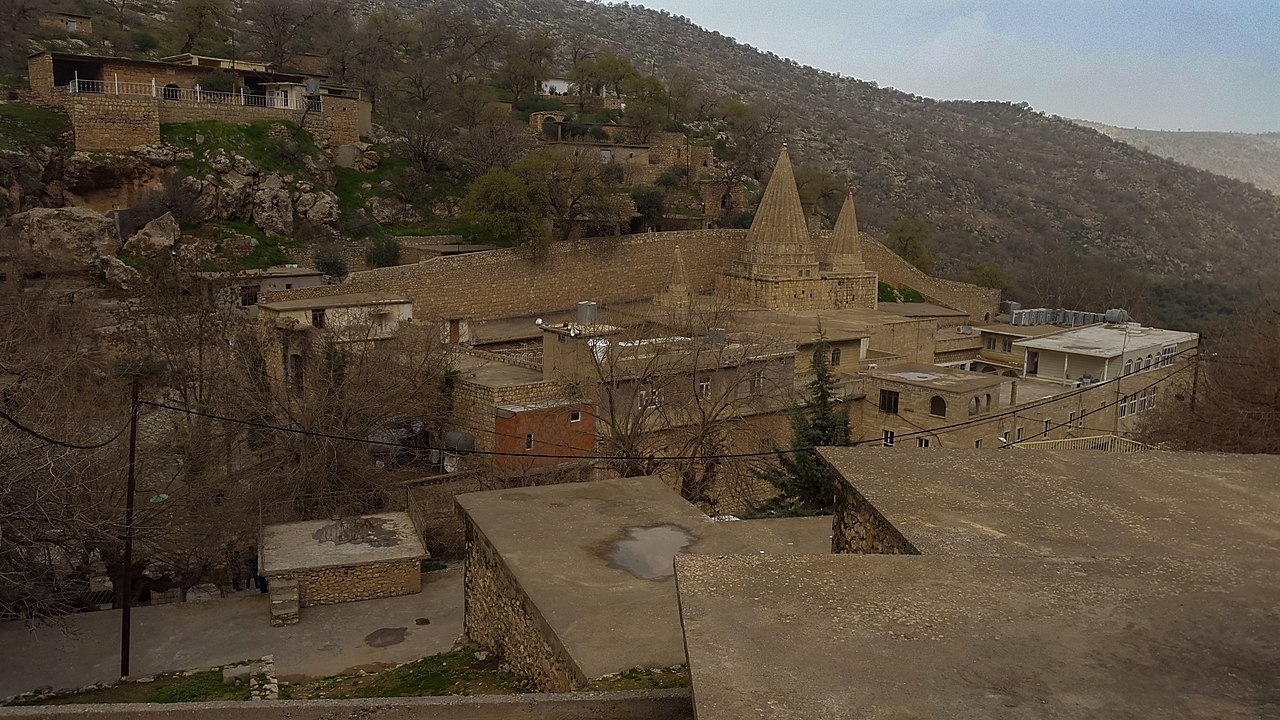
The sacred centre of Yazidi religious life and one of the most important holy places in Kurdish tradition.
Yazidi sacred tradition includes powerful spiritual beings and layered cosmological symbolism.
Yazidi mythology has been preserved through Kurdish religious hymns, ritual knowledge and memory.
Spirits, Demons and Supernatural Beings
Kurdish folklore contains many supernatural beings. Some are shared with wider Iranian and Middle Eastern traditions, while others take specific Kurdish forms depending on region, dialect and local belief.
A giant, demon or monstrous being often linked to caves, mountains, danger and heroic trials.
A fairy-like supernatural being. Perî figures can be beautiful, helpful, dangerous or mysterious.
Invisible beings from Islamic-era folk belief, often connected to haunted places and strange events.
A frightening female spirit often associated with childbirth, mothers, infants and protective customs.
Powerful symbols of both danger and wisdom, from Zahhak’s serpents to Şahmaran’s hidden knowledge.
Şahmaran: The Serpent Queen of Wisdom
Şahmaran, also written Shahmaran or Shamaran, is one of the most famous serpent figures in Kurdish and regional folklore. She is usually imagined as a being who is half-woman and half-serpent.
In many versions, Şahmaran lives underground or in a hidden world of serpents. A young man discovers her secret realm. She teaches him wisdom or healing knowledge, but eventually she is betrayed. Her death often brings medicine, knowledge or transformation.
The Şahmaran story often turns on a broken trust between the human world and the hidden world.
She represents hidden knowledge, healing, feminine power and secrets beneath the surface.
Her death is tragic, but it often releases medicine, transformation or sacred knowledge.
Şahmaran remains popular in Kurdish art, jewellery, tattoos, textiles and cultural design.
Kurdish Epic Tales and Heroic Romances
Kurdish mythology is closely connected to oral epic literature. Many Kurdish myths are not simply “god stories” but heroic romances, tragic love stories, resistance epics and songs of social memory.
The most famous Kurdish romance, later transformed into the classical literary masterpiece Mem û Zîn by Ehmedê Xanî.
A major Kurdish resistance epic connected to the Castle of Dimdim, siege, betrayal and mountain defence.
A major oral epic connected to love, honour, conflict and Yazidi-Muslim Kurdish memory.
A classic Kurdish mountain romance involving love, wilderness, separation and tragedy.
Sacred Mountains, Caves, Springs and Fire
Kurdish mythology is deeply geographical. The Kurdish world is full of sacred and symbolic places: mountains, caves, springs, rivers, fortresses, shrines, trees, bridges, fireplaces and hidden valleys.
Mountains are especially important. They are places of refuge, rebellion, mystery and divine nearness. For a people whose history has often involved survival against empires, the mountain became both home and myth.
Fire is also central, especially through Newroz and the Kawa story. Fire represents light after darkness, rebellion after oppression and the rebirth of the year.
Why Kurdish Mythology Was Preserved Orally
One reason Kurdish mythology is difficult to catalogue is that much of it was preserved orally. For centuries, Kurdish stories were carried by dengbêj singers, village elders, religious teachers, travelling storytellers, mothers, grandmothers, wedding songs, laments and sacred hymns.
This oral background explains why the same story can have many versions. One village may tell Şahmaran one way; another region may tell it differently. One dengbêj may perform Memê Alan with certain details; another may preserve another version.
Variation is not weakness. It is proof that Kurdish mythology lived among the people.
Legacy of Kurdish Mythology Today
Kurdish mythology still shapes Kurdish identity today. Kawa appears in Newroz celebrations, political art, flags, songs and speeches. Şahmaran appears in tattoos, murals, jewellery, feminist art and cultural design. Mem û Zîn remains one of the greatest symbols of Kurdish love and national longing.
Yazidi mythology continues to preserve one of the most distinctive sacred traditions in the Middle East. Dengbêj epics continue to influence Kurdish novels, songs, cinema and historical memory.
FAQs About Kurdish Mythology
What is the most famous Kurdish myth?
The most famous Kurdish myth is probably the story of Kawa the Blacksmith and Zahhak, especially because of its connection to Newroz. The most famous Kurdish romantic epic is Memê Alan / Mem û Zîn.
Did ancient Kurds have gods?
Kurdish mythology does not have one simple list of gods like Greek mythology. It includes ancient Iranian themes, sacred Yazidi figures, Yarsan spiritual traditions, Islamic-era spirits, folk beings and heroic legends.
Who is Kawa the Blacksmith?
Kawa is the heroic blacksmith who rebels against Zahhak, the serpent-shouldered tyrant. In Kurdish memory, Kawa became a symbol of resistance, Newroz and liberation.
Who is Tawûsî Melek?
Tawûsî Melek is the Peacock Angel and one of the central sacred figures in Yazidi Kurdish tradition. Yazidi mythology gives Tawûsî Melek a central role in divine order, creation and sacred cosmology.
Is Şahmaran Kurdish?
Şahmaran is part of a wider regional serpent-queen tradition, but Kurdish communities have preserved their own versions of the story. She is widely treated as an important figure in Kurdish folklore and art.
Why are Kurdish myths hard to list?
Because many Kurdish myths were transmitted orally rather than through one central written canon. Stories changed by region, dialect, religion, tribe and storyteller.
References and Further Reading
- Encyclopaedia Iranica — Kawa / Kāva the Blacksmith
- Encyclopaedia Iranica — Yazidis: General Overview
- Encyclopaedia Iranica — Memê Alan
- Encyclopaedia Iranica — Kurdish Written Literature
- Open Book Publishers — Neo-Aramaic and Kurdish Folklore from Northern Iraq
- Cambridge University Press — From Dengbêj to Modern Writer
The central symbol
Fire appears again and again in Kurdish mythology as a sign of renewal, Newroz, rebellion and the end of darkness.
The mountain world
Kurdish myths are deeply tied to mountains, caves, castles, springs and sacred landscapes.
The serpent mystery
Serpents can represent tyranny, healing, wisdom, betrayal and hidden knowledge.