Debates about Kurdish government and Assyrian political rights need dated evidence and clear distinctions between legal guarantees, reported abuses and official promises. Neither collective accusation nor dismissal of grievances can replace that work.

What the argument actually says
Ninos Marcus’s opinion essay “A Betrayed Partnership,” published on 21 December 2025, argues that post-1991 governance marginalized Assyrian political agency. It raises representation, land, education and accountability. Marcus expressly says that partnership did not require demographic parity or joint sovereignty over all northern Iraq. His broad conclusion that none of the necessary conditions was met is an argument requiring examination, rather than a substitute for a place-by-place record. A response should address those institutional questions without attributing one position to every Assyrian or every Kurd. [1]
Regional autonomy and minority rights in the same constitution
Iraq’s 2005 Constitution recognizes the Kurdistan Region and its existing authorities as a federal region in Article 117. It also guarantees equality in Article 14 and protections for mother-tongue education, including Syriac, in Article 4. Article 125 addresses the administrative, political, cultural and educational rights of nationalities, explicitly including Chaldeans and Assyrians, with regulation by law. These provisions place regional government and minority rights within the same constitutional framework. Article 125’s wording does not itself draw the boundaries of a Nineveh Plains administration or create a completed administrative structure. Political proposals and implementation therefore need to be distinguished from the constitutional guarantee. [2]
What the 2009 investigation established—and did not
Human Rights Watch’s On Vulnerable Ground drew on fieldwork in February and March 2009, including interviews with 57 minority-community members and meetings with senior Kurdish officials. It documented extremist attacks and reported intimidation, arbitrary detention and political pressure by Kurdish forces. It also recorded housing, church repairs and aid financed through Kurdish patronage, alongside concerns about political conditions attached to assistance. KRG officials denied intimidation and violence. Crucially, the investigators found no evidence linking Kurdish authorities to the major 2008 anti-Christian killing campaign they examined. That finding must be retained alongside the report’s criticism of Kurdish authorities. The report concerns particular places and a particular period; it is neither a verdict against an entire people nor a current assessment of every institution. [3]
An official commitment concerning Christian property
In a speech at the Catholic University in Erbil on 26 May 2025, Nechirvan Barzani supported faster legislation to protect Christian endowments and called for legal and institutional safeguards. He described Christians as rights-bearing members of the country rather than temporary guests. The speech is primary evidence of the presidency’s stated policy and proposed reform. It does not, on its own, show that the proposed legislation was enacted or that every private land claim was resolved. Endowments supporting churches and individual families’ property claims also require distinct records. [4]
How to assess land, education and representation
A useful inquiry identifies the village or institution, the relevant date, the authority responsible and the underlying document. For land, that means title records, the disputed transfer, a court or administrative decision and evidence of enforcement. For education, it means the actual textbook edition, language provision and named decision-makers. For representation, it means electoral rules, appointment powers and the ability to organize independently. These are editorial criteria for assessing claims, not findings that every case has already been decided. They allow both achievements and violations to be examined without making citizenship depend on gratitude or a contest over which community suffered more.
A partnership measured through institutions
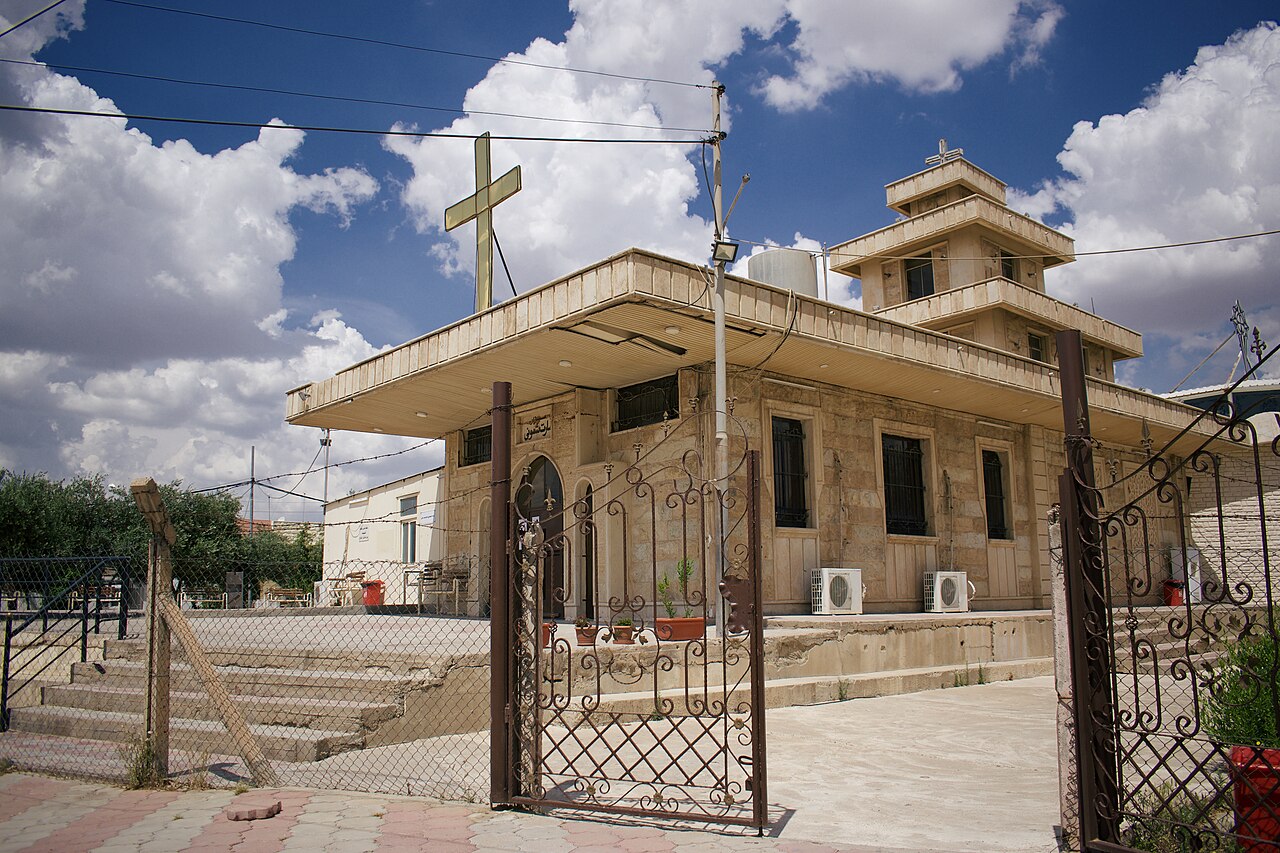
Kurdish autonomy, Assyrian political agency and equal protection can be discussed together through the legal guarantees and evidence above. The practical questions concern accessible remedies, freedom to participate and the ability to maintain language and community institutions. The accompanying Ankawa photograph documents one church in 2018. Its presence cannot prove the absence of discrimination, just as an allegation about one official cannot establish collective responsibility. Accountability requires identifiable acts and institutions. [2] [5]
Sources and further reading
- Ninos Marcus, “A Betrayed Partnership: Assyrians and Post-1991 Governance in Northern Iraq,” Assyria Post, 21 December 2025. Opinion essay discussed here; claims distinguished from independently established findings.
- Constitution of Iraq (2005), Articles 4, 14, 117 and 125; unofficial English translation by UNAMI, hosted by UNHCR Refworld.
- Samer Muscati and Peter Bouckaert, On Vulnerable Ground, Human Rights Watch, 10 November 2009; methodology, summary, Kurdish patronage and investigation of the 2008 killings.
- Kurdistan Region Presidency, Nechirvan Barzani’s speech at the Catholic University in Erbil, 26 May 2025: Christian endowments, proposed legislation and institutional protection.
- Levi Clancy, Syriac Catholic Church of Saint Shmony in Ankawa, 14 May 2018; CC0 photograph, Wikimedia Commons.