Khanzad, also called Khanzada Sultan, exercised authority in seventeenth-century Soran. Ottoman travel writing, modern historical research and oral traditions preserve different accounts of her rule.

Who was Mîr Xanzad?
Mîr Xanzad was a woman who held political and military authority in the Kurdish principality of Soran. Her name appears in historical writing as Khanzada or Khanzade Sultan. Harir and Soran lay east and northeast of Erbil, within the Ottoman–Safavid borderlands. [1] [2]
Family and chronology
Saadi Uthman Haruti’s 2018 study compares oral narratives with Ottoman and Safavid historical writing. In his published English abstract, he identifies her as the daughter of Soran’s Omer Bek and places her accession after her father’s killing in 1617. He traces her authority until at least 1629. His reconstruction describes her as a leading ruler among others in the emirate, rather than its sole emir throughout that period. [1] These dates identify a documented span of authority; they do not establish her birth or death.
What Evliya Çelebi reported
Evliya Çelebi’s narrative places her over Harir and Soran during Murad IV’s reign (1623–1640), leading raids into Iran. It describes a veiled horsewoman in a black cloak and reports 40,000–50,000 troops. Van Bruinessen cautions that Evliya heard stories and may have embellished them; these figures are not a verified army census. [2] Haruti likewise places her military activity within cooperation with the Ottoman authorities against Iran. [1]
Oral memory and women’s authority
Songs helped preserve Khanzad’s reputation across generations. Haruti cautions that oral accounts contain conflicting details and exaggerations; he compares them with Iskandar Beg Turkman’s and Muhammad Yusuf Wala Isfahani’s Safavid history, Abdülkadir Efendi’s Ottoman chronicle and Evliya’s travel narrative. [1] Van Bruinessen notes provisions for daughters’ succession in Shahrizur and stresses that elite family connections enabled women’s leadership; prominent female rulers do not establish equality for all women. [2]
The castle and her continuing memory
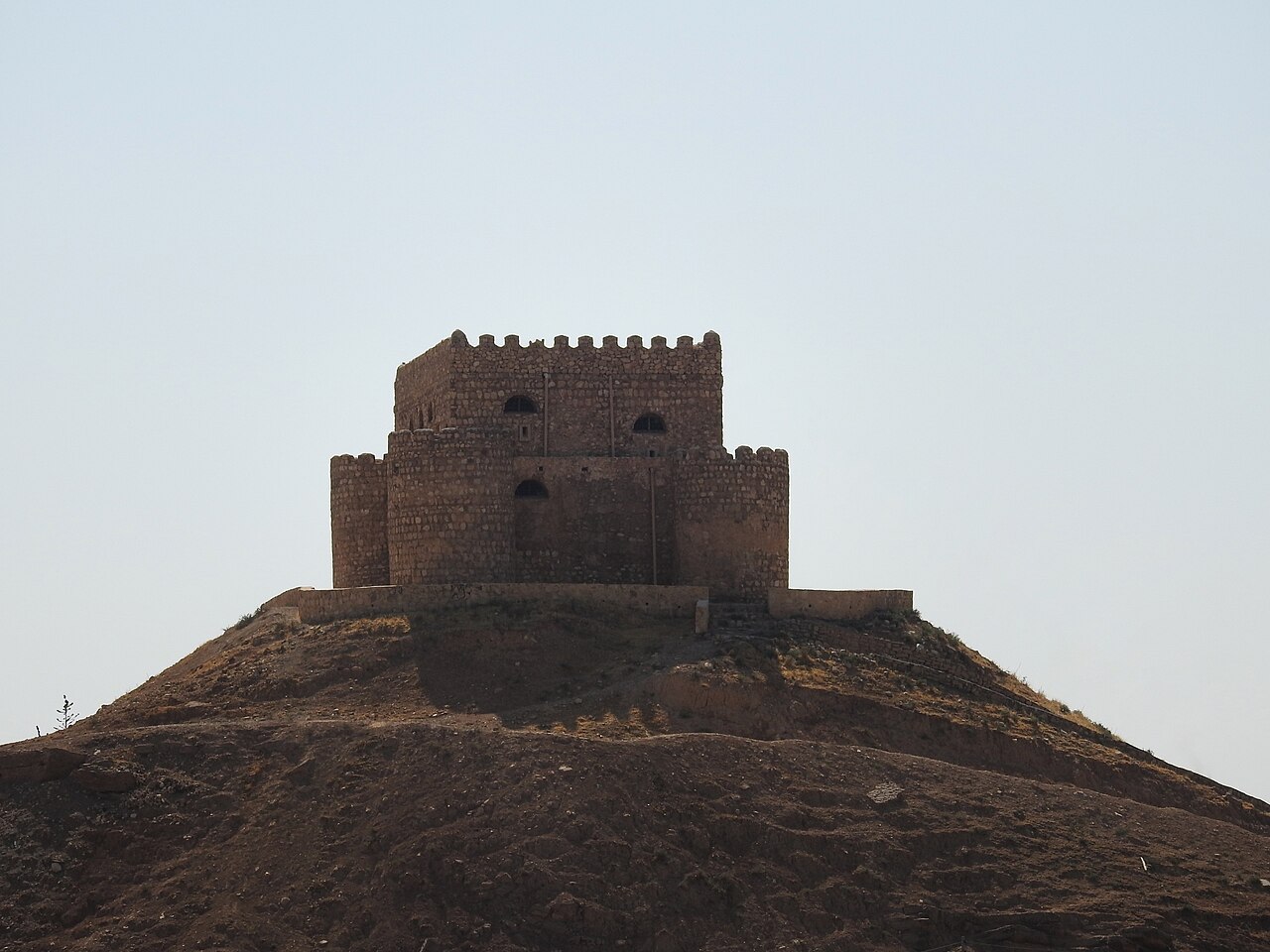
Khanzad Castle stands on a hill beside the Erbil–Shaqlawa road, about 22 kilometres from Erbil. In Goran Sabah Ghafour’s 2021 reporting, local historian Amanj Adil described its stone-and-gypsum construction, while residents explained how the castle and the name Khanzad express pride in a female Kurdish ruler. [3] This reporting documents contemporary local memory. Establishing the building’s precise construction history requires architectural evidence alongside the stories attached to it.
Sources and further reading
- Saadi Uthman Haruti, Khanzad of Soran and the Oral Literature in Two Historical Studies (Kurdish Academy, 2018): author’s published English abstracts.
- Martin van Bruinessen, “From Adela Khanum to Leyla Zana: Women as Political Leaders in Kurdish History” (2001), especially manuscript pp. 4–6 and 10–11.
- Goran Sabah Ghafour, Kurdistan 24, “Khanzad: An ancient castle and a legendary female Kurdish leader” (4 December 2021): interviews about the castle and local memory.