Publishing abroad, contacts with journalists and broadcasting across borders are documented parts of Kurdish media history. Specific examples show how information travelled, while distinguishing those activities from measured influence on global news agendas.
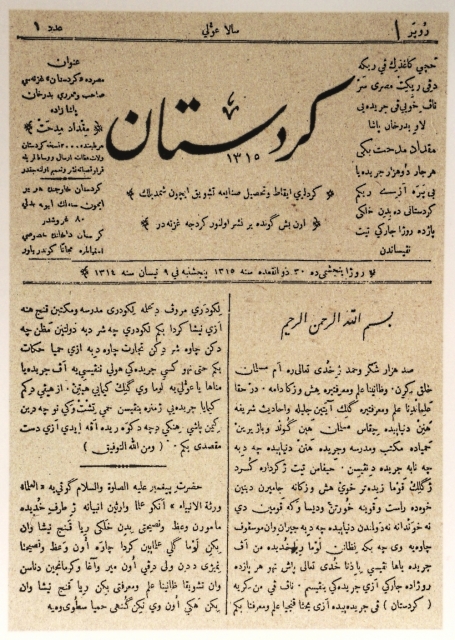

An early example: a newspaper continued from Europe
Miqdad Midhat Bedirhan launched Kurdistan in Cairo on 22 April 1898. Abdurrahman later continued the paper from Europe and took part in Young Turk opposition circles. Murat Issı’s study documents their different roles. [1] Publishing outside the homeland involved practical work: editing, printing and circulating texts through political and personal connections. A surviving issue gives evidence of what was produced. Its readership and influence require additional evidence, such as circulation records or references by other publications.
Paris in 1960: making contacts with journalists
Joyce Blau recalls that in early 1960 Henri Curiel helped Kamuran Bedir Khan distribute information about Kurdistan to journalists, NGOs and politicians. Her account names Éric Rouleau and Jean Gueyras of Le Monde and Paul Balta of Agence France-Presse among the media contacts. [2] This participant testimony identifies a mechanism of advocacy: preparing texts and connecting their author with reporters. Establishing the effect on particular published stories would require comparing the information supplied with the reporting that followed.
A broadcaster in Denmark and audiences across borders
The European Court of Human Rights Registry’s release of 24 May 2018 describes Roj TV as Danish-licensed in 2003 and broadcasting mainly Kurdish satellite programmes across Europe and the Middle East from 2004. It reports the rejection of the company’s application after Danish convictions concerning PKK propaganda. The Court applied Article 17 and found the complaint outside Article 10 protection. [3] This is a specific historical case about one broadcaster and particular programmes. It illustrates both cross-border distribution and accountability in the country hosting the company.
Nashville in 2023: a traceable local record
Nashville’s Historical Commission reported that the Kurdish Americans in Nashville marker was unveiled on 21 January 2023 at 3904 Nolensville Pike. Its February newsletter recorded the ceremony and linked coverage. [4] A city bulletin is a concrete example of Kurdish community history entering local public information. It supplies a date, place and accountable publisher. Those details make the event traceable without needing to claim it changed international news priorities or represented every member of the community.
Why preserving periodicals matters
The Kurdish Library in Stockholm describes holdings of periodicals, media articles, organisational documents, posters, letters and programmes. Its everyday documents are arranged by issuing organisation. [5] These collections can help researchers reconstruct what a diaspora organisation published and compare it with outside reporting. Keeping the original text, date, language and issuing body visible also helps distinguish a press release, a personal recollection and an independently reported story. These source types can illuminate one another while answering different questions.
What would demonstrate influence on news agendas?
The examples establish publishing, outreach, cross-border broadcasting and local documentation. Measuring wider influence would require tracing citations, translations, republication and editorial uptake over a defined period. Audience location and the difference between seeing a post and changing an opinion also matter. A source-based account should identify the particular organisation, outlet, event and audience involved. That approach lets readers assess how Kurdish diaspora information reached others without inventing a single worldwide trend or an inevitable future outcome.
Sources and further reading
- Murat Issı, Kürt Basını ve Kürdistan Gazetesi (1898–1902), e-Şarkiyat 9 (2013), pp. 127–147, especially pp. 128–130.
- Joyce Blau, Le gardien de la flamme, 1 March 2023; recollections of the 1960 information network and contacts with journalists.
- European Court of Human Rights Registry, release ECHR 186 (2018), 24 May 2018, Roj TV A/S v. Denmark, application 24683/14; broadcasting history and inadmissibility.
- Nashville Metropolitan Historical Commission, February 2023 History Gram, MHC Markers; Kurdish Americans marker ceremony.
- The Kurdish Library, Stockholm, Collections; periodicals, media articles and organisational ephemera.
- Kurdistan newspaper, 1898, front-page reproduction credited to the Kurdish Academy of Language via Wikimedia Commons; public domain.