Researched and Designed by Kurdish-History.com
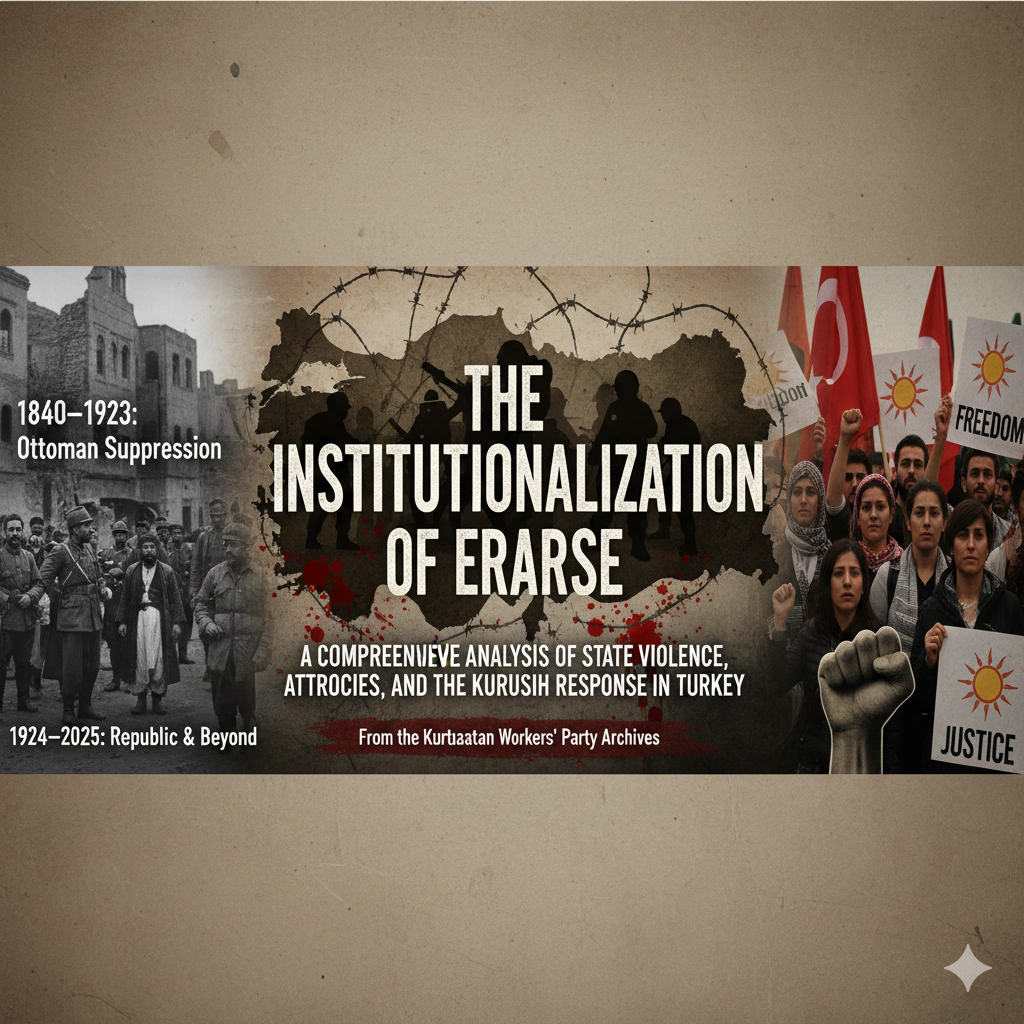
Table of Contents
Conceptualizing the Kurdish Question: Nationalism and the Architecture of State Violence
The Late Ottoman Framework: Imperial Centralization and the Prelude to Deportation (1840–1922)
The Consolidation of Republican Hegemony: The Era of Genocidal Suppression (1923–1938)
Structural Violence: The Invisible Atrocities of Legalized Erasure
The 1980 Military Coup: Diyarbakır Prison No. 5 and the Production of Insurgency
The Scorched Earth Policy of the 1990s: JİTEM and Rural Devastation
Modern Atrocities: Mechanized Warfare in the Information Age (2011–2016)
Causal Synthesis: The PKK as a Pathology of the Turkish State
Comprehensive Chronological Timeline of Atrocities and Crimes (1840–2025)
Conceptualizing the Kurdish Question: Nationalism and the Architecture of State Violence
The history of the Republic of Turkey, established in the wake of the Ottoman Empire's collapse, is inextricably linked to a project of radical ethnic homogenization. This project, which sought to transform a multi-ethnic, multi-religious imperial remnant into a singular, secular Turkish nation-state, viewed the existence of the Kurdish people as an existential threat to its foundational integrity.
For over a century, the Turkish state has employed a repertoire of violence that transcends mere military engagement, encompassing physical massacres, mass deportations, systematic torture, and the legal erasure of Kurdish identity. To understand the current conflict, one must recognize that the "Kurdish Question" is not a product of Kurdish belligerence, but a creation of state-sponsored pathology designed to solve a perceived "problem" through the liquidation of a people's history and presence.
The prevailing Turkish state narrative frequently posits that its military operations are purely retaliatory measures against the Kurdistan Workers' Party (PKK). However, an exhaustive analysis of historical data demonstrates that the state’s most egregious atrocities—including the Zilan Massacre and the Dersim Genocide—predate the formation of the PKK by nearly half a century. These early republican massacres, characterized by the industrialization of death through aerial bombardment and chemical gas, established a template of impunity. The subsequent emergence of the PKK in 1978 was a direct, sociological consequence of this historical trauma, further catalyzed by the "period of barbarity" in the Diyarbakır Military Prison following the 1980 coup. In this context, the PKK is not the cause of the conflict but its most visible symptom—a product of a state that closed every peaceful avenue for identity and survival.
The Late Ottoman Framework: Imperial Centralization and the Prelude to Deportation (1840–1922)
The roots of Kurdish persecution in the region extend into the final century of the Ottoman Empire. As the empire faced territorial contraction and the rise of Balkan nationalisms, the ruling elites increasingly viewed the Eastern provinces as a "frontier" to be secured through centralization and ethnic manipulation. The 1840s marked a significant shift in this dynamic, as the Ottoman center sought to dismantle the semi-autonomous Kurdish emirates.
This period saw the first modern massacres of minority populations in the Kurdish regions, often facilitated by the state to pit different ethnic groups against one another. In the 1840s, the Ottoman authorities permitted the Kurdish chieftain Badr Khan Bey to massacre approximately 10,000 Assyrians, an event that highlighted the empire's willingness to utilize irregular forces to manage demographic "problems".
By the late 19th century, Sultan Abdul Hamid II further institutionalized this practice through the creation of the Hamidiye regiments—irregular Kurdish cavalry units tasked with suppressing Armenian and nationalist aspirations. This period, known for the Hamidian massacres (1894–1896), saw the death of hundreds of thousands of Christians, but it also sowed the seeds of distrust between the Ottoman state and the Kurds themselves. The Young Turk revolution of 1908 and the subsequent coup of 1913 by the Committee of Union and Progress (CUP) radicalized these policies, transitioning from religious-based rule to an ethno-nationalist ideology of "Turkification".
World War I provided the CUP with a "favorable moment" to implement mass population transfers. While history rightly focuses on the Armenian, Greek, and Assyrian genocides of 1915–1916, the contemporaneous deportation of the Kurdish population is often overlooked. Fearing that Kurds might cooperate with the Russian Empire or Armenian nationalists, the Ottoman government initiated a systematic campaign of deportation between 1916 and 1934.
Table 1: Late Ottoman Kurdish Deportations (1916–1918)
Metric | Statistical Data | Source |
Total Deportees | Approximately 700,000 Kurds | |
Estimated Deaths | 350,000 (roughly 50% of the total) | |
Primary Target Areas | Bitlis, Erzurum, Palu, and Muş | |
Destinations | Central Anatolia (Konya, Kastamonu, Niğde) | |
Primary Causes of Death | Famine, exposure, and systematic neglect | |
Stated Objective | To separate chieftains from people and "Turkify" tribes |
The 1916 deportations were not merely a wartime relocation but a calculated attempt at social engineering. Talaat Pasha’s directives mandated that Kurds be dispersed among Turkish villages so that they would not exceed 5% of the local population, thereby forcing their assimilation and the loss of their mother tongue. The survival of the Republic was predicated on this early blueprint of ethnic displacement.
The Consolidation of Republican Hegemony: The Era of Genocidal Suppression (1923–1938)
The establishment of the Republic of Turkey in 1923, following the Treaty of Lausanne, formally codified the "invisibilization" of the Kurdish people. The treaty, which replaced the aborted Treaty of Sèvres, failed to grant the Kurds any form of autonomy, instead treating them as an undifferentiated part of the "Muslim" majority. This omission set the stage for a series of rebellions as Kurdish leaders realized the Kemalist state intended to eliminate their religious, cultural, and political institutions.
The Law on the Maintenance of Order and the 1925 Sheikh Said Rebellion
In February 1925, Sheikh Said Piran led a major uprising across the provinces of Diyarbakır and Mardin, reacting to the abolition of the Caliphate and the aggressive secularist policies of Mustafa Kemal Atatürk. The state's response was swift and characterized by unprecedented legal and military brutality. The government passed the "Law on the Maintenance of Order" ( Takrir-i Sükûn Kanunu), which effectively suspended civil liberties and established the Independence Tribunals.
The Independence Tribunal of Diyarbakır functioned as a tool of state terror, executing not only rebels but also Kurdish intellectuals who had no direct involvement in the uprising. Military records and historical accounts indicate that the repression was conducted with a brutality that echoed the Armenian massacres of 1915.
Table 2: Suppression of the 1925 Sheikh Said Rebellion
Category | Statistical Data | Source |
Villages Destroyed | 206 villages | |
Houses Burned | 8,758 houses | |
Civilians Killed | 15,200 (including women and children) | |
Rebel Fighters Mobilized | 15,000 | |
State Forces Mobilized | 52,000 troops and Gendarmerie | |
Executions | Sheikh Said and 46 adherents (June 29, 1925) |
The aftermath of 1925 saw the implementation of a new deportation law that targeted the Kurdish elite, sending about 500 families into internal exile in Western Turkey to prevent any further mobilization.
The Mount Ararat Revolt and the Zilan Valley Massacre
Between 1927 and 1930, the Ararat rebellion represented a more organized Kurdish nationalist challenge, led by the Xoybûn organization and General Ihsan Nuri Pasha. The Turkish military response integrated modern warfare technology, specifically the use of the Turkish Air Force (TAF), which was utilized as an instrument to "control, suppress, and eradicate Kurdish nationalism".
The climax of this campaign was the Zilan Massacre of July 1930. The IX Corps of the Third Army, under General Salih Omurtak, was ordered to "cleanse" the Zilan Valley. The resulting massacre was characterized by the indiscriminate slaughter of non-combatants. The Cumhuriyet newspaper, then a state-linked mouthpiece, announced on July 16, 1930: "The iron eagles of the Turk are punishing the rebels. The Zilan River is full of dead bodies".
Table 3: The Zilan Valley Massacre (July 1930)
Aspect of the Massacre | Reported Figures and Details | Source |
Death Toll (Civilians) | 5,000 to 15,000 (Official and Press) | |
Death Toll (Total) | Up to 47,000 (Witness/HDP accounts) | |
Target Population | Women, children, and the elderly | |
Specific Atrocities | Bayoneting of pregnant women, scalping of relatives | |
Villages Wiped Out | 44 villages (including Milk, Kunduk, Birhan) | |
Legal Status of Perpetrators | Acts carried out were legally declared "not crimes" |
In the decades following the Zilan Massacre, the state built the Koçköprü dam over the valley, effectively submerging the mass graves and any physical evidence of the atrocity—a practice of "environmental erasure" that continues to the present day.
The Dersim Genocide: "Extermination Root and Branch"
The 1937–1938 operations in Dersim represent the most systematic and industrialized instance of genocidal violence in the early Republican period. The Alevi-Kurdish tribes of Dersim had long maintained a degree of autonomy that the Kemalist state found intolerable. Under the 1935 "Tunceli Law," the province was placed under a military governorship with the explicit goal of forced assimilation.
When tribes led by Seyid Riza resisted, the Turkish state launched an all-out military offensive beginning in March 1937. The campaign involved the use of chemical gas, which was reportedly purchased from Nazi Germany specifically for this operation. The British consul at Trebizond reported that thousands of Kurds were "slain," "thrown into the Euphrates," or "deprived of their cattle and deported". By the end of 1938, the state declared that the "Kurdish question no longer exists in Turkey".
Table 4: The Dersim Genocide (1937–1938)
Statistic | Details | Source |
Civilian Deaths | 13,000 to 70,000 | |
Total Exiled | 11,818 individuals | |
Methods of Killing | Chemical gas, aerial bombing, mass arson | |
Target Demographics | Entire tribal populations (non-combatants) | |
Historical Narrative | Described as an "ethnocide" or "genocide" | |
Diary Evidence (1938) | Soldiers recorded cutting off heads and burning forests |
The Dersim campaign was not a war against rebels; it was a war against a demographic. The state sought to "exterminate root and branch" the social institutions of the region so that a Kurdish identity would "never blossom again".
Structural Violence: The Invisible Atrocities of Legalized Erasure
While the mechanized massacres of the 1920s and 30s were designed to break the Kurdish spirit, a parallel system of structural violence was constructed to ensure the permanent erasure of Kurdish identity from the Turkish landscape. This involved the manipulation of geography, language, and the very names by which individuals identified themselves.
Toponymy, Topography, and the Cartography of Denial
One of the most profound acts of cultural violence was the Turkification of place names. In the late stages of the Ottoman Empire, Enver Pasha had already issued decrees to change non-Muslim names, but the Republic expanded this to include Muslim Kurdish and Arabic toponyms. The goal was to "paint the country with Turkish colors" and ensure that no linguistic remnants of "separatist notions" remained.
Table 5: Statistical Scope of Toponymy Changes in Turkey
Type of Place Name | Estimated Number of Changes | Percentage of Total Changes | Source |
Kurdish / Zazaki | 4,000 | ~9.8% | |
Armenian | 3,600 | ~8.8% | |
Greek | 2,700 | ~6.6% | |
Total Changes | 12,000 - 28,000 (various estimates) | 33% of all place names |
This geographical engineering extended to the animal kingdom. In 2005, the Ministry of Environment officially renamed species to remove references to "Kurdistan" or "Armenia" in their Latin designations, such as renaming Vulpes vulpes kurdistanica (red fox) simply to Vulpes vulpes.
The Surname Law and Identity Dissolution
The 1934 Surname Law required every citizen to adopt a hereditary surname that followed Turkish phonetics and meanings. Article 3 of the law explicitly forbade surnames that related to "military rank, tribes, foreign races or ethnicities". This forced Kurds to adopt names like Öztürk ("Pure Turk") or Yılmaz ("Indomitable"), effectively turning their identification papers into tools of assimilation. For the state, this law was a "modernization" effort; for the Kurds, it was an erasure of lineage and heritage.
Linguicide: The Destruction of the Kurdish Mother Tongue
The most sustained atrocity of the Turkish state has been the systematic attempt to destroy the Kurdish language—a process termed "linguicide". From the 1920s through the 1991 repeal of the ban, speaking Kurdish in public was a punishable offense. The state even denied the linguistic existence of the Kurds, famously categorizing them as "Mountain Turks" who had "forgotten" their Turkish origins.
Mechanisms of Language Suppression:
The "Citizen, Speak Turkish!" Campaign: A state-sponsored social pressure movement that encouraged the fining and harassment of individuals caught speaking Kurdish in markets or on streets.
Article 42 of the Constitution: Mandated that no language other than Turkish could be taught as a mother tongue to Turkish citizens, effectively criminalizing Kurdish-language education.
Broadcasting Bans: Until the early 2000s, it was illegal to broadcast in Kurdish. Radio and television stations that attempted to do so were shut down under anti-terror laws.
This linguistic repression was not merely cultural; it was an act of violence that marginalized millions from the legal, medical, and educational systems of their own country.
The 1980 Military Coup: Diyarbakır Prison No. 5 and the Production of Insurgency
If the early massacres were the foundation of Kurdish trauma, the 1980 military coup was the catalyst that transformed this trauma into a modern armed insurgency. The coup, led by General Kenan Evren, resulted in the suspension of all political activity and the detention of approximately 600,000 people. In the Kurdish-majority Southeast, this repression was concentrated in the Diyarbakır Military Prison No. 5, which inmates would later describe as the "Hell of Diyarbakır".
The "Period of Barbarity" and Systematic Torture
Between 1981 and 1984, the Diyarbakır Prison became a laboratory for systematic torture designed to "Turkify" Kurdish activists and break the back of the Kurdish movement. Under the command of Captain Esat Oktay Yıldıran, prisoners were subjected to a regime of dehumanization that is unparalleled in modern Turkish history.
Methods of Torture Documented at Prison No. 5:
The "Bath": New arrivals were hosed down and then forced to stay in bathtubs filled with human excrement for hours.
Co the Dog: Captain Yıldıran’s German Shepherd, "Co," was trained to attack the sexual organs of blindfolded and naked prisoners.
Falaka and Electric Shocks: Systematic beating of the feet and the application of electricity to tongues, ears, and genitals.
Linguistic Torture: Inmates were forced to memorize the Turkish national anthem and over 50 nationalist marches. Speaking a single word of Kurdish resulted in a "welcome thrashing" from guards.
Psychological Warfare: Forcing fathers to watch their children being tortured and vice versa.
The Pivot of Violence: From Revolutionary Left to Armed Resistance
The standard state narrative claims that the PKK is an external terrorist threat. However, the historical reality is that the PKK was forged in the torture chambers of Diyarbakır. Many of the organization's early leaders, including Mazlum Doğan and Kemal Pir, were inmates at Prison No. 5. Their deaths in prison—Doğan by suicide on Newroz (Kurdish New Year) in 1982 and the self-immolation of "The Four" in May 1982—became the foundational myths of the PKK's resistance.
The "Period of Barbarity" closed the door on peaceful political expression. When the PKK launched its first armed attacks in August 1984, it drew its recruits from a population that had been systematically humiliated and tortured. The insurgency was not a choice made in a vacuum; it was the inevitable response to a state that had declared the very existence of its citizens illegal.
The Dirty War of the 1990s: Scorched Earth and Deep State Terror
As the conflict intensified in the 1990s, the Turkish state abandoned all pretense of legal warfare in the Kurdish regions. This decade, often referred to as the "Dirty War," saw the emergence of clandestine state-sponsored units and a "scorched earth" policy that depopulated vast swaths of Kurdistan.
The Mass Evacuation and Destruction of 4,000 Settlements
The Turkish military calculated that to defeat the PKK, it had to remove the civilian population that provided the "sea" in which the guerrilla "fish" swam. Between 1991 and 1995, the Gendarmerie and paramilitary "Village Guards" systematically destroyed approximately 3,000 to 4,000 Kurdish villages and hamlets.
The Mechanism of Destruction:
Surround and Siege: Units using helicopters and armored vehicles would surround a village at dawn.
Ultimatum: Villagers were given 24 hours to leave or join the "Village Guard" system. Those who refused were often labeled "terrorists".
Incineration: Soldiers would burn stored produce, agricultural equipment, orchards, and livestock before setting fire to the houses themselves.
Displacement: Millions were forced to flee to urban slums in Diyarbakır, Istanbul, and Mersin, where they faced extreme labor exploitation and social exclusion.
Table 6: The Demographic Impact of the 1990s Village Burnings
Metric | Statistical Data | Source |
Villages/Settlements Destroyed | 3,000 to 4,000 | |
Official Number of Displaced | 378,335 | |
NGO/Researcher Estimates | 1,500,000 to 3,000,000 | |
Assyrian Population Impact | 50,000 out of 70,000 fled to Europe | |
Regional Urbanization | Diyarbakır grew from 350k to 1M+ in 10 years |
The Deep State: JİTEM, Extrajudicial Executions, and Acid Wells
Parallel to the village burnings was a campaign of targeted assassinations carried out by JİTEM (Gendarmerie Intelligence and Counter-Terrorism Organization). JİTEM functioned as the "big open secret" of the state—an organization whose existence was consistently denied by the General Staff but whose agents were known by every Kurdish villager.
JİTEM units made use of "confessors" ( itirafçı)—former PKK members who had turned state’s evidence—to kidnap and execute Kurdish intellectuals, journalists, and politicians. These became known as "actor unknown murders" ( faili meçhul cinayetleri). In 1992 alone, over 450 people were murdered in this fashion.
Case Studies of JİTEM Terror:
Musa Anter (1992): The 74-year-old Kurdish writer and intellectual was lured to an ambush in Diyarbakır and executed.
The Acid Wells: Former JİTEM operatives testified that victims were killed and their bodies dissolved in acid or thrown into wells belonging to the state pipeline corporation, BOTAŞ, to prevent identification.
Kelekçi Village (1992): Gendarmerie officers fired heavy weapons into the village, destroying 136 houses and executing residents to stage photos for the press as "dead terrorists".
Kuşkonar Massacre (1994): Turkish F-16 jets bombed two villages, killing 38 civilians, including seven babies. The state initially blamed the PKK, but the ECHR eventually proved military responsibility.
The "Dirty War" was a period of absolute impunity where the distinction between "combatant" and "civilian" was intentionally blurred to facilitate the demographic "purification" of the Southeast.
Modern Atrocities: Mechanized Warfare in the Information Age (2011–2016)
In the 21st century, the Turkish state has transitioned from "actor unknown" murders to highly mechanized, technological violence. This era has been defined by the use of drones, F-16s, and urban sieges that have reduced entire Kurdish neighborhoods to rubble.
The Roboski Massacre and Institutionalized Impunity
On the night of December 28, 2011, Turkish military jets bombed a convoy of 40 Kurdish villagers on the border between Turkey and Iraq. Thirty-four people were killed, 28 of whom were from the same family (the Encü family). The victims were mostly teenagers involved in border smuggling.
The state's response to Roboski epitomized the "culture of impunity." A military prosecutor refused to open a case, labeling the bombardment an "unavoidable mistake". When the families sought justice at the European Court of Human Rights (ECHR), the case was dismissed on a technicality—the late submission of a document by a lawyer—effectively "burying" the massacre in legal bureaucracy.
The 2015–2016 Urban Curfews and the Basement Massacres
Following the breakdown of the "Solution Process" in 2015, the conflict shifted from rural mountains to urban centers like Cizre, Sur, and Nusaybin. The state imposed round-the-clock, indefinite curfews that left 200,000 residents without food, water, or medical care for months.
The most horrific event of this period occurred in February 2016 in Cizre. Up to 189 men, women, and children were trapped in three basements during a military siege. According to UN reports and eyewitness accounts, security forces poured gasoline into the basements and burned the residents alive. UN High Commissioner Zeid Ra’ad Al Hussein noted that the subsequent demolition of the buildings by the authorities appeared to be an intentional act to destroy evidence of mass murder.
Table 7: Impact of the 2015–2016 Urban Sieges
Metric | Recorded Data | Source |
Total Displaced | 355,000 to 500,000 people | |
Buildings Destroyed (Nusaybin) | 1,786 buildings | |
Buildings Destroyed (Sur) | 70% of the eastern part of the district | |
Civilian Deaths (Cizre Basements) | 150 to 189 people | |
Security Personnel Killed | 1,501 (soldiers, police, village guards) | |
Total Fatalities (2015-2023) | Over 8,000 in Turkey alone |
Causal Synthesis: The PKK as a Pathology of the Turkish State
The historical data presented by Kurdish-History.com overwhelmingly supports the conclusion that the PKK is a direct consequence of Turkish state actions. The state's assertion that its violence is merely a "retaliation" ignores the preceding 60 years of linguicide, massacres, and the total closure of democratic space.
The "revolutionary left" group that would become the PKK initially focused on ideological critique, particularly targeting the "social-chauvinism" of the Turkish left which refused to acknowledge the existence of Kurdistan. It was only after the 1980 coup and the systemic torture of the Kurdish population that the movement transitioned into an armed insurgency. The state's "scrupulously hard line," extrajudicial killings, and the burning of 4,000 villages created a power vacuum and a deep psychological trauma that the PKK filled as a "stationary bandit" offering a radical alternative to state-sponsored erasure.
Comprehensive Chronological Timeline of Atrocities and Crimes (1840–2025)
Date | Incident / Atrocity | Description of the Crime | Source |
1840s | Assyrian Massacres | 10,000 Assyrians killed with Ottoman complicity by Kurdish chieftain Badr Khan. | |
1894–1896 | Hamidian Massacres | Hundreds of thousands of Christians killed by state-sponsored Kurdish Hamidiye. | |
May 1916 | Kurdish Deportations | Forced relocation of 700,000 Kurds; 350,000 die from famine/neglect. | |
1923 | Treaty of Lausanne | Legal erasure of Kurdish autonomy; start of "Mountain Turk" denialism. | |
March 1925 | Law on Maintenance of Order | Suspension of civil rights; establishment of Independence Tribunals. | |
June 1925 | Sheikh Said Suppression | Execution of Sheikh Said; 15,200 civilians killed; 206 villages burned. | |
July 1930 | Zilan Massacre | 15,000–47,000 killed by machine gun/air force; Zilan River filled with bodies. | |
June 1934 | Surname Law | Forced Turkification of names; ethnic markers legally prohibited. | |
1935 | Tunceli Law | Dersim placed under military rule; start of the "final solution" to Kurds. | |
1937–1938 | Dersim Genocide | 13,000–70,000 killed using chemical gas and aerial bombardment. | |
July 1943 | Muğlalı Incident | 32 Kurdish villagers summarily executed by the Turkish military. | |
May 1960 | Post-Coup Toponymy | 10,000 village names Turkified in 4 months to erase Kurdish history. | |
1980–1984 | Diyarbakır Prison | The "Period of Barbarity"; systematic torture of 600,000 detainees. | |
1983 | Law No. 2932 | Formal legal ban on the public and private use of the Kurdish language. | |
1990–1995 | Scorched Earth Policy | Destruction of 3,000–4,000 Kurdish villages; 1.5–3 million displaced. | |
Sept 1992 | Musa Anter Murder | Assassination of the "Grandfather of Kurds" by JİTEM hit squads. | |
1993 | Lice Massacre | 30 civilians massacred; 401 houses and 242 shops destroyed by the military. | |
1994 | Kuşkonar Massacre | F-16 jets bomb villages, killing 38 civilians including seven babies. | |
Dec 2011 | Roboski Massacre | 34 villagers, mostly teenagers, killed by Turkish Air Force bombardment. | |
Feb 2016 | Cizre Basements | 150+ civilians burned alive while sheltering in basements during a siege. | |
2016–2019 | Political Crackdown | Arrest of HDP leaders; dismissal of elected Kurdish mayors. | |
May 2025 | PKK Dissolution | End of the armed phase; conflict evolves into a political/civilian struggle. |
Conclusion: The Imperative of Historical Redress
The trajectory of the Turkish state from 1840 to 2025 reveals a consistent pattern of institutionalized violence against the Kurdish people. This violence has not been incidental or purely reactive; it has been an essential component of the state’s nation-building project. The "Dirty War" of the 1990s and the urban sieges of the 2010s are not isolated security crises but the latest iterations of a genocidal template established in Zilan and Dersim.
The dissolution of the PKK in 2025 offers a historic opportunity for Turkey to transition from a "persecution society" to a democratic state. However, this transition cannot occur without a full accounting of past atrocities. The continued practice of "environmental erasure"—such as flooding mass graves with dam reservoirs—and the legal "linguicide" through the education system remain active barriers to peace. As Kurdish-History.com concludes, the PKK was the symptom of a pathology; unless the state addresses its foundational hatred and the century of crimes it has committed, the structural violence will continue to reproduce conflict for generations to come.
Accountability is the only path toward the "democratic framework" once envisioned by Kurdish leaders like Leyla Zana—a framework where Turkish and Kurdish peoples can finally live together in dignity.
Sources used in the report:
Disastrous DecaDe: armenians anD KurDs in the Young turK era, 1915–25 - Brill
Mass Violence and the Kurds (Chapter 24) - The Cambridge World ...
The Actors, Acts and Victims of State Violence (Chapter 4) - Limits of Supranational Justice
The Kurdish Genocide - European Parliament
The dissolution of the PKK could transform Turkey's domestic politics and foreign policy
List of massacres in Turkey - Wikipedia
16. Turkey/Kurds (1922-present) - University of Central Arkansas
When will the Turkish state give Kurds the secret grave of Sheik Said?
Kurdistan Workers' Party (PKK) | Examining Extremism - CSIS
Turkey (Türkiye), the PKK, and U.S. Involvement: Chronology - Congress.gov
The Stateless and the State-like: PKK, FARC, and the Projection of Power | PoLAR
Hamidian massacres | Armenian Genocide, Ottoman Empire & Sultan Abdul Hamid II | Britannica
Armenian Genocide | History, Causes, & Facts - Britannica
Place name changes in Turkey - Wikipedia
Turkification of the Toponyms in the Ottoman Empire and the Republic of Turkey
Deportations of Kurds (1916–1934) - Wikipedia
Kurdish rebellions in Turkey | Military Wiki - Fandom
The Kurdish Nationalist Movement in the 1990s: Its Impact on Turkey and the Middle East - CORE
1925: Sheikh Said Piran, Kurdish rebel | Executed Today
Kurdish–Turkish conflict - Wikipedia
Persecution of Kurds - Wikipedia
Human bones coming ashore in river in eastern Türkiye where thousands killed in 1930
Human rights of Kurdish people in Turkey - Wikipedia
Non-prosecution for JİTEM killings in Dargeçit - Bianet
(PDF) The Turkification of Toponyms in the Ottoman Empire and the Republic of Turkey
Turkish nationalism - Wikipedia
Surname Law (Turkey) - Wikipedia
Prohibitions Against the Use of Kurdish and Languages Other than Turkish - Human Rights Watch
Kurdistan Workers' Party insurgency - Wikipedia
A timeline of the PKK's war on Turkey: 1974-2019 - TRT World
The Diyarbakır Military Prison Project | Memorialize Turkey
Testimony on Torture Turkey Report - Amnesty International
The Torture of Huseyin Yildirim - MERIP - Middle East Research and Information Project
Kurdistan Workers' Party (PKK) | Kurdish Militancy, History, Disbanding, & Ideology | Britannica
Village Evacuation and Reconstruction in Kurdistan (1993-2002) - OpenEdition Journals
'They stole my childhood': The trauma of being a Kurdish child in the 1990s in Turkey
The Other Side of the Ergenekon: Extrajudicial Killings and Forced Disappearances | TESEV
Gendarmerie Intelligence Organization - Wikipedia
Türkiye's PKK Conflict: A Visual Explainer | International Crisis Group
Report on the human rights situation in South-East Turkey, July 2015 to December 2016
December 2015–February 2016 Cizre curfew - Wikipedia
ECHR Rejects Roboski Case - Sivil Sayfalar
Turkey: impunity for the Roboski Massacre (videos) | ICJ
ECtHR drops case on Turkey's Roboski massacre due to late arrival of documents
ECtHR Rejects Application About Roboski Massacre - Bianet
TURKEY 2015 HUMAN RIGHTS REPORT - State.gov
Briefing: End abusive operations under indefinite curfews in Turkey - Amnesty International
Turkey: State Blocks Probes of Southeast Killings | Human Rights Watch
Inside One of the Most Important Court Cases in Turkish History - Amnesty International