Comprehensive Chronological List of Treaties, Pacts, Agreements, and Accords Involving or Affecting Kurds and Kurdistan
Date | Name | Description |
672 BC | Formal oaths of allegiance imposed by the Assyrian king on Median city-lords and chieftains, linking to early Median (proto-Kurdish) groups under Assyrian influence. | |
614 BC | Anti-Assyrian pact between Median king Cyaxares and Nabopolassar of Babylon, leading to the fall of Assur and strengthening Median control in regions ancestral to Kurds. | |
585 BC | Peace agreement mediated by Babylon and Cilicia after the "Battle of the Eclipse," setting the Halys River as the border between Lydian and Median empires, defining Median (proto-Kurdish) territories in Anatolia. | |
69 BC | Treaty between Gordyene and Rome | Agreement where King Zarbienus of Gordyene (ancient Kurdish region) sought Roman aid against the Armenian Empire, establishing Roman alliances in Kurdish hill countries. |
296 AD | Rome-Sassanid Peace Treaty | Accord between Diocletian and Persians recognizing Roman influence over Gordyene, impacting Kurdish-inhabited border regions between empires. |
1000 AD | Byzantine-Marwanid Agreement | Protocol granting Kurdish Marwanid emir titles like "Maxitros" and "Duke of the East" from Emperor Basil II, formalizing autonomy in eastern Anatolian Kurdish areas. |
1192 | Treaty of Jaffa | Truce ending the Third Crusade between Saladin (of Kurdish origin) and Richard the Lionheart, allowing shared access to Jerusalem and stabilizing Ayyubid (Kurdish-led) territories. |
1229 | Treaty of Jaffa | Agreement by Ayyubid Sultan al-Kamil ceding Jerusalem to Frederick II for ten years, reflecting ongoing diplomacy in Kurdish-influenced Ayyubid realms. |
1514 | Chaldiran Agreement / 1514 Accord | Partnership between Ottoman Sultan Selim I and Kurdish princes via Idris Bitlisi, granting Kurdish autonomy for border defense against Safavids after the Battle of Chaldiran. |
1555 | Peace of Amasya | First formal Ottoman-Safavid peace treaty dividing Kurdish lands into eastern (Safavid) and western (Ottoman) zones, setting precedents for future partitions. |
1639 | Treaty of Zuhab (also known as Shirin Palace Agreement) | Border agreement finalizing the Ottoman-Safavid division of Kurdistan, establishing foundations for modern Turkey-Iran-Iraq borders and fragmenting Kurdish territories. |
1823 | First Treaty of Erzurum (added; Ottoman-Qajar border pact) | Agreement between the Ottoman Empire and Qajar Persia resolving border disputes in Kurdish-inhabited regions, preceded the second treaty and influenced porous frontiers. |
1847 | Second Treaty of Erzurum | Treaty under British and Russian mediation replacing traditional frontiers with defined boundaries in Kurdish areas between Ottomans and Persians. |
1916 | Sykes-Picot Agreement (added; secret Anglo-French pact) | Secret accord dividing Ottoman Middle East into British and French spheres, partitioning Kurdish regions across future Iraq, Syria, and Turkey without Kurdish input. |
1919 | Kurdish-Armenian Declaration of Solidarity (added; Paris Peace Conference agreement) | Joint declaration at the Paris Peace Conference supporting independent Kurdish and Armenian states as buffers against Turkish nationalists. |
1920 | Treaty of Sèvres | Unratified post-WWI treaty proposing an autonomous or independent Kurdish state in Ottoman territories, subject to League of Nations approval. |
1922 | Joint British-Iraqi Declaration (added; communicated to League of Nations) | Statement recognizing Kurds' right to form a government within Iraq's borders, influencing Mosul's inclusion in Iraq. |
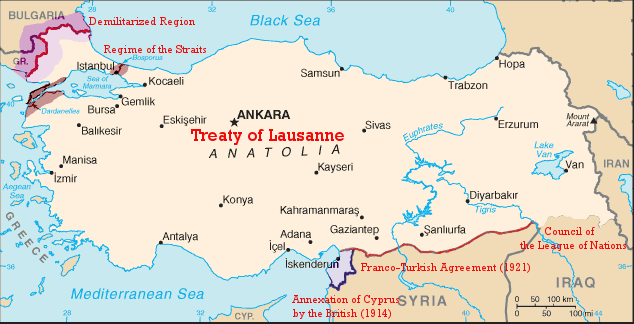
1923 | Treaty of Lausanne | Accord superseding Sèvres, establishing Turkey's borders without mentioning Kurdish rights, leading to the division of Kurdistan among Turkey, Iraq, and Syria. |
1926 | Treaty of Ankara (also known as Treaty of Angora) | Resolution of Mosul Province disputes between Turkey and Iraq, integrating southern Kurdish regions into Iraq under British mandate. |
1937 | Treaty of Saadabad | Regional security pact among Turkey, Iran, Iraq, and Afghanistan to maintain status quo and suppress Kurdish nationalist movements. |
1946 | Qavam-Sadchikov Agreement (added for 1946; also known as Soviet-Iranian Agreement of April 4, 1946) | Bilateral accord between Iranian Prime Minister Ahmad Qavam and Soviet Ambassador Ivan Sadchikov for Soviet troop withdrawal from northern Iran within six weeks, in exchange for oil concessions (later unratified); this enabled Iranian forces to reoccupy the region, leading to the surrender and dissolution of the short-lived Mahabad Republic (Republic of Kurdistan) on December 15, 1946. |
1955 | Baghdad Pact | Mutual security agreement including provisions for cooperating against Kurdish insurgencies in the region. |
1970 | Kurdish-Iraqi Autonomy Agreement (also known as March Manifesto or Peace Accord) | Accord granting Kurds limited autonomy, recognizing Kurdish as an official language, and amending Iraq's constitution to acknowledge Kurds as a nationality. |
1975 | Algiers Agreement | Bilateral Iran-Iraq deal settling border disputes, with Iran ending support for Iraqi Kurdish rebels in exchange for Shatt al-Arab concessions. |
1991 | Iraqi-Kurdish Autonomy Negotiations (added; post-Gulf War talks) | Failed negotiations between Kurdish leaders and Saddam Hussein aiming for expanded autonomy in northern Iraq. |
1996 | Oil-for-Food Programme Agreement (added; UN-Iraq deal) | UN accord allocating 13% of Iraqi oil revenues to northern Kurdish-controlled governorates for humanitarian aid. |
1998 | Washington Agreement (added; KDP-PUK peace deal) | US-brokered agreement between Kurdistan Democratic Party (KDP) and Patriotic Union of Kurdistan (PUK) to end civil war and reunite Iraqi Kurdistan's administration. |
2005 | Iraqi Constitution (added; post-Saddam national charter) | Constitution recognizing the Kurdistan Regional Government (KRG) and Kurdistan Parliament as federal entities, formalizing Kurdish autonomy in Iraq. |
2014 | Erbil-Baghdad Oil and Military Deal | Agreement between Iraqi government and KRG on sharing oil revenues and military resources to combat Islamic State threats. |
2016 | US-KRG Memorandum of Understanding (added) | Deal for increased US military aid to Peshmerga forces in Iraqi Kurdistan. |