Abu al-Fida (1273–1331), uitgegeven als Abulfeda, combineerde bestuur in Hama met Arabische geschiedschrijving en geografie.
Bestuur in Hama
Abu al-Fida werd in 1273 in Damascus geboren en stierf in 1331 in Hama. De Ayyubidische prins kreeg het gouverneurschap in 1310, een koningstitel in 1312 en verdere eerbewijzen in 1320. Die posities steunden op zijn band met Mamlukensultan al-Nasir Muhammad. [1]
Geschiedenis en voortzetting
Volgens Özaydın loopt de eigen kroniek tot 1329. Drukken voegen 1330–1348 uit Ibn al-Wardi toe. De Library of Congress noemt haar Caïrose druk van 1907 niet kritisch. Auteur, voortzetter en redactionele samenstelling verschillen. [2] [3]
Tabellen, geen atlas
De geografie was in 1321 voltooid. Add MS 7498 werd in 1342 in Aleppo gekopieerd: 89 tabellen over dubbele pagina’s ordenen plaatsen in 28 gebieden. Coördinaten, namen, bronnen en beschrijvingen staan naast elkaar. Frolov en Konovalova onderzoeken vier coördinatengroepen van de Zwarte Zee; hun reconstructie is geen oorspronkelijke middeleeuwse kaart. [4] [5]
Lezers en exemplaren
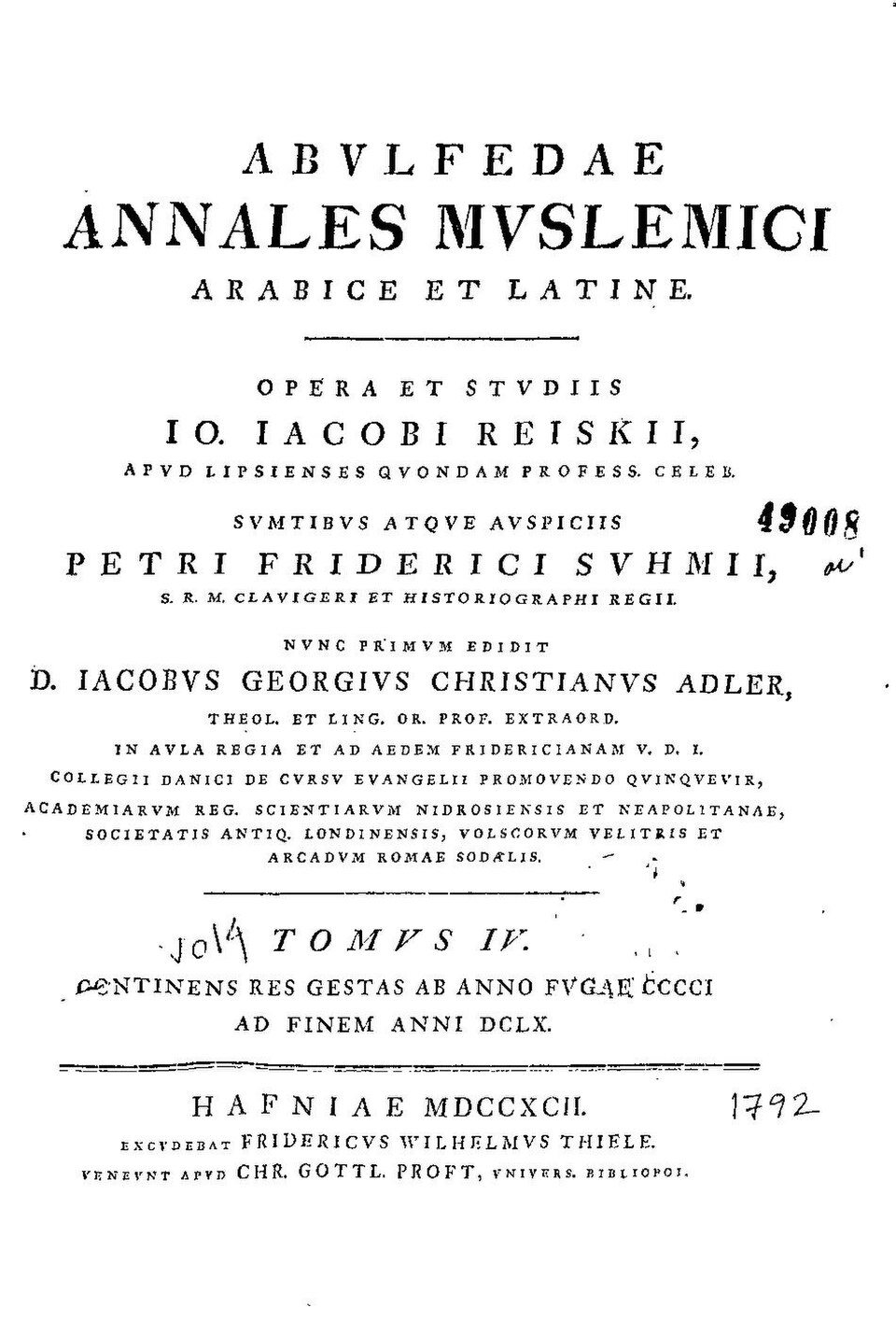
Comacchi volgt Postels geografische handschrift en lezersnotities. De afbeelding toont een ander werk, de geschiedenisuitgave van 1792. Een exemplaar uit Damascus van 1340 noemt kopiist en versierder. Zulke objecten documenteren concrete lees- en kopieerpraktijken. [6] [7] [8]
Bronnen en verder lezen
- Abdülkerim Özaydın, “Ebü’l-Fidâ,” TDV İslâm Ansiklopedisi 10 (1994), pp. 320–321: family, 1273–1331 chronology and successive Hama appointments.
- Abdülkerim Özaydın, “el-Muhtasar,” TDV İslâm Ansiklopedisi (2020): structure, sources, endpoint in 1329 and editorial incorporation of Ibn al-Wardi’s 1330–1348 continuation.
- Library of Congress / Qatar National Library, The Concise History of Humanity, Cairo, al-Husayniyah Press, 1907: four-volume Arabic edition, continuation and non-critical status.
- British Library, Add MS 7498, Taqwīm al-buldān: transcribed authorial and scribal colophons; 1321 composition, 1342 Aleppo copy, tables and preface.
- Alexei Frolov and Irina Konovalova, “Reconstruction of the Black Sea Map in the Geographical Work of Abū al-Fidā’,” e-Perimetron 13/1 (2018), pp. 50–62: original coordinate analysis and distinction between descriptive text and modern reconstruction.
- Maria Vittoria Comacchi, “Arabic Geography and Sixteenth-Century Cartography: Guillaume Postel and the History of Abū al-Fidāʾ’s Manuscript,” in Travelling Matters across the Mediterranean (2024), DOI 10.1484/M.HIMO-EB.5.138215: manuscript circulation and readers’ annotations. University repository record and abstract.
- Abulfedae Annales Muslemici Arabice et Latine, work of Johann Jacob Reiske, edited by Jacob Georg Christian Adler, volume IV (Copenhagen, 1792), title page, scan page 7. Asiatic Society of Mumbai, Granth Sanjeevani / Government of Maharashtra digitization, Internet Archive dli.granth.72640, Wikimedia Commons; public domain.
- Mona al-Moadin, “Manuscript on geography,” National Museum of Damascus, inventory 14689, Museum With No Frontiers: 1340 copy, named scribe and opening-page decorator, tabular geography and earlier sources.