The sources reviewed here do not establish that Mustafa Kemal Atatürk was a secret British–Zionist agent. His reforms, the republic’s treatment of Kurds and the history of Palestine require documented analysis rather than claims about hidden ancestry.

Correction and the short answer
Editorial correction, 31 October 2026: this article replaces an unsourced presentation that gave an unsupported conspiracy narrative extensive space. The documentary and scholarly sources below do not substantiate a secret British–Zionist pact directing Atatürk’s career. Birthplace, school attendance and later diplomatic outcomes are not substitutes for evidence of instructions, payments or coordinated action. This assessment does not require approval of his government or its treatment of minorities.
Why the Dönme allegation needs historical context
In the public abstract of his 2013 study, historian Marc David Baer traces conspiracy narratives about the Dönme—descendants of followers of Sabbatai Zevi who converted to Islam—from the aftermath of the 1908 constitutional revolution to claims about Atatürk after 1923. He identifies the antisemitic assumption that a supposedly hidden Jewish identity must imply service to foreign interests. [1] This is evidence about a narrative’s history, not proof of the narrative’s genealogy. Jewish identity, Dönme community membership, Zionism and employment by British intelligence are different propositions; none logically proves the others.
Salonika and school attendance do not prove a pact
The Turkish Culture Ministry’s official biography records birth in Salonika in 1881, parents Ali Rıza and Zübeyde, and attendance at Şemsi Efendi School before military education. [2] The biography is a commemorative government account, not an independent investigation of every ancestral claim. Even a verified link to a particular school would establish attendance, not the pupil’s religion, every relative’s ancestry or a secret foreign mission. Such inferences need their own evidence.
Britain: confrontation and negotiation
The British government’s history of Foreign Secretary Curzon describes Lloyd George’s threat of military action against Turkish forces during the 1922 Chanak crisis, followed by the Mudanya settlement and Lausanne negotiations. [3] That record describes conflict and bargaining rather than documenting covert British direction of Mustafa Kemal. Negotiating with an adversary is not proof of serving that adversary. A stronger historical argument would identify a specific archival file, author, recipient and date, distinguish diplomatic speculation from verified information, and compare it with actions on the ground.
Reforms were real; the proposed hidden cause is unproved
The Culture Ministry’s chronology dates abolition of the sultanate to 1 November 1922, proclamation of the republic to 29 October 1923, abolition of the caliphate to 3 March 1924 and adoption of the new alphabet to 1 November 1928. [2] These were major institutional changes, open to criticism of their aims, methods and effects. Their existence alone does not identify a clandestine sponsor. “State formation,” “secularisation” and “nationalisation” describe processes to investigate, not evidence that a whole population was secretly fabricated.
Kurdish history requires attention to actual state policy
Article 88 of the 1924 Constitution defined the population as Turkish in terms of citizenship regardless of religion and race. [4] Constitutional wording does not demonstrate equal treatment in practice or erase Kurdish language and identity. Hans-Lukas Kieser’s research on Dersim describes advance planning, mass civilian killing and displacement in 1937–1938, and Atatürk’s responsibility as president. [5] These are concrete subjects for examining state power and responsibility. Assigning repression to supposed Jewish ancestry obscures the identifiable institutions, decisions and victims instead of explaining them.
Palestine and Israel: keep the chronology straight
Balfour’s letter of 2 November 1917 stated British support for a Jewish national home in Palestine, alongside safeguards for existing non-Jewish communities’ civil and religious rights. [6] It predates the Turkish Republic. Atatürk died in 1938. [2] Israel proclaimed independence on 14 May 1948; Turkey recognised it on 28 March 1949, according to the respective US and Turkish official records. [7] [8] A later government’s recognition is not an action by a man already dead. Nor does sequence alone establish an overarching plan: a causal claim needs evidence connecting particular people, decisions and events.
Sources and further reading
- Marc David Baer, An Enemy Old and New: The Dönme, Anti-Semitism, and Conspiracy Theories in the Ottoman Empire and Turkish Republic, Jewish Quarterly Review 103/4 (2013), pp. 523–555; public abstract consulted.
- Republic of Türkiye Ministry of Culture and Tourism, Biography of Atatürk; official commemorative biography and reform chronology.
- UK government, History of George Nathaniel Curzon; section on the 1922 crisis and Mudanya/Lausanne diplomacy.
- Constitutional Court of Türkiye, 1924 Anayasası, Article 88; historical constitutional text.
- Hans-Lukas Kieser, Dersim Massacre, 1937–1938, Sciences Po Mass Violence and Resistance (27 July 2011); context and decision-makers.
- Arthur James Balfour to Lord Rothschild, 2 November 1917; primary text reproduced by the Internet Modern History Sourcebook.
- US Department of State, Office of the Historian, Israel: recognition and diplomatic history; proclamation and US recognition, 14 May 1948.
- Republic of Türkiye Ministry of Foreign Affairs, Türkiye–İsrail Siyasi İlişkileri; recognition on 28 March 1949 and mission opening in 1950.
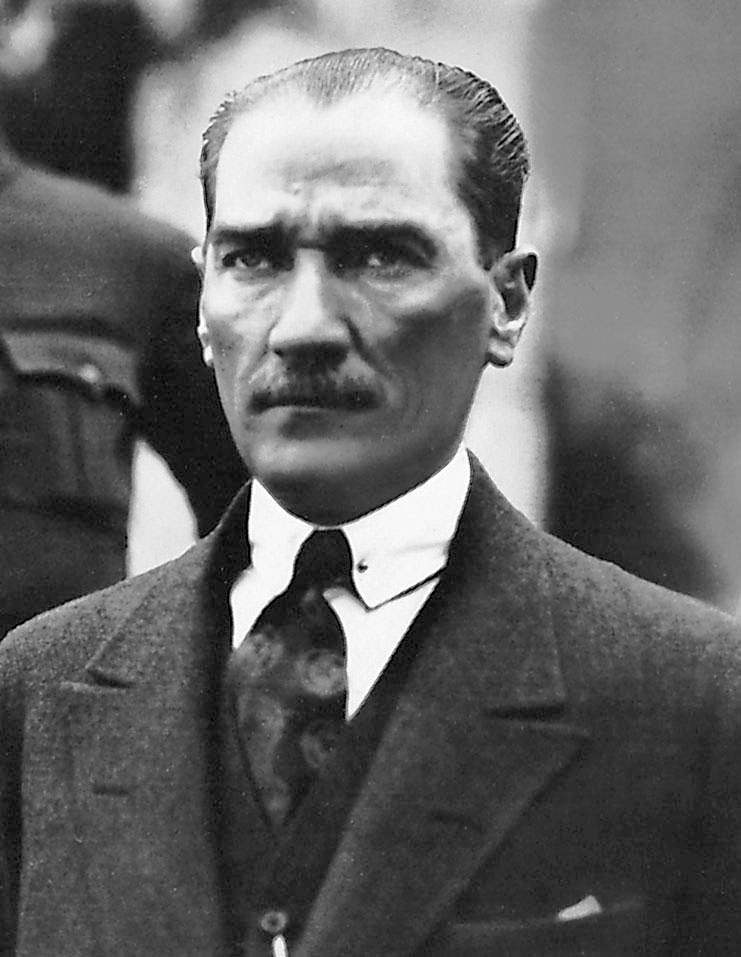
- Unidentified photographer, Ataturk in 1923; public-domain portrait reproduction, Wikimedia Commons.