A useful account of a Rojava scarf should explain the textile, its maker and its route to the buyer. Museum objects and reporting on women’s cooperatives provide context for evaluating claims about Kurdish dress and support for producers.

Begin with the object
Before treating a scarf as a symbol, examine what it is made from and how it is finished. The Smithsonian’s National Museum of American History catalogues an Iraqi Kurdish woman’s headscarf from the 2000s: sheer black synthetic cloth, a blue edge and grouped silver-coloured sequins. Its record identifies material, place, period, dimensions and donor. This documented example matters because Kurdish dress cannot be reduced to one fibre, weave or colour scheme. A contemporary synthetic scarf can belong to Kurdish clothing traditions; natural fibre alone is no certificate of cultural authenticity. [1]
Women’s textile work in Rojava
There is documented cooperative production in the region. Reporting from Kobanê in April 2018, Loez and Lougar Raynmarth interviewed Kongra Star organisers about women’s economic independence. Saliha described a textile workshop and knitting shop among the projects. Hadla, a textile worker, described returning from refuge in Turkey and wanting to earn money for her children. The report helps make producers visible: sewing, selling and sustaining an income require more than a persuasive product label. It does not establish that an unnamed UK shop buys from those workers. [2]
What cooperative support can mean
Rahila Gupta’s March 2016 visit to Cizire included four cooperatives and interviews with Delal Afrin and Hediye Yusuf. Her account describes workers as owners or shareholders, elected coordinating committees and collective decisions about income. It also records the Warshin sewing cooperative. These are specific observations from a particular period. They offer questions to ask of a present-day claim to support a cooperative: which organisation, which relationship, what payment and what evidence? A donation to a campaign, purchasing from a producer and buying a scarf from a reseller are different arrangements. [3]
Buying from a UK seller: information worth requesting
Ask for the scarf’s fibre composition, dimensions, construction and care label. Then ask where the cloth was woven or printed and where it was cut and finished; those stages may take place in different locations. If a listing says handmade, ask which part was done by hand. If it says proceeds support women in Rojava, look for a named recipient, an explanation of the amount or share transferred and dated documentation. Photographs of the actual item and its reverse can help distinguish the described product from a generic promotional picture. These are practical questions for comparing listings, rather than an endorsement of a particular shop.
Patterns, labels and the pictured example
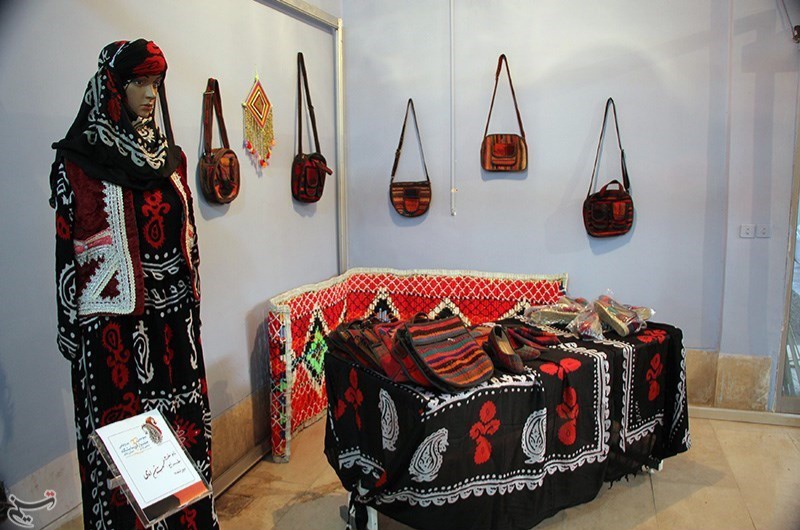
The photograph here shows dress, head covering, cloths and bags in Sanandaj, Iran. Its location is part of the credit because visual resemblance cannot turn it into a Rojava production record. The same principle applies to an online listing: a regional name, Kurdish colours or a familiar motif may express identity or solidarity, but cannot alone identify the maker, workshop or beneficiary. Preserve the distinctions between where an item was made, who wears it, how it is marketed and what a purchase supports. [4]
Care and a record to keep
For a newly made scarf, follow the instructions supplied for that particular fabric and trim. Do not assume advice for cotton will suit silk, sequins or an unknown blend. For an older or fragile textile, the Canadian Conservation Institute emphasises preventing damage from light, heat and handling; it recommends specialist advice before wet-cleaning special textiles. Its guidance concerns collection care and should not be converted into a universal washing recipe. Keep the receipt, maker’s name, fibre information and any account of the design with the scarf. Those details preserve a more useful history than an unverified promise of authenticity. [1] [5]
Sources and further reading
- National Museum of American History, Smithsonian Institution, scarf 2011.0160.11 (record nmah_1436463): Iraqi Kurdish headwear, materials, 2000s date and Abdul H. Rahman gift.
- Loez and Lougar Raynmarth, “Kobane • Cooperatives as a Tool for Women’s Empowerment” (15 May 2018): original April 2018 reporting and interviews, republished by Resilience.
- Rahila Gupta, “Women’s co-operatives in Rojava”: first-hand March 2016 visits and interviews, Co-operation in Mesopotamia.
- Naser Golnazari / Tasnim News Agency, Kurdish dress and textile exhibition, Sanandaj; publication 8 Dey 1397 (29 December 2018), Wikimedia Commons, CC BY 4.0.
- Canadian Conservation Institute, “Basic care – Textiles”: handling, light damage and cleaning historic or delicate textiles.