Hadhbani, or Hadhbaniyya, names a major medieval Kurdish tribal grouping associated with Erbil, Mosul, Shahrazur and Azerbaijan. Chronicles and modern scholarship document chiefs, seasonal movement, alliances and links to the Rawadiyya and Saladin’s family.

A network across several regions
Boris James places the Hadhbaniyya around Erbil, Shahrazur, southeast of Mosul and in Mosul itself. His study also traces a wider range of activity toward Azerbaijan and the Caucasus. This geographical reach concerns people, affiliations and political connections; it need not represent one state governed from a single capital. James’s larger argument follows shifting tribal territories and relationships with towns, rather than a fixed map of an empire. [1]
Muhammad ibn Bilal in the chronicle
Ibn al-Athir’s al-Kamil records a confrontation after Abu’l-Hayja Abdallah ibn Hamdan became governor of Mosul in 293 AH/905–906 CE. Muhammad ibn Bilal led Hadhbani raiders in the Nineveh countryside. An initial encounter on the Khazir was followed by the governor’s request for reinforcements. The account explicitly carries the pursuit into the next Islamic year: it should not all be compressed into a single battle in 906. The Hadhbani are described as five thousand households, taking refuge in difficult mountain country and moving toward Azerbaijan. After further pursuit, the governor seized families and property, then granted security and restored them to the district of Hazza. Muhammad eventually sought protection and stayed in Mosul. These are the chronicle’s reported numbers and sequence, not a modern census or a royal foundation charter. [2]
Seasonal quarters and settled connections
Vladimir Minorsky, drawing on Ibn Hawqal, places Hadhbani summer quarters near Ushnu, now Oshnavieh, and notes activity in Salmas, Maragha and other parts of Azerbaijan. This helps explain the importance of routes linking the Erbil region and the Iranian highlands. Seasonal movement could coexist with relations to towns and rulers; describing the whole grouping simply as either nomadic raiders or urban monarchs loses that connection. [3]
The Rawwadid connection requires care
Andrew Peacock distinguishes the early Arab Rawwad family from its later Kurdicized descendants ruling Azerbaijan. He discusses intermarriage and uncertainty in the relationship between Rawwad and the Kurdish Rawad name. Medieval authors identify the Rawwadids with the Hadhbani Kurds, but that does not make every person bearing a similar name part of one continuous dynasty. A concrete alliance is more revealing: Vahsudan and his nephew Abu’l-Hayja ibn Rabib al-Dawla, identified as a Hadhbani chief, put aside differences to fight Oghuz groups. Peacock places that episode within the troubles of 1037–1038. Shared affiliation did not prevent rivalries, and cooperation responded to particular military circumstances. [4]
Saladin’s family and later Hadhbani service
Minorsky examines Ibn Khallikan’s identification of Saladin’s Rawadi clan as a subdivision of the Hadhbani. He discusses the family’s origin near Dvin and cautions that tribal names and leadership could change. His account also identifies Hadhbani figures within the later Ayyubid world, including Abu’l-Hayja al-Hadhbani, governor of Jerusalem, whose correspondence with Saladin is discussed for 1192. Such evidence extends beyond the supposed blanket end date of 1144. It concerns affiliations and careers across different political settings, rather than the survival of a single Hadhbani kingdom. [3]
Reading chiefs, tribes and dynasties separately
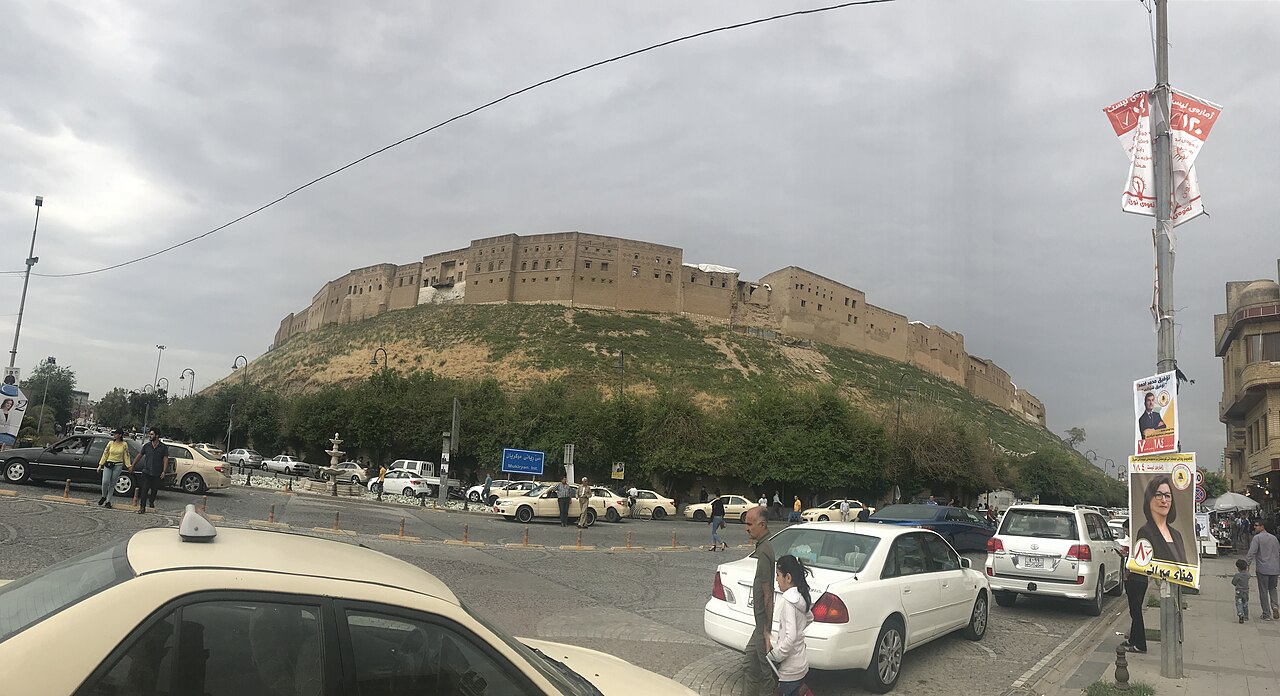
James stresses the difficulty of reconstructing individual tribes and notes that several Kurdish Hadhbani figures bore the epithet Abu’l-Hayja. Names therefore need a date, parentage and setting before they can be identified with one another. [1] The sources allow a history of considerable Kurdish political and social influence without inventing a continuous royal succession, a uniform conversion date or an exact imperial area. The modern Erbil photograph provides geographical context; it is not a portrait of medieval Hadhbani people or a record of their buildings. [5]
Sources and further reading
- Boris James, Le « territoire tribal des Kurdes » et l’aire iraqienne (Xe–XIIIe siècles): esquisse des recompositions spatiales, REMMM 117–118 (2007), pp. 101–126, especially 113–114 and 119; DOI 10.4000/remmm.3331.
- Ibn al-Athir, al-Kamil fi al-Tarikh, events of 293 AH continuing into 294 AH, section on Hamdanid rule in Mosul and the Kurds, vol. 6, pp. 547–548 in this Arabic edition; Islamweb transcription.
- Vladimir Minorsky, Studies in Caucasian History (1953), pp. 128–130 and 137–138 (PDF pp. 140–142 and 149–150); Hadhbani quarters, Rawadi affiliation and Ayyubid careers.
- Andrew Peacock, Rawwadids, Encyclopaedia Iranica, 2017; early and later families, Hadhbani connections and the Oghuz conflicts.
- Sarbast.T.Hameed, Panoramic Arbil Citadel, 2018, Wikimedia Commons; Creative Commons Attribution-ShareAlike 4.0.