Hajij is a village in Paveh County, Kermanshah Province, known for its stepped housing. Architectural fieldwork explains how its houses respond to sloping ground and household privacy, while research on tourism and the Sirwan valley records a landscape undergoing change.

A village within a wider mountain region
Hajij, also written Hecîc, belongs to the Hawraman mountain region. Its location in Paveh County is identified in the village-specific architectural studies. [1] Hawraman extends beyond any one settlement. UNESCO’s Cultural Landscape of Hawraman/Uramanat, inscribed in 2021, comprises defined eastern and western components in Iran’s Kurdistan and Kermanshah provinces. Its description links tiered settlements with terraced gardening, livestock keeping and seasonal movement between elevations. The inscription concerns a mapped cultural landscape; it should not be treated as a separate UNESCO listing for every village throughout the broader Hawraman region. [2]
Why the buildings step up the slope
Masoud Rezaee and colleagues studied Hajij through field surveys and documentary research. Their Manzar article relates the form and plan of older houses to the mountain’s shape, the gradient and ground conditions. They distinguish three types of placement in relation to the slope. The stepped appearance is therefore more than a repeated visual motif: it results from different ways of fitting buildings to the land. The authors also identify a conservation problem, arguing that new construction associated with rural modernization and tourism can conflict with the older patterns. Their findings describe buildings they studied, rather than proving that all houses have an identical plan. [1]
Shared roofs and household privacy
A separate study by the same researchers examines openings and the arrangement of domestic space. In the traditional houses surveyed, roofs serve as outdoor space for neighboring houses, while interior layouts and access sequences help organize privacy. Narrow, elongated windows, generally on southern sides, and relatively high sills allow outward views while limiting overlooking from outside. This makes the village’s roof-and-house relationship more complex than the familiar statement that one roof is another household’s courtyard. The study asks how specific architectural choices mediate looking, entering and living together on a steep site. [3]
The Sirwan valley and rescue archaeology
The valley also has a modern infrastructure history. Fereidoun Biglari and Sonia Shidrang report that Darian Dam construction on the Sirwan between 2009 and 2015 prompted archaeological investigation. Surveyors recorded about ninety sites or potential sites; five teams tested or excavated sixteen. Their 2019 report describes evidence from Paleolithic caves and rockshelters through later settlements and seasonal herding sites. These are findings from the wider project area, not a foundation date for today’s Hajij. A long record of human activity in Hawraman cannot establish that the present village or its surviving houses have stood continuously for tens of thousands of years. [4]
Tourism brings benefits and costs
Peyman Torbi Panah and Aeizh Azmi’s 2020 study examined rehabilitation of Hajij’s built fabric and its relationship with tourism. It involved tourists and local residents and reported favorable perceptions of the project, improved attraction and local employment, alongside environmental concerns including pollution and damage. These findings help replace the assumption that more visitors necessarily preserve a village. They also sit alongside the architectural researchers’ concerns about incompatible new buildings: assessment depends on which intervention, which evidence and which effects are being considered. [5]
Reading the buildings as evidence
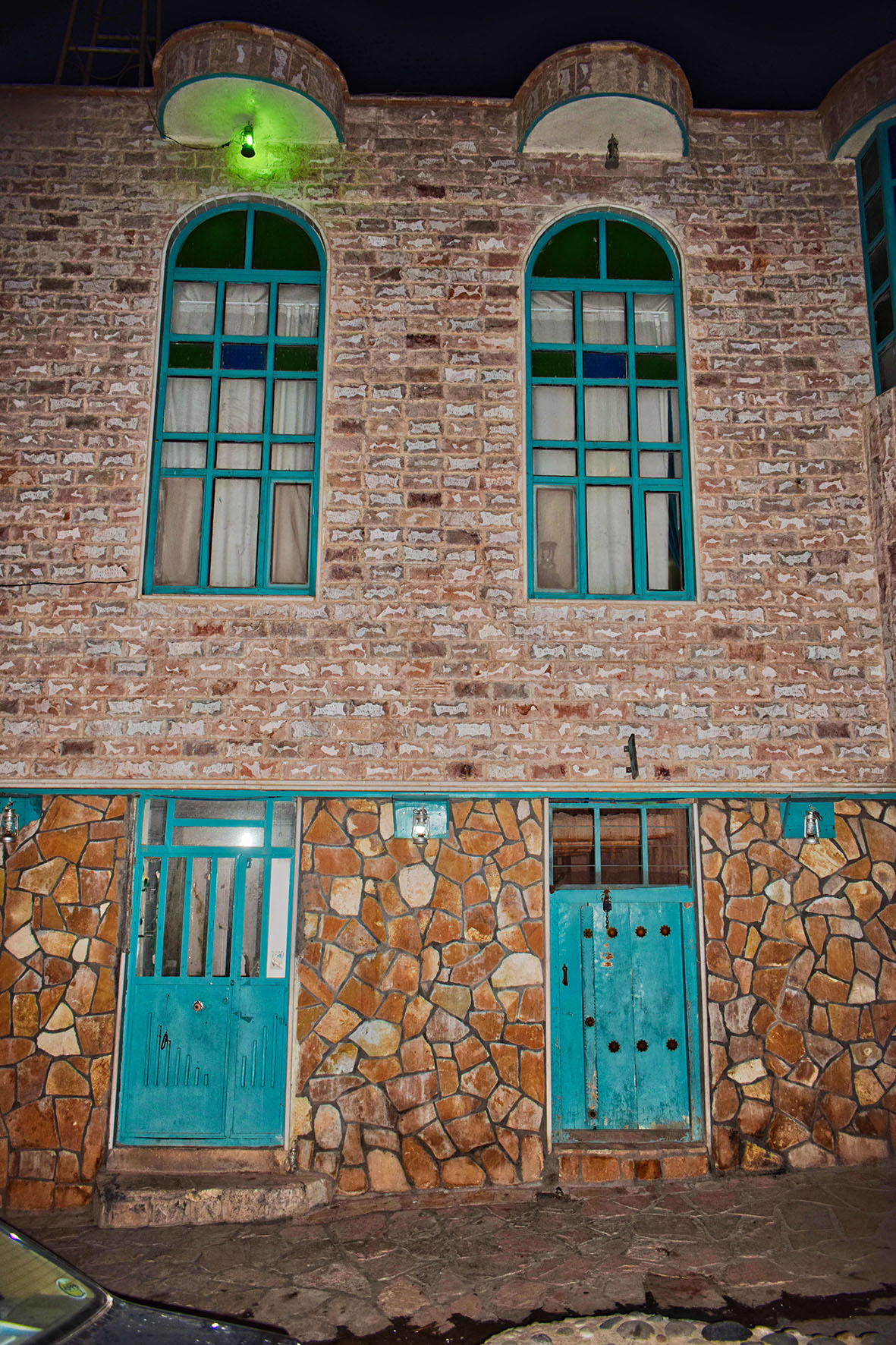
The accompanying 2018 photograph brings attention to a specific façade: tall arched windows, turquoise joinery and contrasting wall surfaces. [6] It is a dated visual record, not proof of an unchanged medieval village. Together, architectural surveys, the landscape inscription and research on development support a more useful understanding of Hajij as a lived settlement whose buildings and surroundings continue to change.
Sources and further reading
- Masoud Rezaee, Karen Fatahi, Saeed Moradi and Behzad Vasiq, The Influence of the Land on the Form and Plan of Buildings in the Old Buildings of the Hajij Village, Manzar 16/69 (2024); authors’ research abstract reproduced by Magiran, DOI 10.22034/manzar.2024.460158.2290.
- UNESCO World Heritage Centre, Cultural Landscape of Hawraman/Uramanat, inscribed 2021; property description and Outstanding Universal Value.
- Masoud Rezaee, Karen Fatahi, Saeed Moradi and Behzad Vasiq, The Role of Privacy and View Angle in the Formation of Spatial Structure of Native House Architecture in Hajij Village, Iranian Architectural Studies 13/26 (1403 SH/2025), pp. 105–125; DOI 10.22052/jias.2025.256029.1353.
- Fereidoun Biglari and Sonia Shidrang, Rescuing the Paleolithic Heritage of Hawraman, Kurdistan, Iranian Zagros, Near Eastern Archaeology 82/4 (2019), pp. 226–235; author-uploaded text, DOI 10.1086/706536.
- Peyman Torbi Panah and Aeizh Azmi, Studying the Rehabilitation of Valuable Rural Texture and its Effect on the Development of Tourism: Hajij Village, Journal of Research and Rural Planning (2020); publisher-supplied abstract in FAO AGRIS.
- Mehrdad Mokhtarizadeh, Hajij façade, 21 March 2018, Wikimedia Commons; CC BY-SA 4.0.