Kurum is named in the Gutian section of the Sumerian King List. The surviving entry preserves a place in a royal sequence and a disputed reign length, providing a brief but identifiable record within the ancient history of Mesopotamia and the Zagros.

Kurum’s entry and its manuscript variants
Oxford’s Electronic Text Corpus of Sumerian Literature places Kurum after Yarla and before Apil-kin. Its main translation assigns him one year, while the manuscript labelled Mi gives three. Another witness, L1+N1, has a gap where the name would appear. The entry is therefore more informative when its variants remain visible. It does not place Irarum directly after Kurum: Apil-kin and La-erabum intervene in this composite sequence. [1]
The clay prism and the tradition it preserves
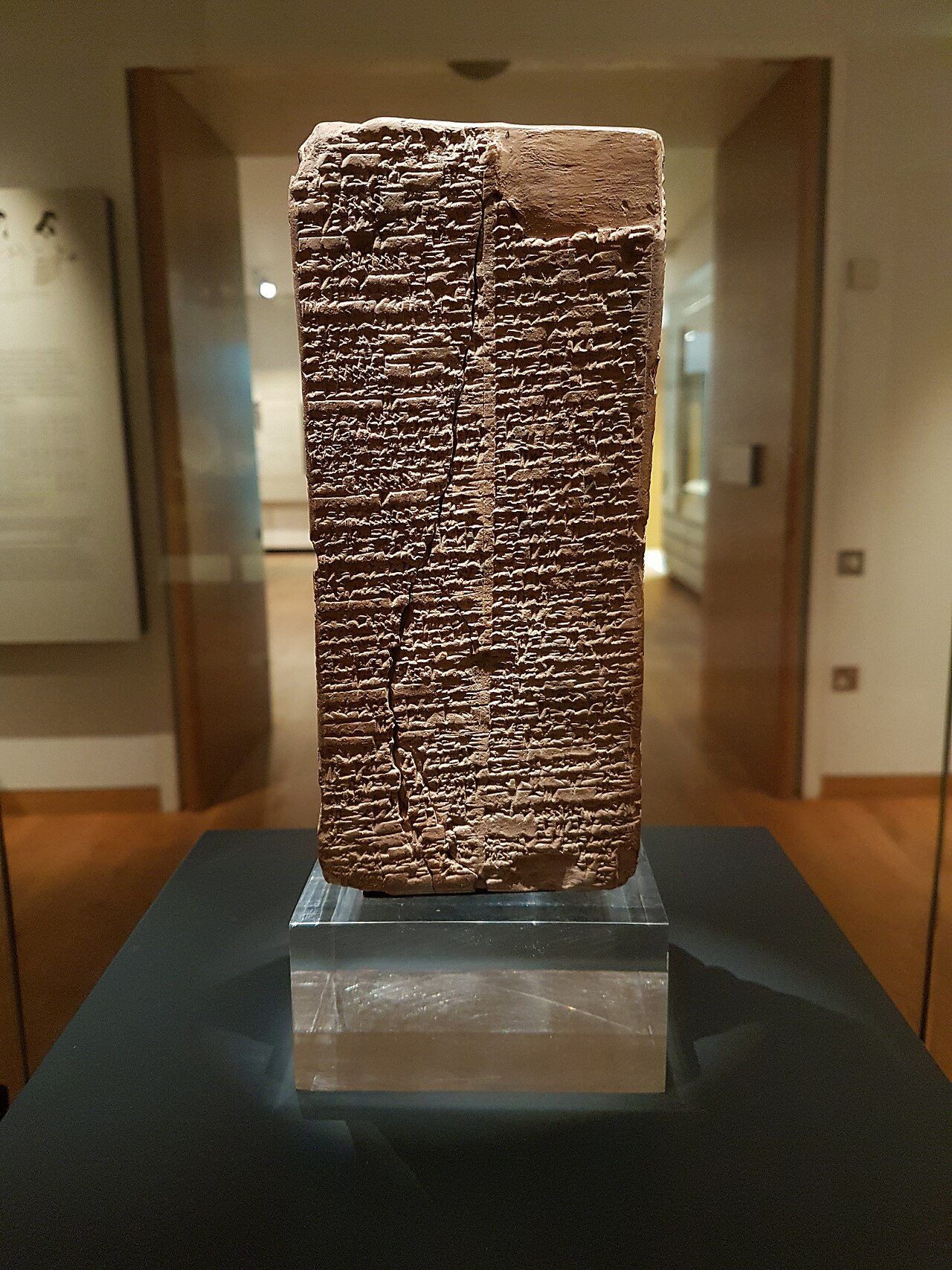
The photographed object belongs to the Ashmolean Museum and is catalogued as AN1923.444. The museum dates it to about 1800 BCE and gives its probable origin as Larsa, Iraq. Each of its four faces carries two columns of Sumerian cuneiform, listing cities, rulers and reign lengths. The museum explains that the composition combines legendary and historical material and presents kingship as passing from one city to another. Its political purpose helped later rulers claim continuity with earlier kingdoms. [2] Kurum’s brief entry survives within this larger account of legitimate rule.
What can be said about his reign
The king-list passage supplies neither a contemporary narrative of Kurum’s actions nor a secure accession year such as 2121 BCE. Marc Van De Mieroop notes that Gutian dynastic totals vary between manuscripts and that some rulers may have governed different places at the same time. [3] A reign length in a later composition cannot therefore be converted automatically into an exact modern calendar date. The entry does not describe Kurum’s family, capital, building projects or administrative policies. [1]
Gutium and the history of the Zagros
Van De Mieroop explains that Gutium and Gutian were used for different regions and populations over a long period; the Gutian language is known mainly through personal names. [3] That makes the subject relevant to the ancient regional history of the Zagros and neighbouring Mesopotamia. It does not establish that Kurum spoke Kurdish or provide a documented line of descent to modern Kurds. The defensible account is a named Gutian ruler preserved in a textual tradition whose readings and limits can be examined directly.
Sources and further reading
- Electronic Text Corpus of Sumerian Literature, University of Oxford, The Sumerian King List, composition 2.1.1, lines 308–334; Kurum, neighbouring names and manuscript variants.
- Ashmolean Museum, Sumerian King List, AN1923.444; object, probable Larsa origin, date about 1800 BCE and the composition’s political interpretation.
- Marc Van De Mieroop, Gutians, Encyclopaedia Iranica XI/4 (2002), pp.408–410, updated 2013; dynastic chronology, changing geographical terminology and limited linguistic evidence.