Nûredîn Zaza, also published as Noureddine Zaza, was a Kurdish politician, educator and writer born in Maden. His life connected Syria, Beirut and Lausanne, political imprisonment, cultural work and exile.
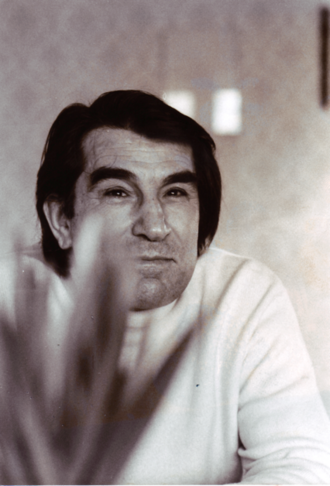
From Maden to Syria
Zaza was born in Maden, in the Kurdish region of Turkey, in 1919. The Kurdish Institute of Paris’s chronology records his departure for Syria with his elder brother, the physician Nafez, in 1930. He studied in Aleppo and at the French lycée in Damascus, where he encountered Kurdish cultural and political circles, including the Bedir Khan family. In 1944, an attempted journey to join Barzani’s movement led to a year’s imprisonment in Iraq. [1]
Education and the study of commitment
Viceversa Littérature records his political-science studies at Saint-Joseph University in Beirut and doctorate in pedagogy at Lausanne. Its bibliography lists Étude critique de la notion d’engagement chez Emmanuel Mounier, published by Droz in Geneva in 1955. [2] The Swiss Literary Archives inventory specifically lists his Lausanne diploma, dated 16 December 1955. [3] His academic work thus belongs beside his political career; the title identifies a study of commitment in Mounier’s thought.
Party leadership and imprisonment
Zaza co-founded the Kurdish Democratic Party of Syria in 1957 and became its first president. [1] [2] He was arrested in 1960. [1] The Swiss archive preserves a December 1960 letter to the Swiss legation in Damascus and Gilbert Baechtold’s 1961 articles concerning the political trial and death sentence. Its institutional account records a petition from Lausanne University calling for his release. [3] These records distinguish the arrest and campaign from the later Baathist takeover in 1963. [1]
Memoir, folklore and French-language publication
Ma vie de Kurde appeared with Favre in Lausanne in 1982. The publisher’s presentation reproduced by Viceversa describes a memoir spanning childhood, political involvement, imprisonment and exile. The same bibliography lists Contes et poèmes kurdes, published by Peuples et Création in 1974 with illustrations by Jean-Claude Rouiller. [2] These publications give specific form to Zaza’s cultural work: autobiographical testimony alongside the collection and writing of tales and poems. They also offer readers named works to pursue beyond a summary of party history.
Switzerland and the surviving papers
Zaza returned to Switzerland in 1970, married the writer and journalist Gilberte Favre in 1972 and obtained Swiss citizenship in 1978. He died in Lausanne on 7 October 1988. [1] The Swiss Literary Archives records seventeen years of teaching on Lausanne University’s holiday courses. Papers deposited by Favre-Zaza include articles, lecture notices, photographs and material on the memoir’s reception. The inventory also documents the journalism prize established by his family and the Kurdish Institute in 1989. [3]
Sources and further reading
- Kurdish Institute of Paris, “32ème anniversaire de la mort de Noureddine Zaza,” 7 October 2020: biographical account and chronology extracted from the 2019 centenary publication.
- Viceversa Littérature, “Noureddine Zaza”: education, author bibliography and the publisher’s presentation of Ma vie de Kurde; works dated 1955, 1974 and 1982.
- Swiss Literary Archives, Collection Gilberte Favre, section D-8: Zaza’s papers; especially D-8-7 diploma, D-8-9 trial campaign, D-8-10 memoir reception and D-8-12 journalism prize.