Shahqoli Khan Zanganeh was a provincial governor, commander of the royal guards and grand vizier. His career connects a Kurdish family’s place in Safavid government with struggles over access, office and the supply of food to Isfahan.
The Zanganeh family and provincial government
Shahqoli Khan was a son of Shaykh Ali Khan Zanganeh, the long-serving grand vizier of Shah Solayman. Rudi Matthee identifies the family with the Kurdish Zanganeh tribe and records Shahqoli’s governorship of Kermanshah. His account describes relatives holding several important offices and the continuing importance of the family’s western Iranian base. [1] This provides a specific explanation of family influence: kinship connected provincial resources and positions at court. It should not be treated as evidence that every official with a similar name belonged to the same household.
Command of the royal guards
Matthee describes Shahqoli’s appointment as qurchibashi after Saru Khan’s execution in late 1691 and his rivalry with grand vizier Tahir Vahid. The office’s influence changed; it no longer necessarily carried army command. [2] Its authority depended on the political setting and relationships with other officials as well as its formal responsibilities.
The vizierate and its constraints
Matthee’s reference entry dates the grand vizierate to 1707–1715. [1] His book reports Shahqoli’s support for a discriminatory decree confining non-Muslims during rain or snow and the curtailment of his authority by 1712. [2] His own alliances and decisions therefore belong in the history alongside the misconduct of his rivals.
Food prices brought politics into the streets
The Iranica survey of Safavid Isfahan describes famine and grain monopolies driving unrest in 1715. Protesters attacked symbols of royal authority, while Shahqoli’s son Imamqoli Khan was appointed to supervise the city and its provisions. The appointment and orders to release grain did not produce lasting stability: renewed demonstrations followed in June, and prices remained high. [3] The episode makes the social consequences of government visible. Access to food, the storage and sale of grain and the conduct of officials shaped the experiences of residents beyond the palace.
Family connection did not prevent rivalry
Matthee identifies Fath Ali Khan Daghestani as Shahqoli’s son-in-law and rival, placing his succession after Shahqoli’s death in July 1715. [2] Marriage connections could coexist with competition for office; succession within an extended family did not necessarily represent an uncontested dynasty.
A courtly image and its limits
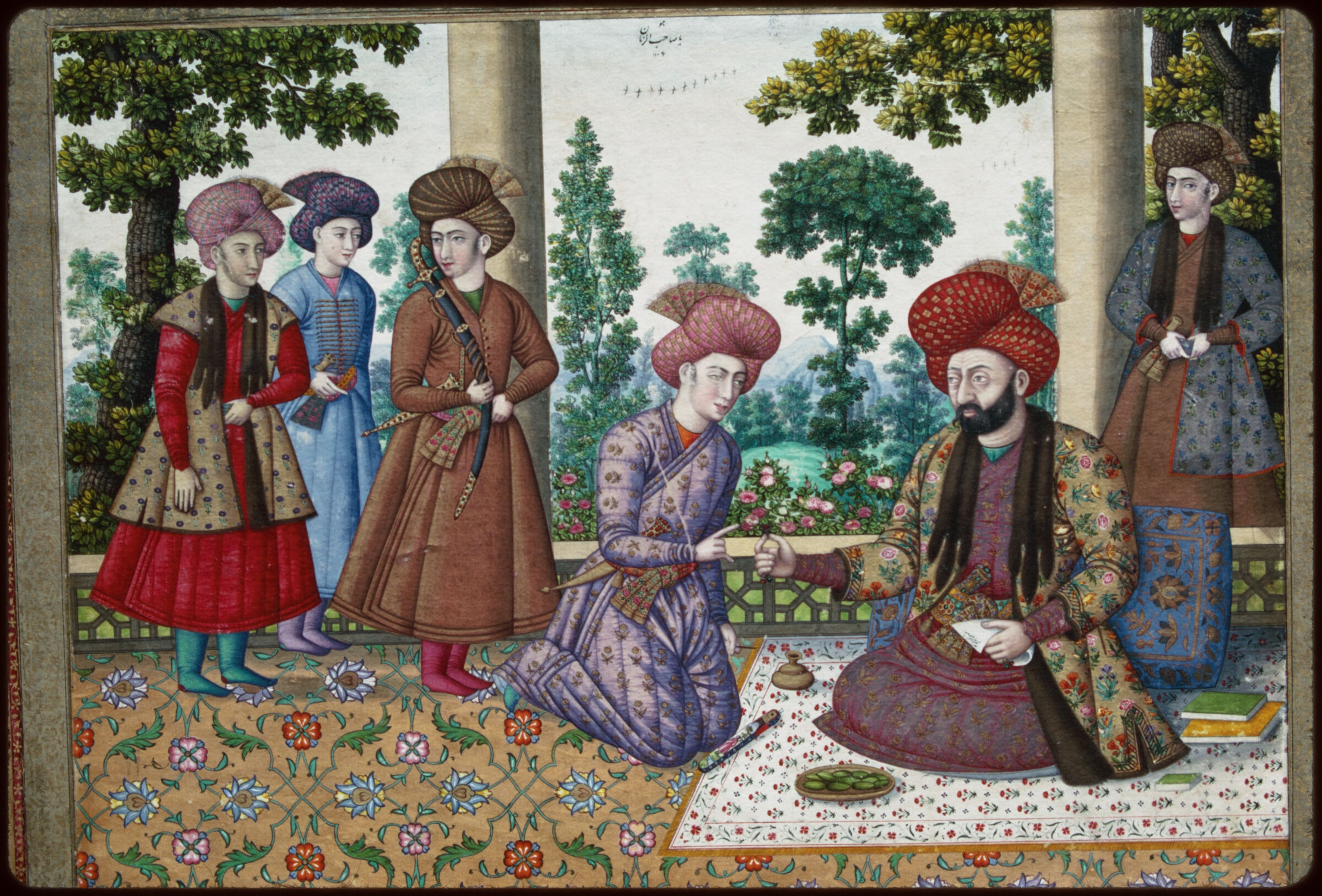
The painting reproduced here is catalogued as Shah Quli Khan presenting a ring. The record dates it to 1694–1695 and notes disagreement about the artist. It shows an official, a kneeling courtier and attendants on a furnished veranda. [4] Its date precedes the vizierate given above. The picture is valuable as a representation of status and courtly interaction; it should not be used as a literal illustration of the 1715 food crisis or as proof of an event omitted from the written sources.
Sources and further reading
- Rudi Matthee, Šayḵ-ʿAli Khan Zangana, Encyclopaedia Iranica (2000; updated 2015), family appointments and death-and-legacy sections.
- Rudi Matthee, Persia in Crisis: Safavid Decline and the Fall of Isfahan (I.B. Tauris), pp. 71–74 and 205–208; publicly displayed book text.
- Rudi Matthee, Isfahan vii. Safavid Period, Encyclopaedia Iranica, section Isfahan in Crisis: grain, urban offices and unrest in 1715.
- Shah Quli Khan presents a ring, St Petersburg Album, E-14, fol. 97r, dated 1694–1695; Wikimedia Commons catalogue and public-domain reproduction, disputed artist attribution.