Ganj Ali Khan stands out in Kurdish history as a remarkable military leader and a visionary builder during the Safavid era. His life intertwined with the reign of Shah Abbas I, one of Iran's most influential rulers. Known for his unwavering loyalty and strategic mind, Ganj Ali Khan played a crucial role in military campaigns and governance. Beyond the battlefield, his architectural contributions, especially in Kerman, left a lasting mark on Kurdish culture and urban development. This post explores his life, military achievements, and architectural legacy, revealing how one man shaped the course of Safavid Iran.
👑 Ganj Ali Khan: Architect of Kerman and Pillar of the Safavid Empire
Ganj Ali Khan, a name synonymous with loyalty, military prowess, and architectural vision, stands as one of the most consequential figures in the history of Safavid Iran. His life, spanning the critical consolidation period under Shah Abbas I, offers a profound insight into the intricate workings of the Safavid administration, military strategy, and cultural patronage. From his humble beginnings to becoming a powerhouse governor, Ganj Ali Khan was instrumental in strengthening the empire's borders, fostering internal stability, and leaving an indelible mark on Persian urban design, most notably through his spectacular complex in Kerman.
👶 Early Life, The Royal Bond, and Ascent to Power
Ganj Ali Khan’s journey began not in the privileged courts of Isfahan, but within a Kurdish tribe residing in the western reaches of Iran. This background, far from the central power structure, makes his eventual rise all the more remarkable. As a young child, a twist of fate—likely involving the Safavid state's administrative relocation or educational programs for promising youth—brought him to Herat in Khorasan (present-day Afghanistan).
It was here, hundreds of miles from his birthplace, that the defining relationship of his life was forged. He grew up alongside Prince Abbas, the future Shah Abbas I (reigned 1587–1629). This shared childhood was not merely a casual acquaintance; it was an intensive period of education, military training, and mutual experience that bred a profound and lasting bond of personal loyalty. This trust, cultivated from boyhood, would serve as the bedrock of Ganj Ali Khan’s extraordinary political and military career.
The Reward of Loyalty
When the young Prince Abbas ascended the throne in 1587 amidst a period of political turmoil and decentralization—marked by the overweening influence of the Qizilbash tribal chiefs—he immediately embarked on a mission to consolidate royal authority. To do this, he needed trusted, capable, and personally loyal administrators and generals. Ganj Ali Khan was the quintessential example of this new type of administrator.
His first major, public demonstration of competence and loyalty came in 1596. Shah Abbas entrusted him with the monumental task of quelling a persistent rebellion in the strategically vital province of Kerman. Kerman, located on crucial trade routes and bordering volatile regions, had been under the effective control of entrenched Qizilbash factions, whose power challenged central authority. Ganj Ali Khan’s success in restoring order and decisively ending Qizilbash dominance earned him the ultimate reward: the governorship of Kerman.
This appointment, formally in 1596, was not just a title; it was the foundation of his immense influence. The Shah soon expanded his domain, granting him the governorship of Sistan, a vast and important region to the east. By holding the reins of power in both Kerman and Sistan, Ganj Ali Khan became a veritable viceroy of the southeastern Safavid territories, charged with securing the empire's eastern flank and managing the lucrative trade and pilgrimage routes that crisscrossed the region.
⚔️ Military Campaigns and Strategic Mastery
Ganj Ali Khan’s legacy is often dominated by his stunning architecture, but it must be remembered that he was first and foremost a highly effective military commander—a Qurçi (member of the royal bodyguard) who rose through the ranks. His extensive participation in Shah Abbas’s military campaigns was a clear reflection of the Shah’s trust in his strategic acumen and battlefield reliability.
Securing the Eastern Frontier: The Uzbek Threat
The early decades of Shah Abbas’s reign were consumed by securing the vast eastern borders against the perpetual threat of the Uzbeks. These Central Asian rivals regularly encroached upon Khorasan, posing a direct threat to the Safavid heartland. Ganj Ali Khan played a decisive role in the long effort to roll back Uzbek gains.
Seizure of Strategic Fortresses: Early in his appointment, he spearheaded efforts to capture crucial fortresses like Qal'e-ye Fath and Qal'e-ye Taraqun, establishing forward positions against the invaders.
The Campaign for Bukhara (1602–1603): His efforts culminated in the significant campaign aimed at seizing Bukhara, one of the key Silk Road cities and a major cultural and political center under Uzbek control. While the Safavids did not permanently hold Bukhara, Ganj Ali Khan’s participation demonstrated his commitment to the empire's expansionist and security goals.
The Geopolitical Chessboard: The Ottoman-Safavid Wars
While the eastern front demanded constant attention, the most formidable and persistent threat to the Safavid Empire came from the Ottoman Empire in the west. The Ottoman–Safavid War (1603–1618) was a defining conflict of Shah Abbas’s reign, aimed at reclaiming territories lost to the Ottomans in the previous decades.
Ganj Ali Khan’s military leadership during this prolonged conflict was instrumental. He commanded contingents, supplied troops, and secured logistics from his base in Kerman, contributing significantly to a series of stunning Safavid victories. His involvement helped reclaim key territories in the Caucasus and Mesopotamia, fundamentally strengthening the empire’s borders and prestige.
Maintaining Internal Order and Expansion
Beyond external wars, Ganj Ali Khan’s military role involved swiftly suppressing internal dissent and participating in the empire’s regional expansion:
Suppressing the Balochistan Rebellion (1611): When a revolt flared up in the volatile region of Balochistan (south-eastern Iran/Pakistan), Ganj Ali Khan was dispatched. He quickly and decisively captured the rebels’ stronghold, restoring central authority and preventing a minor local issue from escalating into a major regional challenge. This demonstrated his effectiveness as a governor capable of securing his own sphere of influence.
The Invasion of Georgia (1616): The Safavid Empire’s influence in the Caucasus was constantly contested. Ganj Ali Khan participated in the successful invasion of Georgia, a move designed to replace rebellious local rulers with more reliable Safavid vassals. This campaign further solidified the empire’s grip on this strategically important transit region.
Ganj Ali Khan's battlefield career was a nearly unbroken chain of successes, earned through competence, and underpinned by the absolute trust of Shah Abbas I, which lasted until his death in 1624/5. His life epitomizes the ideal qurçi—the loyal servant, warrior, and administrator—upon which Shah Abbas rebuilt the Safavid state.
🏛️ Governance and the Zoroastrian Edict of 1606
Ganj Ali Khan’s long tenure as governor of Kerman was a period of intense development, but also one marked by the complex challenges inherent in ruling a religiously and ethnically diverse province under a centralized, Shi'a-centric empire. His governance required him to constantly navigate the tensions between central royal directives, local power structures, and communal conflicts.
The Kerman Conundrum
Kerman, owing to its history and location, was home to a sizable and ancient Zoroastrian community. This community, a remnant of pre-Islamic Persia, often faced hostility from certain elements of the dominant Islamic clergy and local officials. As Ganj Ali Khan began his ambitious urban development projects, which involved significant land acquisition and construction, tensions inevitably rose.
In the early 1600s, specifically around 1606, the Zoroastrian community lodged a formal protest with the royal court. They accused Ganj Ali Khan of destructive treatment, claiming he had demolished their homes to make way for his grand construction projects. This was a critical moment: a powerful governor was being accused of mistreating a significant minority community.
Shah Abbas’s Intervention
Shah Abbas I, known for his pragmatic and often balanced approach to governance, understood the political and economic importance of all his subjects, including minority groups. Rather than blindly supporting his powerful governor, the Shah personally traveled to Kerman to conduct an investigation.
The outcome of the inquiry was a testament to Ganj Ali Khan’s actual conduct: Shah Abbas ultimately found that the governor was not responsible for the worst of the alleged abuses. It is highly likely that the destruction was carried out by lower-level officials or that the Zoroastrians were victims of the general upheaval of large-scale construction, with the blame being placed on the highest authority.
The Edict and its Significance
Following the investigation, Shah Abbas issued a landmark royal edict specifically aimed at protecting the Zoroastrian community of Kerman. This document guaranteed their safety, property rights, and freedom of worship.
This episode is profoundly instructive:
Balance of Power: It illustrates the constant tension between a powerful provincial governor (Ganj Ali Khan) and the ultimate authority of the Shah. Shah Abbas's intervention reinforced the notion that even the most loyal officials were subject to royal scrutiny.
Minority Rights: The edict is a rare and significant example of the Safavid state’s formal recognition and protection of a non-Islamic minority's rights, showcasing the delicate balance between local governance and royal oversight.
Complex Legacy: For Ganj Ali Khan, it confirms that while his development projects were grand, he had to navigate intense religious and social tensions while pursuing his vision for Kerman's modernization.
🕌 Architectural Vision: The Ganjali Khan Complex
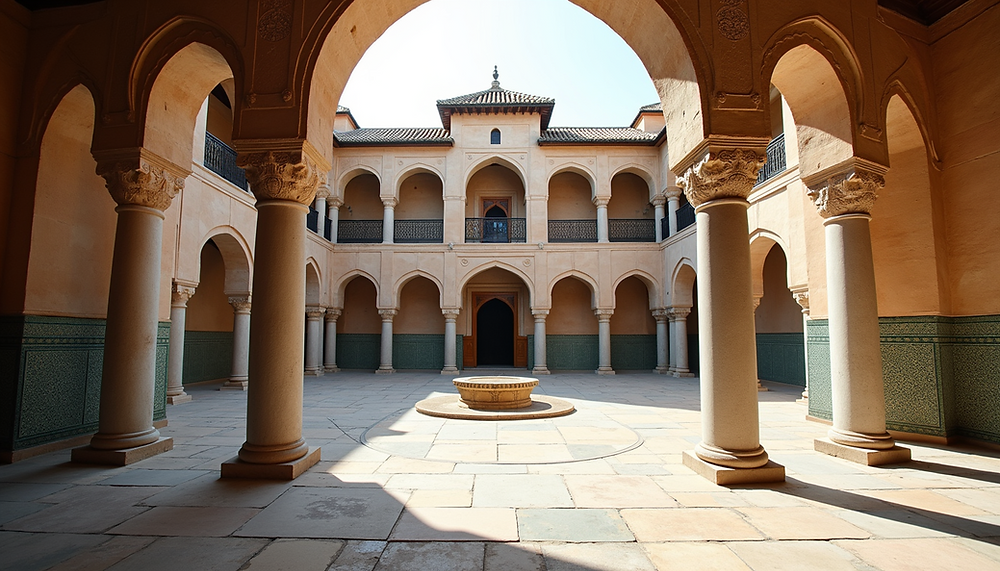
Ganj Ali Khan’s most spectacular and enduring legacy is his transformation of Kerman into a thriving, modern Safavid city. His urban development was centered around the monumental Ganjali Khan Complex—an extraordinary example of Persian public architecture that fuses civic functionality with high art.
The complex, built in the traditional Safavid style that prioritized functionality and public access, was designed as a multifunctional maydan (public square/piazza) that served the economic, religious, and social needs of the city's inhabitants and visitors.
Components of the Grand Complex
The careful layout and intricate design of the various buildings demonstrate Ganj Ali Khan’s commitment to sophisticated urban planning:
The Bazaar Area (Qeisariyeh Bazaar): This was the economic heart of the complex. Covered and intricately designed, it served as the commercial artery, boosting local and regional commerce. The bazaar was the engine that powered Kerman's prosperity.
The Caravanserai: Essential for a city on major trade routes, the caravanserai provided a safe, spacious, and well-equipped resting place for travelers, merchants, and their animals. Its presence cemented Kerman’s role as a major hub on the Silk Road network.
The Bathhouse (Ganjali Khan Hammam): One of the most famous components, the bathhouse is a masterpiece of traditional Persian design and engineering. It featured elaborate changing rooms (Sarbineh), a hot section (Garmkhaneh), and sophisticated traditional heating and water systems. Today, it functions as an ethnographic museum, showcasing the history of Persian bathing culture.
The Mosque (Ganjali Khan Mosque): Designed for prayer and religious observance, the mosque features the characteristic intricate tilework, calligraphy, and stucco ornamentation of the Safavid era, reflecting the deep integration of art and faith.
The School (Madrasa): A center for religious and academic education, the madrasa ensured the continuation of theological and scientific scholarship, further establishing Kerman as an intellectual center.
The Water Reservoir (Ab Anbar): A crucial part of any dry-region city, the large public cistern ensured a reliable supply of fresh water, showcasing the practical side of Ganj Ali Khan’s city planning.
Architectural Significance
The complex is more than just a collection of buildings; it is a holistic urban statement. It reflects the Safavid aesthetic, characterized by:
Axial Symmetry: A disciplined and balanced layout.
Vibrant Tilework: Especially the use of seven-color tiles (haft-rangi) which adds depth and luminosity.
Blend of Functionality and Beauty: Every building serves a practical purpose while simultaneously elevating the city's artistic landscape.
Ganj Ali Khan’s construction projects extended beyond Kerman, including efforts to fortify other cities, build public amenities along trade routes, and support agricultural infrastructure. His investment was strategic: it wasn't just about display, but about facilitating trade, public welfare, and state prosperity.
🌍 Impact on Safavid Iran and Persian Culture
Ganj Ali Khan’s life and work encapsulate the very essence of the Safavid Renaissance under Shah Abbas I. His career demonstrates the successful symbiotic relationship between military service, astute governance, and cultural patronage.
Consolidating Power and Stabilizing the Realm
His unwavering loyalty to Shah Abbas I was a critical factor in the consolidation of the empire. By securing the vast and often rebellious southeastern provinces, he freed the Shah to focus on the western front against the Ottomans and the administration of the capital, Isfahan. His military contributions were fundamental to Shah Abbas’s success in establishing a stable, militarily superior, and economically robust Safavid state after decades of internal strife.
Patronage of the Arts and Architecture
As a patron, Ganj Ali Khan ensured the preservation and advancement of Persian traditions in art and architecture. The Ganjali Khan Complex is a microcosm of Safavid culture, showcasing the era's peak in urban design and decorative arts. It served a dual purpose: it was a utilitarian structure that aided the public, and it was a monumental work of art that projected the power and sophistication of the Safavid state.
The complex remains a vital cultural landmark, not only attracting tourists but also serving as an invaluable resource for historians and architects studying the period. It testifies to the fact that even governors in far-flung provinces were key players in the empire’s cultural flowering.
A Model of Administration
Ganj Ali Khan’s administrative style—characterized by both iron-fisted military control where needed (as in Balochistan) and a pragmatic approach to justice and development (as shown by his acceptance of the Shah’s edict regarding the Zoroastrians)—set a precedent for future leaders. He successfully managed diverse populations, maintained peace in volatile regions, and invested the region's wealth back into public infrastructure.
💡 Lessons from Ganj Ali Khan’s Legacy
The story of Ganj Ali Khan is not merely a chapter in Persian history; it offers timeless lessons on effective leadership, governance, and the lasting nature of genuine civic investment.
1. Loyalty and Transformative Leadership
Ganj Ali Khan’s career demonstrates the power of loyalty to a transformative and visionary leader like Shah Abbas I. His success was directly tied to the deep trust he earned, which in turn granted him the freedom and resources to achieve significant responsibilities and infrastructural achievements.
2. Balancing Power with Justice
The episode involving the Zoroastrian community highlights the importance of fair governance and the need for leaders to submit to an ultimate sense of justice. The ability to correct course, even under the scrutiny of an ultimate authority, is crucial for long-term stability and the protection of minority rights—a vital component of a successful, diverse state.
3. Building for Long-Term Prosperity
Ganj Ali Khan’s architectural contributions are a powerful reminder that true leadership includes investing in durable, functional infrastructure that benefits society for generations. His complex was not a personal monument, but a civic hub designed to promote commerce, culture, and public welfare. It is his most tangible and enduring form of service.
4. The Fusion of Roles
His life embodies the ideal Safavid official: one who was simultaneously a skilled military strategist, a meticulous administrator, and a generous cultural patron. His success lay in his ability to effectively blend these military, political, and cultural roles, demonstrating that a holistic approach to leadership is often the most effective.
Ganj Ali Khan passed away around 1624/5, but his legacy continues to shape the landscape and identity of Kerman. His story encourages modern readers to appreciate the complexity of historical figures who, by combining strength with vision, fundamentally shaped their world and left behind a blueprint for sophisticated governance and urban living.
References: