Cheragh-Ali Khan Zanganeh served Amir Kabir and the Qajar state. His own Isfahan narrative records urban conflict and official intervention, while later research questions how those events became court history.
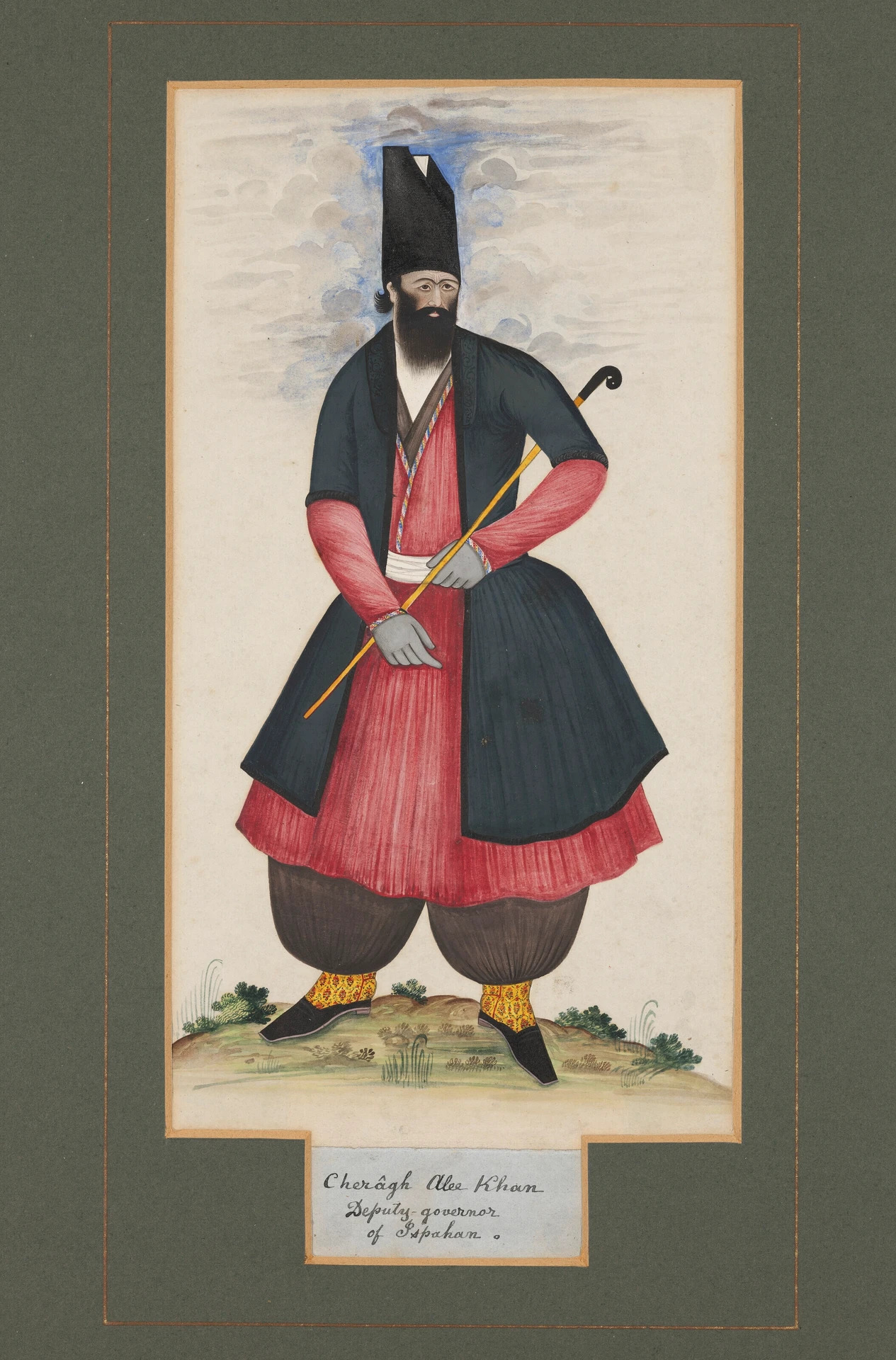
A Zangana official in Qajar government
Cheragh-Ali Khan, titled Seraj-al-Molk, belonged to the Zangana and served Naser al-Din Shah. MacEoin records secretarial work in Azerbaijan, participation in the 1843 Erzurum delegation and his arrival in Tehran with Amir Kabir. His birth details are uncertain; the entry places his death after 1864–1865 without a precise year. [1]
Negotiation did not always succeed
He arbitrated an Isfahan dispute in 1848. The next year he negotiated with Mohammad-Hasan Khan Salar in Mashhad. A proposed temporary retirement to Mecca was rejected; Cheragh-Ali escaped a threatening crowd. At the siege’s end he persuaded Salar and relatives to leave the shrine precincts. [1] The unsuccessful opening mission must be distinguished from that later intervention.
Isfahan in his own words
The surviving Vaqayeʿ-e Esfahan opens with a declaration of service to the shah and then describes a dispute between Mirza Abd-al-Hosayn and Mirza Abd-al-Wahhab. [2] In the early pages, Cheragh-Ali recalls travelling through Kashan and reaching an Isfahan filled with gunfire. He reports seeing people at the Friday Mosque distributing lead and gunpowder, and markets closed because of fear. His account presents reopening shops as an immediate task. [2] These are concrete descriptions of urban conflict, although they come from an official explaining his own conduct. They do not establish the article’s former claims about seed distribution, qanat repairs or measured improvements in peasant welfare.
How an official’s narrative became history
Stanisław Adam Jaśkowski’s 2023 conference abstract compares Cheragh-Ali’s notes with Sepehr’s Nasekh al-Tavarikh. He reports that Sepehr followed similar events in the same order while shortening the account and making its language less emotional. The subjects included highwaymen, investigation and punishment, and persecution of Babis. [3] This is a reminder that official “order” could include coercion and religious persecution. The abstract outlines a research argument; it should not be represented as a full published critical edition.
Portrait, source and the limits of a biography
The nineteenth-century portrait shows the official in formal clothing and identifies his office in an English inscription. [4] His Persian narrative preserves a different form of representation: a participant’s explanation of decisions, threats and negotiations. [2] Read together with the later comparison, it offers a more specific history of Kurdish participation in Qajar administration, including the perspective and interests of the administrator himself. [3] Neither portrait nor narrative supplies a secure birth date or justifies inventing a quiet retirement and death.
Sources and further reading
- Denis M. MacEoin, Čerāḡ-ʿAlī Khan Serāj-al-Molk Zangana, Encyclopaedia IranicaV/3 (1991), pp.263–264; initial indexed first-page passage consulted for early career and Mashhad mission.
- Cheragh-Ali Khan Zanganeh, Vaqayeʿ-e Esfahan, Vahid supplement, autumn 1346 Š./1967; title page and original pp.1–4, digitized primary narrative.
- Stanisław Adam Jaśkowski, Notes of Cheragh Ali Khan Zanganeh and Sepehr’s Nasekh al-Tavarikh: Sources and Historiography in the Qajar Period, ECIS 10 (2023), abstract p.79.
- Anonymous artist, Cheragh-Ali Khan Zanganeh, Qajar Iran,19 th century; painted portrait and identifying inscription, Wikimedia Commons, public domain.