Delal Bridge crosses the Khabur at Zakho. Its stone arches, disputed construction history and recorded folklore reveal different aspects of the monument’s significance.
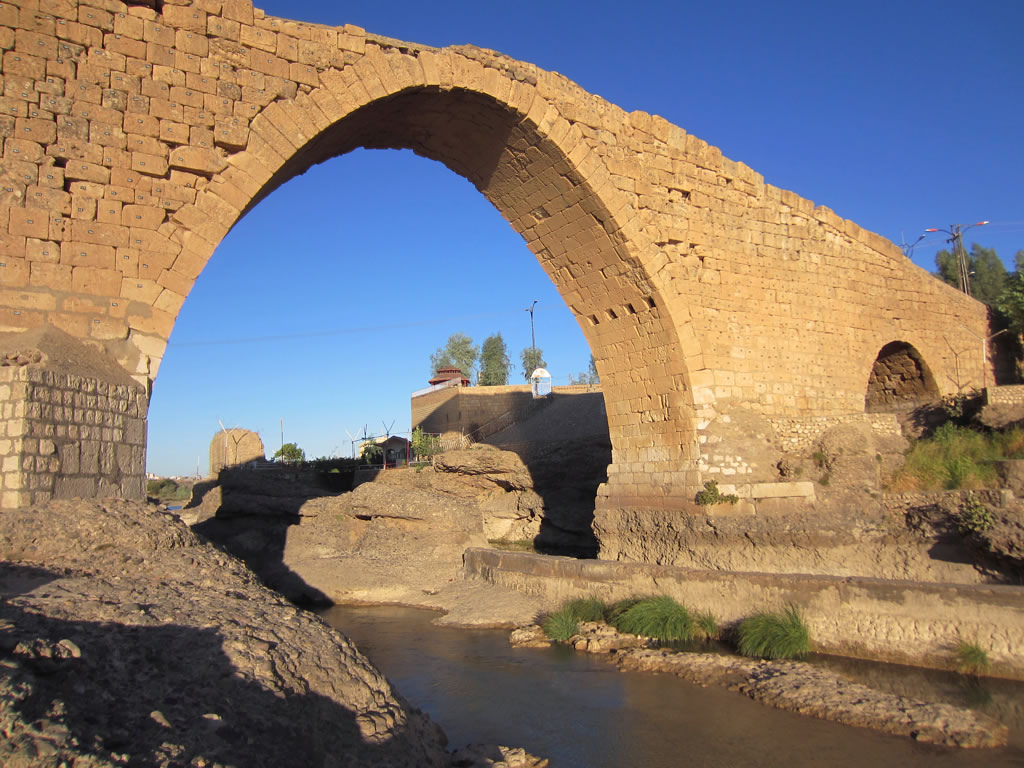
A crossing on Zakho’s Khabur
Delal Bridge stands in southeastern Zakho, in the Kurdistan Region of Iraq. The Khabur here flows from Turkey towards the Tigris; it should not be confused with the Syrian river of the same name that joins the Euphrates. Columbia University’s Mapping Mesopotamian Monuments project documented the bridge during fieldwork in 2013. Its profile also records the alternative name Abbasid Bridge. [1] The river crossing gives the monument a geographical history as well as a place in local storytelling.
Reading the stone structure
The steeply rising roadway passes above a tall principal arch and lower openings. Nizar Alwan Abdullah’s historical study reports five arches and dimensions of approximately 114 metres by 4.70 metres. [2] These are measurements reported in that study, rather than a new survey for this article. The photograph makes the principal opening and one smaller arch particularly clear, together with differences in the surviving stonework. A picture of the bridge is evidence for its appearance when photographed, not proof that every stone belongs to one building phase.
Why its date remains a question
The Columbia profile proposes an initial construction around the third or fourth century CE and rebuilding around the eighth or ninth century. These are proposed phases, not dates supplied by a foundation inscription. [1] Abdullah reviews competing attributions and notes the absence of an inscription identifying the builder. His study also records antiquities registration in 1935 and repair work in 1977. [2] The names “Roman” or “Abbasid” therefore need qualification: a conventional label is not sufficient evidence for a single, securely dated origin.
Dalal in a recorded Kurdish version
Masoud Mohammadirad’s chapter in the comparative anthology Neo-Aramaic and Kurdish Folklore from Northern Iraq presents a version in which a bridge builder comes from Cizre to Zakho. After repeated failure, he is told that the first living being to arrive must be sacrificed. His daughter-in-law Dalal reaches the site before her dog; she becomes the victim incorporated into the structure. [3] This is a recorded story with a particular sequence of events, not archaeological evidence that a woman was actually buried in the bridge.
A story shared through different tellings
The anthology also includes Neo-Aramaic versions associated with Zakho. Its wider project studies tales circulating among Kurdish-speaking Muslims and Neo-Aramaic-speaking Christians and Jews in northern Iraq. [3] Comparing these tellings makes variation part of the bridge’s history: names, motivations and the victim’s response can change as a story is told in another household or language. Delal Bridge can consequently be approached both as a repaired stone monument and as a setting for narratives of building, loss and sacrifice, without treating folklore as a construction record.
Sources and further reading
- Matthew Peebles and Helen Malko, Zakho Bridge, Mapping Mesopotamian Monuments, Columbia University (2021); project field documentation from 2013.
- Nizar Alwan Abdullah, historical study of the great stone bridge at Zakho, Humanities Journal of University of Zakho 5/2 (2017), pp.353–360, especially 353–356.
- Masoud Mohammadirad, The Bridge of Dalal, chapter 11, pp.95–104, in Neo-Aramaic and Kurdish Folklore from Northern Iraq, volume 2 (Open Book Publishers,2022); publisher’s chapter summary and comparative volume description.
- David Stanley, Delal Bridge, photograph from December 2011, Wikimedia Commons; CC BY 2.0.