Elulmesh is associated with the Gutian ruler rendered Silulumeš in the Sumerian King List. The entry preserves a position in the sequence and variant reign lengths, rather than a detailed biography or a securely dated accession.

The name, sequence and recorded reign
The ruler commonly called Elulmesh is rendered Silulumec in Oxford’s Electronic Text Corpus of Sumerian Literature, where c represents š. He follows Shulme and precedes Inimabakesh in the Gutian section. This makes him the fourth named ruler in that sequence, rather than an unqualified fifth. The composite translation gives six years; manuscript G gives seven, while manuscript Mi has the shorter name Silulu. [1] These are readings preserved in different witnesses, not proof that the ruler himself used several official names.
What the pictured prism records
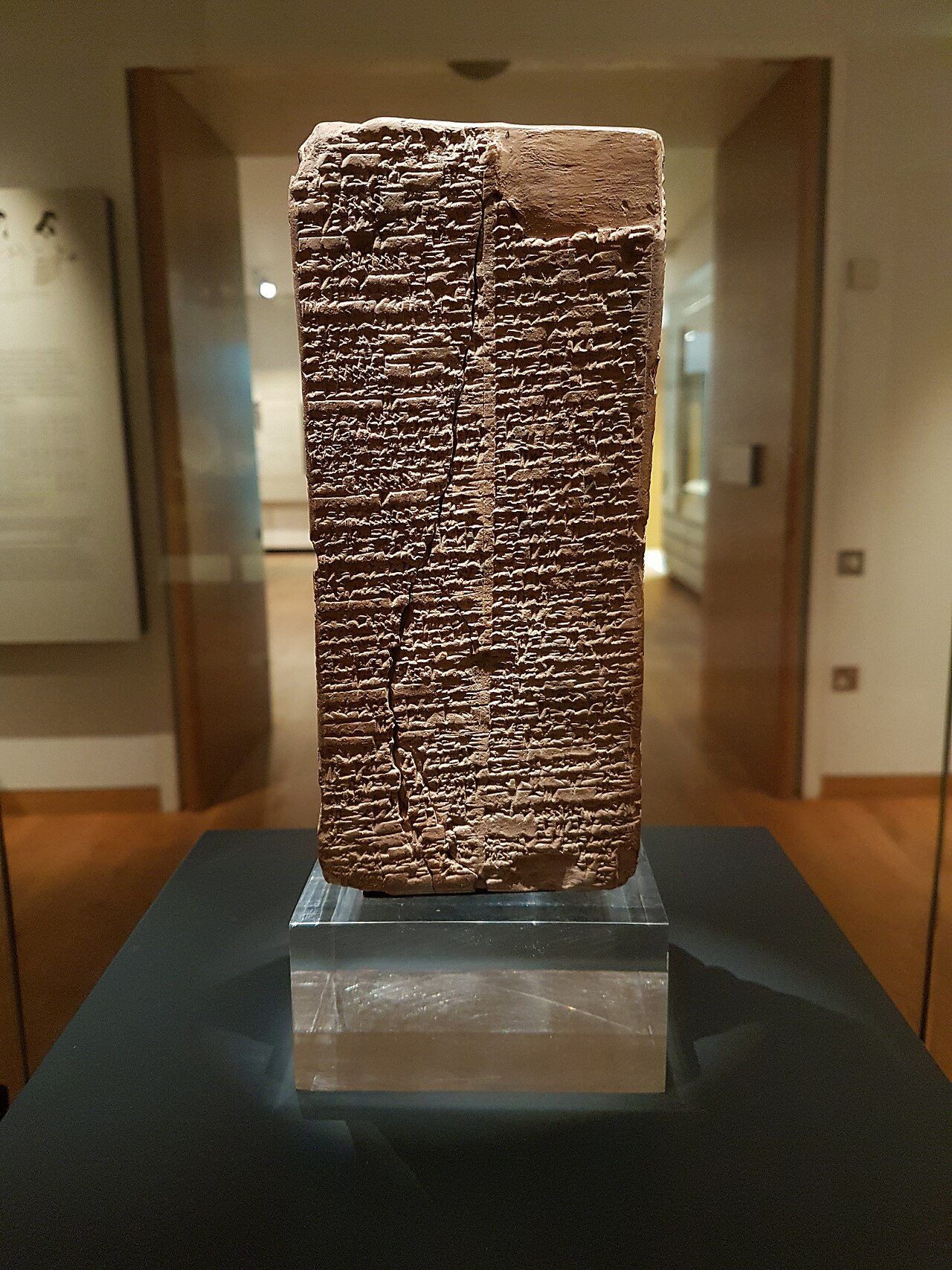
The Ashmolean’s clay prism is about 1800 BCE, several centuries later than the late-third-millennium setting of Gutian rulers. Each of its four faces carries two columns of Sumerian cuneiform. The museum describes the composition as a mixture of myth, legend and historical material, presenting kingship as passing between cities through divine decision. [2] It is evidence of an ancient account of the past. Inclusion in that account is not a surviving legal judgment that every named king was universally recognised, and the object’s date is not Elulmesh’s reign date.
Why a precise accession year is misleading
The Oxford edition records sharply different totals for Gutian rule: one manuscript has 124 years and 40 days, another 25 years. [1] Marc Van De Mieroop explains that some listed rulers may have controlled different cities simultaneously, while other cities remained under local rulers. Gutian responsibility for Akkad’s collapse is uncertain. [3] Simply adding reign lengths cannot securely establish an accession in 2159 BCE. Nor does the brief entry identify Elulmesh’s birthplace, relatives, campaigns or building projects.
Gutium, the Zagros and Kurdish historical interest
Gutium belongs to the ancient history of Mesopotamia and neighbouring highland regions. Van De Mieroop stresses that the geographical and population labels changed with context over a very long period, and that knowledge of the Gutian language is largely confined to personal names. [3] Neither geographical overlap with modern Kurdistan nor resemblance between names establishes this ruler’s Kurdish speech or a direct family line to modern Kurds. His profile can still serve regional history through a precisely identified ancient entry, with uncertainty preserved instead of an invented ancestral biography.
Sources and further reading
- University of Oxford, ETCSL 2.1.1, The Sumerian King List, lines 308–334; Silulumec, manuscript Mi name and G reign variant.
- Ashmolean Museum, Sumerian King List, AN1923.444; object date, probable Larsa origin, physical description and political interpretation.
- Marc Van De Mieroop, Gutians, Encyclopaedia Iranica XI/4 (2002), pp. 408–410; chronology, terminology and limited linguistic evidence.
- Gts-tg, Sumerian King List, 15 March 2017, Wikimedia Commons, CC BY-SA 4.0; independent photograph of the Ashmolean prism.