Malabadi Bridge crosses the Batman River near Silvan in Diyarbakır province. Its twelfth-century stonework, pointed main arch, inscriptions and interior chambers preserve evidence of medieval routes and the engineering needed to maintain a river crossing.
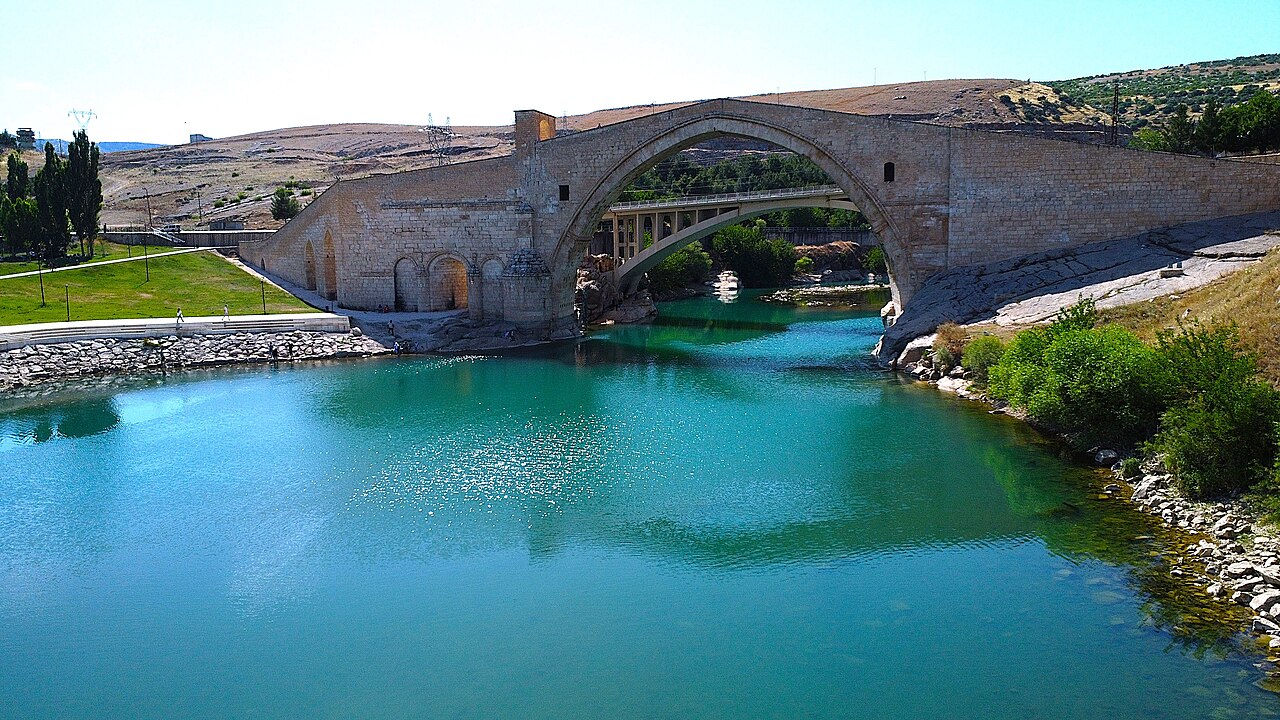

An Artuqid commission near Silvan
The bridge served medieval Mayyafariqin, today Silvan. Its fragmentary Arabic inscription names Timurtash, son of Ilghazi, and 542 AH (1147–1148), associating the commission with his personal funds. Columbia University’s monument survey dates the broader construction sequence to 1147/48–1153/54. [1]
An angled crossing with a large pointed arch
The central arch crosses the river while the approaches change direction to meet the banks. The nomination submitted by Turkey to UNESCO describes five arches, ashlar facing, rubble masonry and brick vaulting within the rooms. Rock foundations help explain the irregular plan. [2] Published measurements differ: the nomination gives the main span as 40.86 metres, while the 2017 engineering study uses 38.6 metres. [2] [3] The measured span is one part of a structure whose approaches and foundations adapt to uneven terrain.
Rooms, windows and carved figures
Windows mark interior chambers, described by Evliya Çelebi as accommodation for travellers. Columbia’s survey records human reliefs and a worn animal beneath a sun disc, probably a lion. [1] The crossing combined shelter, passage and carved decoration.
Construction difficulties and repeated repairs
Columbia’s account describes construction-stage flood damage and continuing work under Timurtash’s successor, Najm al-Din Alpi. Twentieth-century refacing followed. A repair inscription records 15 May 1955, the year the nearby modern crossing opened. [1] The 2016 nomination reports restoration in 2009–2013 addressing deteriorated stone, changing water levels associated with the nearby dam, and problems from earlier interventions. [2] The visible monument therefore includes the results of a long repair history.
What structural research examined
Karaton, Aksoy, Sayın and Calayır’s 2017 study combined material investigations with computer modelling at three earthquake-loading levels. Their abstract reports no arch or spandrel-wall damage in the D1 and D2 simulations, although backfill deformation occurred at D2. The model produced heavy main-arch damage at D3. [3] These are results for specified simulated loading conditions. They demonstrate why masonry, fill and earthquake response need to be studied together in conservation planning.
UNESCO status
Turkey submitted Malabadi to the UNESCO Tentative List on 13 April 2016, reference 6113. The record is a state-submitted proposal for possible future nomination. It does not establish inscription on the World Heritage List. [2]
Sources and further reading
- Matthew Peebles, Malabadi Bridge, Mapping Mesopotamian Monuments, Columbia University, 2020; description, inscriptions and construction history, with documentation from 2015.
- Permanent Delegation of Turkey to UNESCO, The Malabadi Bridge, Tentative List submission, 13 April 2016, reference 6113; architecture, conservation and nomination status.
- Muhammet Karaton, H. Suha Aksoy, Erkut Sayın and Yusuf Calayır, Nonlinear Seismic Performance of a 12th Century Historical Masonry Bridge under Different Earthquake Levels, Engineering Failure Analysis 79 (2017), 408–421; public abstract and section summaries.