Vian Dakhil’s appeal in Iraq’s parliament during the August 2014 assault on Sinjar brought international attention to the Yazidis’ plight. Her subsequent work included seeking support for displaced people and captives, speaking about survivors’ needs and receiving international human-rights awards.

An appeal from inside Iraq’s parliament
Dakhil became internationally known through her emotional appeal to fellow Iraqi parliamentarians during the Islamic State’s assault on the Yazidis in August 2014. The Geneva Summit’s 2016 award announcement describes her speech and her subsequent campaign for the community. [1] Its setting matters: she was speaking within Iraq’s national legislature, seeking action for a community in immediate danger. Her intervention made that emergency visible and brought reports from the region into a public demand for assistance. The subsequent record shows that campaigning continued after the televised moment, through relief requests, meetings and appeals for the return of captives.
International action had more than one stated purpose
The White House’s account of President Barack Obama’s 7 August 2014 statement distinguishes protection of American personnel near Erbil from humanitarian assistance to civilians trapped on Mount Sinjar. It records the Iraqi government’s request, food and water airdrops, and authorisation of targeted strikes if necessary to help break the siege. [2] Dakhil’s appeal belongs to this wider emergency and mobilisation. The presidential account does not establish that her speech alone caused the intervention. Keeping the policy record alongside her advocacy avoids confusing public influence, military decisions and the work of those helping people escape.
Injury during the rescue effort
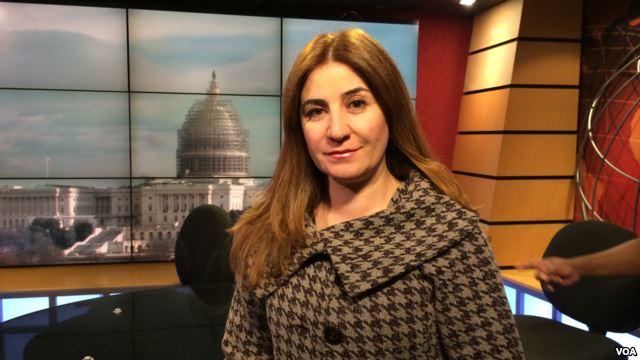
VOA’s December 2014 interview report describes Dakhil walking with a crutch after being injured in a helicopter crash on Mount Sinjar during the rescue effort. [3] The injury connects her public campaigning with the danger of reaching people on the mountain. It should not turn the other people involved in the crisis into background characters: displaced families, rescue crews and local responders were participants in the same emergency. The photograph on this page comes from her later VOA visit, rather than from the crash.
Washington, December 2014: relief beyond the first headlines
On 11 December 2014, VOA reported Dakhil’s Washington meetings with lawmakers and administration officials. She sought assistance for captives, families still trapped on Sinjar and displaced people facing winter, and discussed plans for rehabilitation programmes for women and girls who had escaped captivity. [3] These were requests and plans reported at that date, not proof that every programme was subsequently delivered. Her agenda extended beyond immediate rescue to shelter, recovery and continuing international attention.
Two awards, and a date worth distinguishing
RAW in WAR identifies Dakhil as its 2014 Anna Politkovskaya Award recipient. Her acceptance address, framed as a letter to Anna, emphasised the return of captives, finding missing people and future protection rather than treating recognition as an end in itself. [4] The Lantos Foundation names her its 2016 Human Rights Prize recipient, with the ceremony held in Washington on 8 February 2017. [5] The prize year and ceremony year are therefore different. Together these records document international recognition and preserve her own stated priorities; award tributes are not independent counts of every person her work saved.
Survivors, recognition and accountability
The Geneva Summit announced its 2016 International Women’s Rights Award for Dakhil and psychologist Jan Ilhan Kizilhan, recognising work for Yazidi women and other survivors of Islamic State captivity. Its announcement includes Dakhil’s demand for release and protection of those still held. [1] A later milestone concerned recognition of the crimes: on 1 August 2023 the UK formally acknowledged acts of genocide against the Yazidis, following German court proceedings. [6] That later announcement is context, not an outcome attributable to Dakhil alone. Her biography spans parliamentary speech, relief advocacy and international campaigning, while survivors’ experiences and the legal record remain distinct sources for the history of the genocide.
Sources and further reading
- Geneva Summit for Human Rights and Democracy, Geneva Summit Announces 2016 International Women’s Rights Award, 18 February 2016. Organisers’ announcement and Dakhil’s comments.
- David Hudson, President Obama Makes a Statement on the Crisis in Iraq, White House archive, 7 August 2014.
- Voice of America, Iraq’s Only Yazidi Lawmaker Seeks US Help, 11 December 2014. Contemporary interview report; title reflects its date.
- RAW in WAR, Vian Dakhil (Iraq) 2014: Winner of the Anna Politkovskaya Award, including her acceptance address.
- Lantos Foundation, 2016 Lantos Human Rights Prize Recipient: Vian Dakhil. Ceremony held 8 February 2017.
- Foreign, Commonwealth & Development Office, UK acknowledges acts of genocide committed by Daesh against Yazidis, 1 August 2023.