The 2015 record includes ISIS abductions, Kurdish–Assyrian military cooperation, David Jendo’s killing and disputed accountability. Each event needs its own evidence; none justifies blaming an entire community.
What prompted the dispute
On 30 January 2026, The Assyria Post published allegations made by journalist Shamoun Zitou on Assyria TV. Its article linked a comparison of Assyrian deaths under Kurdish forces and ISIS to the December 2015 restaurant bombings and the killing of David Jendo. It did not present a victim-by-victim comparative dataset. [1] Reporting that someone made an accusation establishes the existence of the accusation, not its truth. Equally, disagreement with that article supplies no basis for calling the publication a supporter of terrorism. The events it names should be examined separately.
The Khabur abductions were a documented ISIS crime
Amnesty International’s 2015/16 Syria entry records that ISIS abducted approximately 253 civilians from mostly Assyrian villages along the Khabur on 23 February 2015. Its account described releases and continuing fears for those still held at that reporting date. [2] These were hostages: the abduction total cannot be substituted for a death toll. The same distinction applies to people displaced from villages. Counting kidnapping, displacement and killing as if they were one category obscures what happened to individual victims and families. The report’s historical account should not be presented as a current list of missing people.
Cooperation did not prevent David Jendo’s killing
Rudaw reported on 26 May 2015 that the YPG announced four arrests in the investigation of Khabur Guards commander David Jendo’s killing on 22 April. The statement denied institutional responsibility and described the suspects as individuals, without clarifying their membership. Rudaw also described Khabur Guards and Syriac Military Council participation alongside the YPG against ISIS. [3] This contemporary record contains both cooperation and a deeply damaging killing. A military alliance does not establish that every allied fighter or official was innocent, and the YPG’s statement should be identified as its position rather than an independent finding.
The trial itself was challenged
An Assyrian Human Rights Network statement, dated 1 August 2015 and reproduced by Welatê Me, reported sentences delivered on 25 July: twenty years for two defendants, five for another and one for a fourth, with a fifth tried in absentia. It described Elias Nasser as the survivor whose testimony identified attackers. The network rejected the court’s independence, questioned defendants’ identities and enforcement, and demanded investigation beyond the immediate perpetrators. [4] This is a primary record of the network’s criticism, not a court judgment independently authenticated here. Announcing sentences does not by itself resolve whether the investigation was complete, impartial or effective.
The restaurant bombings require their own evidence
Contemporary AFP reporting described explosions at restaurants in Qamishli on 30 December 2015, at least sixteen deaths and thirty injuries, citing the Syrian Observatory for Human Rights. Its correspondent reported an attack in a Christian neighbourhood, and it reported an ISIS claim through Amaq. [5] A claim of responsibility is evidence to assess alongside other material; it is not the same as a forensic reconstruction. Conversely, the reporting of YPG-linked suspects in Jendo’s case does not prove who organised a different attack eight months later. The material cited here does not establish the restaurant-bombing accusation against the YPG.
Rights findings must be read within their scope
Human Rights Watch’s June 2014 report documented arbitrary detention, abuse, due-process failures and unresolved killings under PYD-led authorities. It explicitly excluded alleged abuses against local non-Kurdish communities from its scope. [6] It therefore cannot serve as a comprehensive investigation of Assyrian grievances or of events in 2015. Amnesty’s following annual report also documented forced displacement and unfair trials under the PYD-led administration. [2] These findings should not be dismissed as mere administrative disagreements, but they likewise do not automatically determine responsibility in every separate case. Protecting residents and investigating abuse remain compatible obligations.
A defensible comparison needs named cases
A meaningful comparison would need the same dates and geographical boundaries, identified victims, separation of civilians from combatants, and a stated method for attributing responsibility. It would also have to separate confirmed deaths from missing people and avoid counting a person twice. The sources assembled here do not supply such a matched dataset. No reliable numerical ranking follows from this article. Kurdish and Assyrian communities contain differing parties, armed groups, witnesses and victims; a party’s decision cannot simply be assigned to everyone sharing an ethnicity. Historical accountability is stronger when the event, actor, evidence and remaining uncertainty are stated precisely.
Sources and further reading
- The Assyria Post, 30 January 2026; primary record of the allegations being discussed, not independent substantiation.
- Amnesty International Report 2015/16, Syria, printed p. 353; Khabur abductions and abuses under the PYD-led administration.
- Rudaw Arabic, 26 May 2015, report on four arrests in David Jendo’s killing; quotes the YPG statement and describes military cooperation.
- Assyrian Human Rights Network, 1 August 2015, statement on the Jendo trial, reproduced by Welatê Me; attributed criticism.
- AFP reporting in Hürriyet Daily News, 31 December 2015; Qamishli bombings, correspondent’s observation and reported ISIS claim.
- Human Rights Watch, Under Kurdish Rule, 19 June 2014; selected summary, methodology and recommendations, with explicit scope limits.
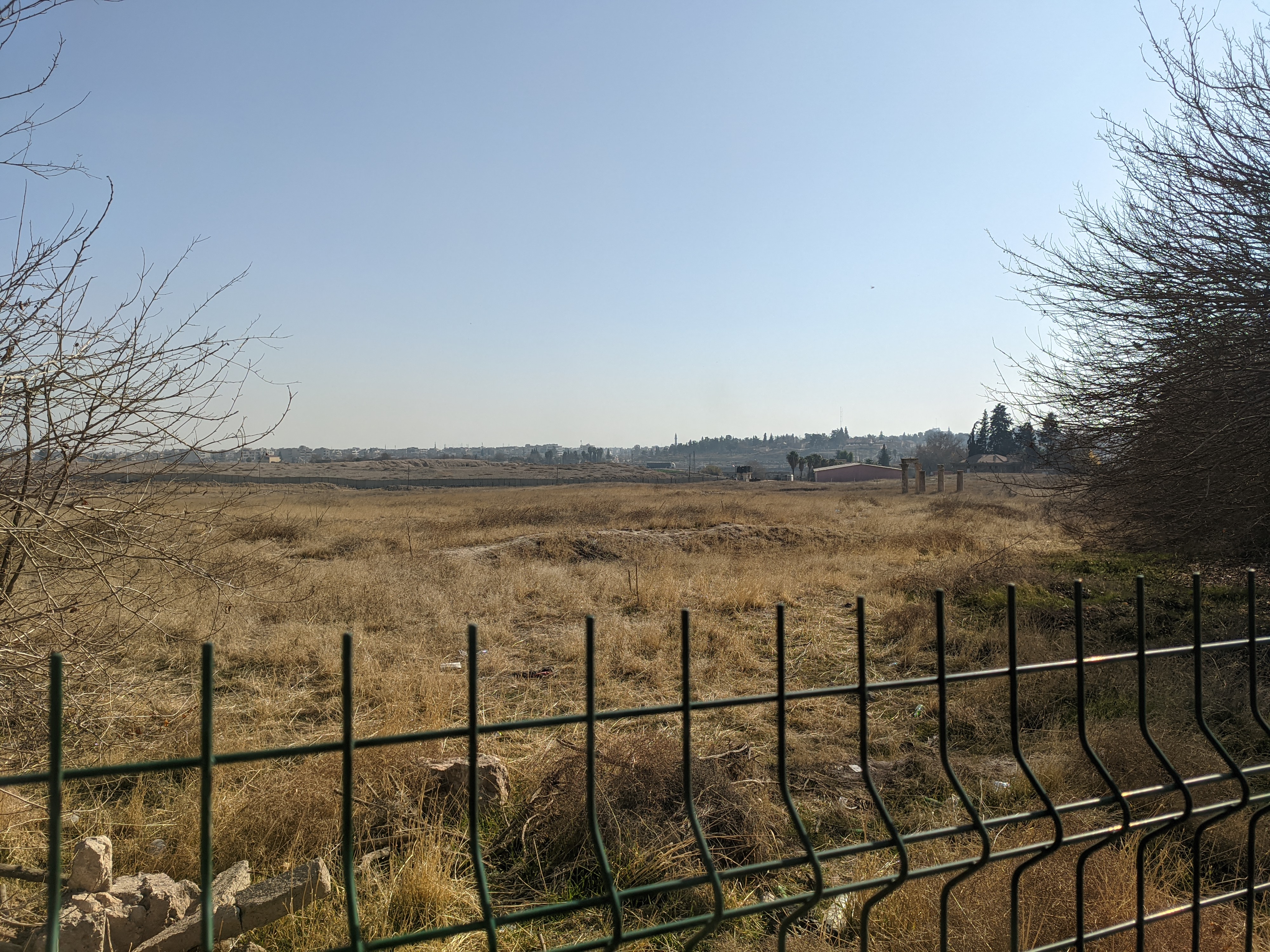
- Oystercard, View of the border zone between Qamishli and Nusaybin, 22 January 2023; CC BY-SA 4.0, Wikimedia Commons.